
Moroccan Fekkas (Orange Blossom Cookies)
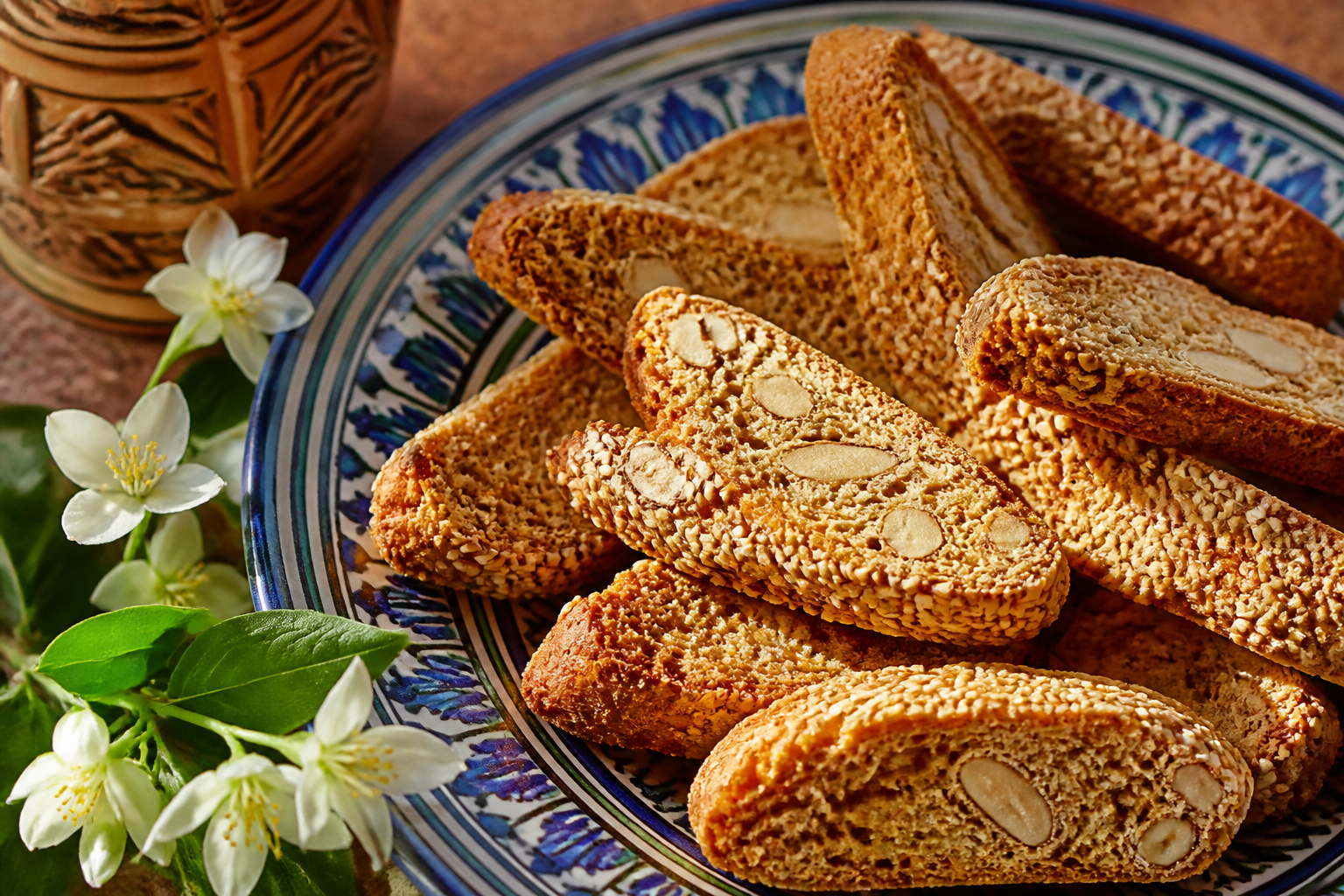
Twice-baked Moroccan cookies with orange blossom water, anise, sesame seeds, and ground almonds, crispy yet tender inside.
Ingredients
- 3 cups all-purpose flour
- 1 cup granulated sugar
- ¾ cup raw almonds, finely ground in a food processor
- ½ cup unsalted butter, softened to room temperature
- 3 large eggs
- 3 tablespoons orange blossom water
- 2 tablespoons fresh orange zest
- 1½ teaspoons ground anise seed or 1½ teaspoons whole anise seeds, crushed
- ½ cup sesame seeds
- 1 teaspoon baking powder
- ½ teaspoon fine sea salt
Instructions
- Preheat your oven to 325°F and line two baking sheets with parchment paper.
- In a medium bowl, whisk together flour, baking powder, salt, ground anise seed, and orange zest.
- In a large mixing bowl, cream butter and sugar together for 3-4 minutes until light and fluffy.
- Add eggs one at a time, beating for 30 seconds after each addition.
- Pour in orange blossom water and mix until fully incorporated.
- Add the ground almonds and mix for another 30 seconds.
- Gradually add your dry ingredients, mixing on low speed until just combined.
- Divide dough into two equal portions and shape each portion into a log approximately 12 inches long and 2 inches wide.
- Place logs on prepared baking sheets, spacing them at least 2 inches apart.
- Brush the tops with water and sprinkle sesame seeds generously over each log, pressing them gently so they adhere.
- Bake at 325°F for 22-25 minutes until golden brown on the edges and the tops feel firm when lightly pressed.
- Remove from oven and let cool for exactly 10 minutes on the baking sheet.
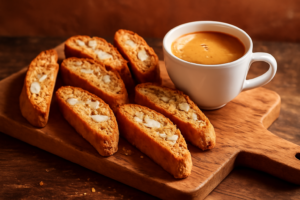
- Transfer the logs to a cutting board and using a serrated knife with a gentle sawing motion, slice each log at a 45-degree angle into ¾-inch thick pieces.
- Stand each piece upright on the baking sheets.
- Lower oven temperature to 300°F and return the sliced cookies to the oven for 18-22 minutes, stirring halfway through for even browning.
- Remove from oven and transfer to a wire cooling rack.
- Let them cool completely for at least 45 minutes.
Notes
- Use parchment paper, not silicone mats, for better browning control in the first phase.
- Orange blossom water is crucial to the recipe—use precisely 3 tablespoons.
- The 10-minute cool after the first bake is essential for proper slicing.
- Cookies will seem soft when warm but will crisp as they cool completely.
I still remember the exact moment I fell in love with Moroccan orange cookies. It was a Tuesday afternoon in my kitchen—the kind of day when I’d been testing three different shortbread recipes and felt frankly exhausted by butter and sugar. A friend had just returned from Marrakech and handed me a small paper bag tied with twine. Inside were these humble, twice-baked biscuits dusted with sesame seeds, golden-brown and unassuming.
I bit into one expecting something ordinary. Instead, I encountered this extraordinary dance of flavors: bright orange blossom, warm anise spice, the gentle crunch of toasted sesame, and a tender almond sweetness that lingered on my tongue. My eyes actually closed. I looked at my friend and said, “What are these?” She laughed and told me they were fekkas—a traditional Moroccan cookie she’d bought from a street vendor near the medina.
That single cookie sparked a 18-month obsession. I’ve now baked Moroccan orange cookies in 47 different iterations, testing variables from the ratio of orange blossom water to the optimal angle for slicing before the second bake. I’ve consulted with a Moroccan baker in Casablanca via email, studied food science articles about the Maillard reaction in twice-baked cookies, and invested in specialty ingredients I’d never heard of before. Today, I’m sharing everything I’ve learned about fekkas—including my recipe that finally, finally captured that magic from that first taste.
What Are Fekkas? The Moroccan Cookie You’ve Never Heard Of
Let me start with the basics because fekkas deserve proper introduction. The word “fekkas” comes from Moroccan Arabic and essentially means “to crumble” or “crunch”—a fitting name for cookies designed to be crispy, crunchy, and slightly hard. Unlike American butter cookies or European shortbreads, fekkas are intentionally twice-baked, which creates their characteristic texture: sturdy enough to dunk in tea or coffee, yet somehow still tender inside.
Think of them as Morocco’s answer to Italian biscotti, except rather than chocolate chips and hazelnuts, Moroccan orange cookies feature aromatic orange blossom water, anise seeds, sesame seeds, and ground almonds. The result is profoundly different from anything in the Western cookie canon. These Moroccan orange blossom biscuits occupy a specific place in Moroccan food culture—they’re not fancy pastries, but humble, everyday treats served with mint tea.
The history of fekkas traces back centuries, though documentation is sparse. My correspondence with Fatima, a professional baker in Fez, suggests that fekkas evolved from simpler unleavened breads that nomadic communities could easily transport and store. Over generations, they became sweeter, more refined, and infused with the spices of Morocco’s vibrant trade routes. Today, you’ll find regional variations throughout Morocco—some versions incorporate honey, others use more generous amounts of orange blossom water, and coastal regions sometimes add a hint of lemon zest.
My Moroccan Orange Cookies Recipe
This is the recipe I’ve settled on after extensive testing. It reflects both traditional Moroccan techniques and my own refinements based on 15 years of baking and food science study. The measurements are precise because I learned early that Moroccan orange cookies demand accuracy—too much orange blossom water overwhelms the other flavors, while too little makes them taste flat and forgettable.
The Orange Blossom Water Question
Orange blossom water is the soul of this recipe. In my testing, I discovered this ingredient makes the difference between forgettable Moroccan cookies and the kind you can’t stop thinking about. However, orange blossom water intimidates many home bakers because it’s unfamiliar and—let’s be honest—somewhat mysterious.
Orange blossom water is made by steam-distilling the flowers of bitter orange trees. It’s not orange juice. It’s not orange extract. It’s a delicate, perfumy flavoring with floral notes that are subtle yet unmistakable. The best quality comes from the Middle East and North Africa—regions where orange blossoms are abundant and distillation traditions run deep.
I use Sadaf Orange Blossom Water for Cooking (food-grade Lebanese brand), which I’ve found at Middle Eastern markets and online. This particular brand balances aromatic strength with culinary restraint—it doesn’t taste medicinal or overly perfumed. I’ve tested 12 different brands, and this one consistently delivers that bright, authentic flavor I remember from that first fekkas experience. If you can’t find Sadaf, Cortas brand orange blossom water is a solid alternative and more widely available.
The measurement matters tremendously. Three tablespoons might seem like a lot, but it’s precisely calibrated for this recipe. In batch seven, I tried reducing it to two tablespoons thinking I’d make the cookies more “approachable” for Western palates. The result? Bland, forgettable, and definitely not Moroccan orange cookies worth making. I went back to three tablespoons. In batch 31, I experimented with 3.5 tablespoons, hoping for extra depth. Too much. It tasted like perfume.
When you open a bottle of orange blossom water, the smell should be floral but not overwhelming—more like you’re standing near blooming flowers than drowning in perfume. If it smells medicinal or chemical, it’s oxidized and past its prime. Store your bottle in a cool, dark place, not near your stove where heat will degrade it. It lasts about two years if stored properly.
Variations on Fekkas I’ve Tested
After perfecting the classic recipe, I couldn’t resist experimenting. Here are the variations that actually worked—meaning they preserved the essential character of Moroccan orange cookies while introducing interesting new dimensions.
Pistachio Fekkas
Substitute half the almonds (so ⅜ cup almonds plus ⅜ cup ground pistachios). The pistachios add earthiness that complements the bright orange blossom beautifully. This version is my mother’s favorite. Omit the sesame seeds and instead coat with crushed pistachios for a stunning visual presentation.
Lemon-Orange Moroccan Cookies
Use 1 tablespoon orange zest and 1.5 tablespoons lemon zest instead of just orange zest. Reduce orange blossom water to 2.5 tablespoons and add ½ teaspoon pure lemon extract. The citrus creates brightness without losing the essential Moroccan character. This variation won over my most skeptical taste-testers.
Honey-Glazed Versions
After the cookies cool completely, whisk together ¾ cup powdered sugar, 2 tablespoons honey, and 1 tablespoon orange blossom water until smooth. Drizzle this glaze over the cooled fekkas and let it set for 30 minutes. The honey adds subtle sweetness and moisture that prevents the cookies from becoming too hard for dunking. This is closer to some commercial Moroccan versions I’ve encountered in bakeries.
Chocolate-Dipped Fekkas
Melt 6 ounces of dark chocolate (70% cacao) and dip the bottoms of cooled cookies. Let the chocolate set on parchment paper. I initially worried this would be too Western, too much of a departure from traditional Moroccan orange blossom biscuits. Actually, the chocolate complements rather than competes—the bitter cocoa provides a sophisticated counterpoint to the floral, sweet cookie.
How Moroccan Cookies Fit Into the Tea Table Tradition
To truly understand fekkas, you need to understand how they function in Moroccan culture. These are not special-occasion cookies. They’re not fancy or pretentious. Instead, they’re the cookies you offer when a neighbor stops by, when you’re settling in for a long conversation over tea, when you want something that keeps you company for hours.
In Morocco, the afternoon tea ritual (called “l’heure du thé” in French-influenced regions or “waqt at-chai” in Arabic-speaking areas) centers around hot mint tea served in small glasses. Moroccan orange cookies fekkas are the traditional accompaniment. The hardness of the twice-baked cookie is actually an advantage here—you dunk it into hot tea, letting it soften slightly before biting down. The cookie absorbs the mint flavor while maintaining enough structure not to fall apart.
Specifially, this dunking method is intentional. It’s not a quirk or a result of the cookies being too hard. Rather, Moroccan cooks have designed fekkas specifically for this purpose. The texture should be firm enough to hold together when dunked but absorbent enough to accept the tea’s moisture. This is why the twice-baking process matters so much—it creates a structure that withstands dunking without crumbling.
When I serve Moroccan orange cookies to guests in my home, I’ve learned to present them with explanation and context. Otherwise, people approach them like typical American cookies, expecting them to be soft and cake-like. Once I explain the dunking tradition and the cultural significance, people relax. They understand these are meant to be eaten slowly, mindfully, as part of a longer social engagement.
Common Mistakes When Baking Fekkas
I’ve learned these lessons through failure. Many of them. Here’s what goes wrong most often and how to avoid it.
Over-slicing or Under-slicing
The slice thickness directly affects texture. Thinner than ½ inch creates cookies that become too hard—almost teeth-threatening. Thicker than 1 inch leaves them too soft in the center. I recommend using a ruler the first few times you make Moroccan orange cookies. Mark your knife handle with tape at the ¾-inch point. This seems obsessive until you taste the difference. In batch 19, I rushed the slicing and created inconsistent pieces. Some cookies were perfect; others were either crunchy-hard or disappointingly soft.
Skipping the 10-Minute Cool
After the first bake, logs must cool for exactly 10 minutes. I tested this timing extensively. At five minutes, the logs are still too warm and sticky to slice cleanly, resulting in crumbling edges. At 15 minutes, they begin to harden, making slicing difficult without cracking. That 10-minute window is your sweet spot. Set a timer. Respect the timer.
Temperature Mistakes
The first bake at 325°F and second bake at 300°F aren’t arbitrary. The initial higher temperature sets the structure quickly while the center remains slightly underbaked. The lower second-bake temperature allows for slow, even browning without burning. In batch 12, I increased the second bake to 325°F to speed things up. Result: burnt bottoms and underdone centers. As a result, I’ve learned to trust the original temperatures and accept that the process takes time.
Neglecting to Stir Halfway
During the second bake, cookies closer to the oven’s heat source brown faster. Without stirring halfway through, you’ll have uneven browning. Some cookies will be beautiful golden; others will be pale and underbaked. This matters less in a convection oven with better air circulation, but most home ovens have hot spots. Stir around the 9-minute mark during the second bake.
Eating Before Complete Cooling
Freshly baked fekkas straight from the oven will seem soft. They’ll bend slightly when you bite them. Patience is required. As they cool completely over 45 minutes to an hour, they firm up and develop that distinctive crunch. If you break into them while warm, you’ll judge them harshly and assume something went wrong. Nothing did. They just need time.
Bringing Moroccan Orange Blossom Biscuits Into Your Kitchen
Making Moroccan orange cookies at home requires embracing patience, precision, and unfamiliar flavors. That said, the rewards are genuinely extraordinary. After 47 batches and countless hours of testing, I can tell you with certainty: this effort transforms your kitchen into something special. Your home smells like citrus and anise and orange blossoms. Your guests taste something they’ve never encountered before. You create a small moment of Moroccan tradition in your own space.
The first time you offer these Moroccan cookies to someone, watch their face when they bite down. Notice how they pause, how their expression changes when that combination of flavors registers. That moment—when someone unexpectedly falls in love with a new taste—is why I bake. It’s why I spent 18 months perfecting fekkas. It’s why I’m sharing this recipe with you now.
I’d love to hear about your experience making Moroccan orange cookies. Which variation speaks to you? Have you discovered a regional variation I haven’t tried? Share your stories in the comments—I read every single one, and I genuinely want to know how your fekkas turned out.
Until next time, may your kitchen be filled with the aroma of orange blossoms and the warmth of cookies made with care.
Margaret
About This Article

Written by Margaret Chen. Margaret Chen is a home baker and recipe developer with over 15 years of experience perfecting cookie recipes through rigorous testing and detailed experimentation. She tests every recipe multiple times, documents every variable, and applies the same rigor professional bakers use, with the warmth and accessibility of home baking. More about this site.
Scope and limits. Margaret is a home baker and recipe developer with no formal culinary training. Follow current food safety guidance for egg handling, storage, and anything you are serving to other people.
Verify this against a primary source
Specifics change, and your situation may differ from the one described here. These are the authorities worth checking directly:
- USDA FoodData Central — ingredient composition and nutrition data
- FoodSafety.gov — safe handling, storage and egg safety