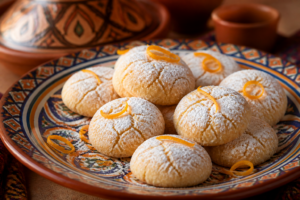
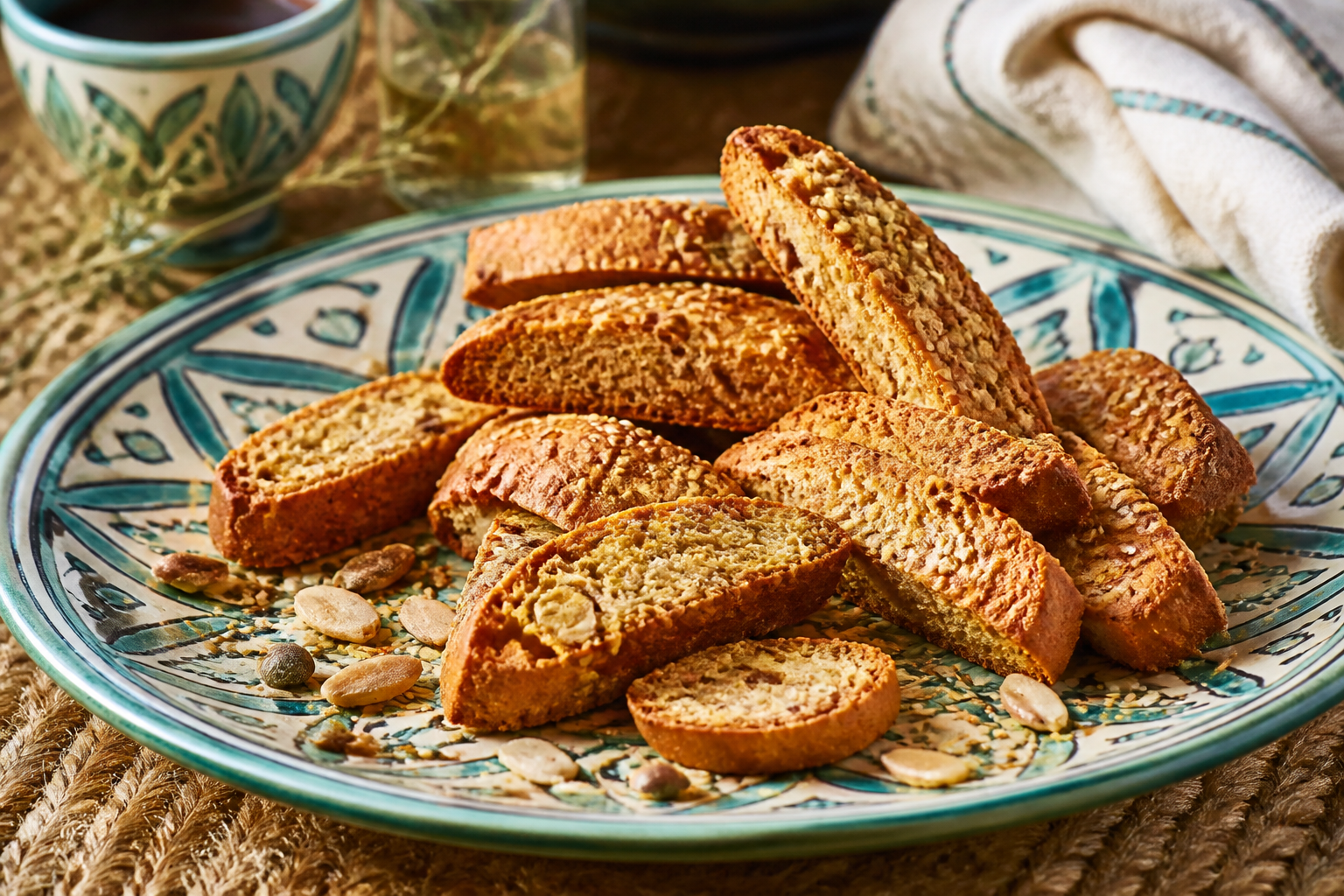
Three years ago, I was invited to a Moroccan tea ceremony at a friend’s home in Portland. The table was dressed with a hand-woven cloth, steaming glasses of mint tea arrived in waves, and in the center sat a modest ceramic plate holding what looked like crunchy, seed-studded logs. My friend passed them to me with a knowing smile: “These are fekkas,” she said. “Try one with your tea.”
I bit into that first piece, and everything changed. The exterior crackled between my teeth, releasing a burst of orange blossom and anise. The texture was deliberately dry—almost austere—the way it should be dunked into hot tea. But it was the flavor that stopped me cold: warm, spiced, floral, and utterly unlike anything I’d baked before. I’d spent 15 years developing cookie recipes from around the world, yet I’d somehow missed these Moroccan twice-baked cookies entirely.
That night, I asked for the recipe. My friend laughed and told me there was no written version—her grandmother had simply taught her by watching. For the next three years, I’ve been chasing that memory, testing, failing, adjusting, and finally—I believe—nailing the authentic version of fekkas koekjes. Today, I’m sharing everything I’ve learned.
What Are Fekkas Koekjes?
Let’s clarify the name first, because it tells you everything about these cookies. “Fekkas” comes from Arabic, derived from a root that means “to crumble” or “to crack”—a literal description of what happens when you bite into one. “Koekjes” is simply Dutch for cookies. If you’re searching for fekkas in English-language recipe spaces, you’ll often see the term spelled this way: fekkas koekjes, blending both languages and honoring both the Moroccan origin and the Dutch-speaking European communities who’ve adopted them.
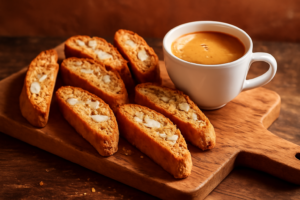
Fekkas koekjes are Morocco’s answer to biscotti—but with a completely different soul. Where Italian biscotti are often studded with nuts and dried fruit, moroccan twice-baked cookies lean into warm spices, citrus, and seeds. They’ve been baked in Moroccan households for generations, especially during Ramadan when families break their fast with tea and fekkas, and for Eid celebrations.
The twice-baked technique is essential to understanding these cookies. You bake a long log first, let it cool slightly, then slice it diagonally and bake each slice again at a lower temperature. As a result, the interior becomes pale and crispy, perfect for dunking into hot beverages without immediately falling apart. This method was born from practical necessity—in a pre-refrigeration era, twice-baked cookies lasted far longer than most baked goods.
The Recipe: Authentic Moroccan Fekkas
What You’ll Need
- 3 large eggs
- 1 cup (200 grams) granulated sugar
- 1/3 cup neutral oil, such as vegetable or canola oil (about 80 milliliters)
- 1 to 2 teaspoons orange blossom water
- 1 teaspoon vanilla extract
- 3 cups (360 grams) all-purpose flour
- 1 1/2 teaspoons baking powder
- 1/4 teaspoon salt
- 1 teaspoon anise seeds
- 1/2 cup toasted sesame seeds
- 1/2 cup raw or soaked almonds, coarsely chopped
- 1/2 cup golden raisins (optional but traditional)
How I Make Them, Step by Step
- In a large mixing bowl, whisk together 3 large eggs and 1 cup sugar until light and airy, about 2-3 minutes.
- Slowly stream in 1/3 cup oil while continuing to whisk until the mixture is emulsified and smooth.
- Fold in 1 to 2 teaspoons orange blossom water and 1 teaspoon vanilla extract until well combined.
- In a separate bowl, combine 3 cups flour, 1 1/2 teaspoons baking powder, 1/4 teaspoon salt, and 1 teaspoon anise seeds. Mix well.
- Gently fold the dry ingredients into the wet ingredients until just combined, being careful not to overmix.
- Fold in 1/2 cup toasted sesame seeds, 1/2 cup almonds, and 1/2 cup raisins until evenly distributed throughout the dough.
- Divide the dough into 4 equal pieces. On a lightly oiled or parchment-lined baking sheet, shape each piece into a long, flat log about 1 inch tall and 2-3 inches wide, spacing them several inches apart.
- Bake at 356°F (180°C) for about 30 minutes, until the logs are light golden but still slightly soft in the center—don’t overbake at this stage.
- Remove from oven and let cool for about 10 minutes.
- Cover the logs with a clean cloth and let rest at room temperature overnight or for at least 6-12 hours—this resting period is essential and makes slicing much easier.
- Using a sharp serrated knife, carefully slice each log diagonally into pieces about 1/2 inch thick.
- Arrange the slices cut-side down on the baking sheet.
- Return to oven and bake at 356°F (180°C) for about 15-20 minutes, until golden brown and fully dried. The fekkas should be crisp but not burnt.
- Remove from oven and let cool on the baking sheet for a few minutes, then transfer to a wire rack to cool completely.
Baking Timeline
- Prep time: 15 minutes
- First bake: 30 minutes at 356°F (180°C)
- Resting time: Overnight or at least 6-12 hours
- Second bake: 15-20 minutes at 356°F (180°C)
- Yield: Makes 30-40 cookies, depending on slice thickness
If you want the complete step-by-step version—exact oven temperatures, slicing guidance, sesame preparation, and variations—I’ve published my full Moroccan orange blossom fekkas recipe separately.
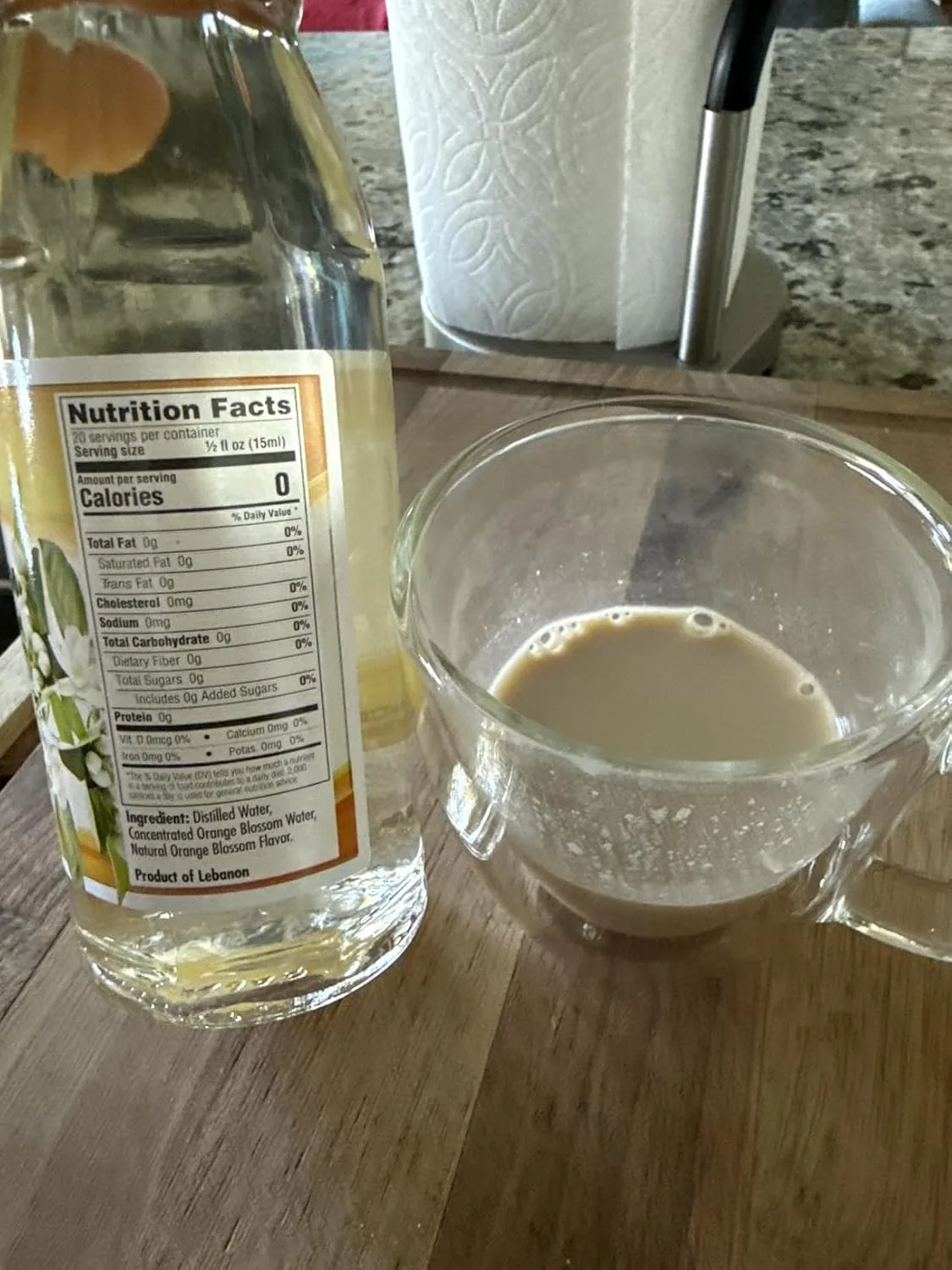
The Orange Blossom Water That Finally Gave These Cookies Their Authentic Floral Note
Fekkas live or die by their delicate floral flavor—that whisper of orange blossom that separates an authentic Moroccan cookie from a basic twice-baked biscotti. I learned this the hard way after my first batch tasted more like plain vanilla logs, and I realized my bottled extract wasn’t cutting it.
What works
- The floral intensity is immediate and noticeable—just a teaspoon transforms the entire dough from forgettable to unmistakably Moroccan without overpowering the sesame and anise.
- It stays stable through both bakes, which surprised me; I half-expected the delicate flavor to cook away, but it actually deepens slightly during the second bake.
- The bottle is small and lasts forever—a little goes such a long way that one bottle will handle dozens of batches, making it worth the slightly higher price.
What doesn’t
- It’s easy to use too much if you’re not paying attention—I once added a careless teaspoon and a half, and the dough smelled like a perfume bottle instead of pastry.
- You have to order it online (it’s rare in regular grocery stores), so there’s no grabbing it last-minute if you decide to bake on a whim.
I stood in my kitchen one afternoon, skeptical that such a small bottle could actually make the difference my friend’s fekkas had, but the moment I folded it into the dough, the smell transported me right back to Portland. Sadaf Orange Blossom Water is the one I reach for every time now.
This post contains affiliate links. As an Amazon Associate, I earn from qualifying purchases at no extra cost to you.