
The first time I made nastar, I pulled forty-two tarts out of the oven, let them cool twenty minutes, and watched the bottoms of every single one go translucent and limp. My pineapple jam was too wet. I had cooked it like an American jam — thick enough to spread on toast — when it needed to be cooked down to something closer to a soft caramel you can roll between your palms. That failure is what sent me down an eighteen-month road of baking southeast asian cookies in my own kitchen, and it taught me more about sugar, starch, and moisture than any pastry book on my shelf.
Where I’m standing, and where I’m not
I’m an American home baker. I did not grow up with these cookies. Everything here comes from research, from recipes shared with me by friends and readers, from Indonesian and Filipino food writers whose work I’ve bought and cooked from, and from a lot of test batches in a suburban oven.
That matters, because Southeast Asia is not one baking tradition. Indonesia, the Philippines, Malaysia, Singapore, Thailand and Vietnam each have their own histories — Dutch, Spanish, Portuguese, Chinese, French — and flattening them into “Asian cookies” does everybody a disservice. If you want the wider view first, I wrote about that layered history in the sweet history of Asian cookies, and there’s a broader survey in my roundup of 15 must-try Asian cookies. This post goes deeper on nine specific ones.
Nine southeast asian cookies worth learning properly
1. Nastar (Indonesia)
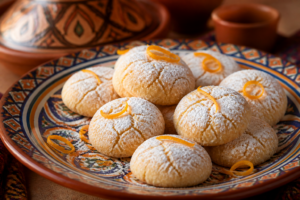
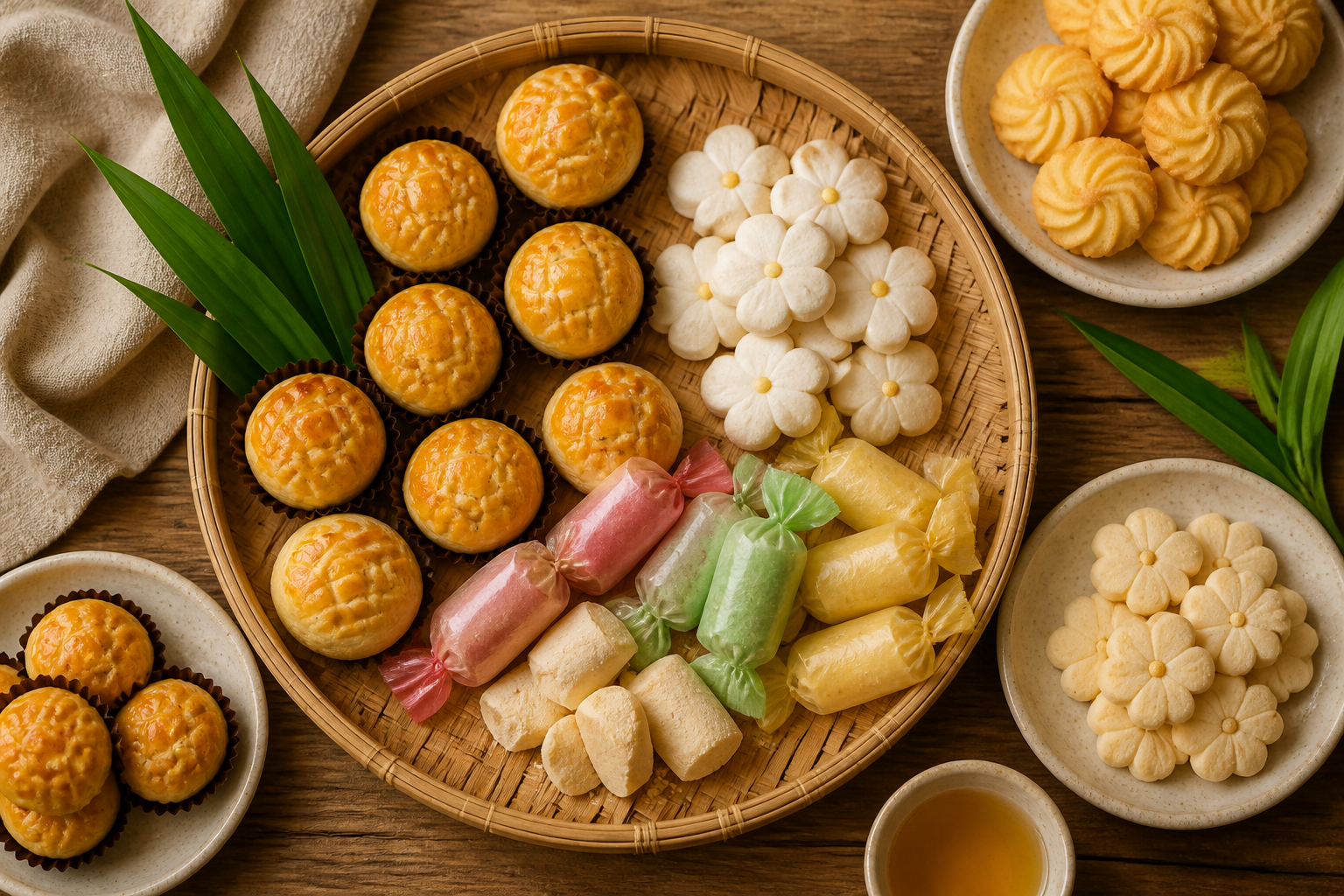
Nastar are small buttery tarts wrapped around a nugget of dense pineapple jam. The name comes from the Dutch ananas taart — pineapple tart — a direct legacy of Dutch colonial baking absorbed and rebuilt into something Indonesian. They are essential at Lebaran (Eid al-Fitr), and they also appear at Christmas and Lunar New Year in Chinese-Indonesian households.
The pastry is short and sandy, usually with cornstarch or milk powder cutting the flour, and often a little grated Edam cheese in the dough. Texture-wise, it should collapse against the roof of your mouth. The jam inside is chewy and intensely tart-sweet, not runny.
The defining technique is the jam. In my kitchen, 1,000g of grated fresh pineapple cooks down to roughly 280–320g of selai nanas. That is a 70% water loss. The finished jam should hold a ball on a spoon and leave a clean track when you drag a spatula through the pan.
What Americans get wrong: stopping the jam at jam consistency. Steam trapped inside the tart migrates into the pastry as it cools, and you get exactly the limp bottoms I got on batch one. Cook it drier than feels reasonable.
2. Kue Putri Salju (Indonesia)
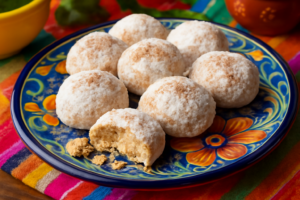
“Snow princess cookies” — crescents buried in a drift of powdered sugar. The shape and the sugar-blanket idea travel back to Austrian and German vanillekipferl, which reached Indonesia through Dutch contact, but the dough has been thoroughly localized. Many recipes use a heavy proportion of cornstarch, and a lot of Indonesian bakers fold in finely grated Edam or cheddar, which reads as savory depth rather than cheese.
Texture is the entire point. Cornstarch has no gluten-forming protein, so it dilutes the flour’s structure and produces a cookie that shatters into powder instead of crumbling into pieces. In my side-by-side, a 3:1 flour-to-cornstarch dough was pleasant; 1:1 was the one people reached for twice.
The common American mistake is sugaring them hot. Warm butter melts confectioners’ sugar into a wet gray glaze. Roll them once when barely warm so a thin layer clings, cool completely, then bury them again. Indonesian bakers often use non-melting “gula donat” (donut sugar); if you can find it, it holds up for weeks.
3. Kue Semprit (Indonesia)
Kue semprit is the piped cookie of the Indonesian holiday table — usually a ridged S, a rosette, or a short bar, often finished with a dot of chocolate sprinkles or a sliver of glacé cherry. The name comes from the Dutch spuiten, to pipe, and it sits in the same family as European spritz. What makes it Indonesian is the fat and liquid: many recipes swap some or all of the milk for coconut milk, and lean hard on cornstarch again.
Piping is the technique, and it’s where things go sideways. The dough has to be soft enough to force through a star tip but firm enough to hold ridges in the oven. Butter that has gone past about 68°F loses its emulsion structure and the ridges slump into blobs.
In my experience, the fix is a five-minute fridge rest for the filled bag, not more flour. If your press or bag isn’t cooperating, the workarounds in my post on spritz cookies without a press apply directly here — the fork-drag method gives you a very credible semprit ridge.
4. Polvoron (Philippines)
Let me be very clear about this one, because the name causes real confusion. Filipino polvoron is not a baked cookie. It is toasted flour, powdered milk, sugar and melted butter, compressed in a small oval mold and wrapped in twisted cellophane. Nothing goes in the oven except the flour, which is dry-toasted in a skillet until it smells nutty and turns the color of sand.
Spanish and Mexican polvorones are a different animal entirely: baked shortbread rounds, traditionally with lard and often almonds. Both names descend from polvo, dust, and both arrived through Spanish colonial contact — but they diverged completely. I cover the baked version separately in my post on Mexican polvorones, and I’d rather you know the difference than assume one is a variation of the other.
The technique is the toasting and the pressing. Undertoasted flour tastes raw and pasty. My ratio that worked best across six batches: 200g flour toasted to light tan, 120g powdered milk, 100g sugar, 150g melted butter. Common Filipino variations include pinipig (toasted young rice), cashew, ube, and cookies-and-cream.
American mistake: not packing the mold hard enough. Loose polvoron disintegrates in the wrapper. Press, tap, press again.
5. Barquillos and Lengua de Gato (Philippines)
Two thin, crisp Filipino cookies that get mentioned together but are made very differently. Barquillos are wafer tubes — a thin batter cooked on a hinged iron, then rolled around a dowel while still pliable. Iloilo is the region most associated with them, and they’re often sold in tall tins. Bite one and it shatters into flakes.
Lengua de gato means “cat’s tongue,” borrowed through Spanish from the French langue de chat. These are wafer-thin ovals of butter, egg white, sugar and flour, piped in short lines and baked until the edges go amber. Filipino versions, especially those associated with Cebu and Baguio, are notably buttery and thin — the good ones snap like a potato chip.
Both live or die on timing. Barquillos must be rolled within about eight seconds of leaving the iron; after that the sugar sets and they crack. For lengua de gato, the batter needs to spread thin, so egg whites go in at room temperature and unbeaten.
Biggest error I see: crowding the sheet. These spread more than you expect. I fit nine per half-sheet pan, no more.
6. Pineapple Tarts (Singapore and Malaysia)
Same fruit as nastar, meaningfully different cookie. In Singapore and Malaysia, pineapple tarts are a Lunar New Year fixture with deep Peranakan (Nyonya) roots. The auspicious logic is linguistic: in Hokkien, pineapple is ong lai, which sounds like “prosperity arrives.”
Three main forms exist. Open-faced tarts have a fluted pastry cup with jam sitting exposed on top, sometimes crosshatched. Enclosed tarts are balls, closer to nastar. Pineapple rolls are logs of pastry wrapped around a jam rope and sliced.
How they differ from nastar: the pastry is generally richer and more short, with a higher butter-to-flour ratio and often extra egg yolk, so it fractures rather than crumbles. The jam is also spiced — cinnamon, star anise, cloves, sometimes a pandan leaf simmered in — where nastar jam usually stays plainer, with a whole clove pressed on top as decoration.
The mistake here is treating the dough like American pie crust and adding water. Don’t. These doughs are bound by fat and yolk. Water develops gluten and turns a short pastry tough — I proved that on a batch I’d rather forget.
7. Kuih Bangkit (Malaysia and Singapore)
If I could get every reader to bake one cookie from this list, it would be kuih bangkit. Made from tapioca or sago starch, thick coconut milk, egg yolk and sugar, they’re pressed in carved wooden molds — flowers, fish, chrysanthemums — and baked at low heat until pale. They contain no wheat at all, so they’re naturally gluten free.
The texture is genuinely unlike anything in Western baking. A kuih bangkit doesn’t crumble; it dissolves. Pure starch with no gluten network and very little free water absorbs saliva instantly and vanishes, leaving coconut behind. They’re a Chinese New Year staple in Malaysia and Singapore, with strong Peranakan associations.
The technique that defines them: drying the starch. Traditionally the tapioca flour is dry-fried with pandan leaves, then rested for a day or more. That drives off residual moisture so the starch can absorb coconut milk without turning gluey.
The American mistake is baking them hot for color. They should stay ivory. Anything approaching golden means you’ve toasted the outside while the inside is still damp.
8. Khanom Ping / Thai Coconut Butter Cookies (Thailand)
Khanom ping translates roughly as “grilled sweet,” and that name is the whole history. Before home ovens were common in Thailand, these coconut cookies were baked in a clay or metal vessel with coconut-shell charcoal underneath and more coals resting on the lid — heat from above and below, essentially a improvised oven.
The batter uses coconut milk or coconut cream in place of dairy, with egg, sugar (often palm sugar), and flour. Texture is somewhere between a macaroon and a crisp drop cookie: chewy center, crackled top, deeply coconut. The charcoal contributes a real smoke note — faintly resinous, a little like toasted coconut husk — that a conventional oven simply cannot produce.
Worth noting: the tinned “Thai butter cookies” you see in shops are a separate, modern, dairy-based product. Khanom ping is the older tradition.
My honest attempt at the smoke: I toasted 40g of unsweetened shredded coconut until dark brown, ground it, and folded it in. It’s not the same, but it moves in the right direction. Do not add liquid smoke — I tried, and it tasted like barbecue sauce.
9. Bánh Quy Bơ (Vietnam)
Vietnamese butter cookies descend fairly directly from French colonial pâtisserie — the sablé and the petit beurre arrived with the French and stayed. Bánh quy bơ are piped rosettes or stamped rounds, sold in tins and given at Tết, alongside the imported Danish tins that occupy the same social role.
Where they diverged is interesting. Fresh dairy was scarce and hard to store in a tropical climate, so sweetened condensed milk — sữa đặc, the same tin that makes cà phê sữa đá — became a standard ingredient. It brings sugar, milk solids and moisture in one shelf-stable package. Many home recipes also cut the sugar noticeably below the French original, and some use coconut milk alongside butter.
The result is a cookie with a softer, milkier snap and more browning, because the extra milk solids and inverted sugars in condensed milk accelerate the Maillard reaction.
What goes wrong for American bakers: substituting condensed milk one-for-one for regular milk without cutting the sugar. I did that once and the edges were near-black at eleven minutes while the centers were raw.
The pantry that makes this region taste like itself
Most of this is available at any Asian grocery, and increasingly online. Here’s what I actually keep and what I’d skip.
- Pandan. Fresh leaves are best but rare outside major cities. Frozen leaves are excellent and freeze indefinitely — buy these. Pandan paste is concentrated and consistent, good for color plus flavor. Pandan extract is usually weak, green-dyed water; skip it. The aroma compound is the same one that makes jasmine rice smell like jasmine rice.
- Coconut milk vs. cream. Canned coconut milk runs roughly 10–17% fat; coconut cream runs 20–25%. Kuih bangkit and khanom ping want cream. Never use the cartoned coconut beverage — it’s mostly water and will ruin the dough.
- Tapioca and sago starch. Tapioca comes from cassava root, sago from sago palm. Southeast Asian markets often label them interchangeably. Either works for kuih bangkit; both must be dried before use.
- Ube. Purple yam, Filipino. Sold as frozen grated ube, as ube halaya jam, and as extract. Ube is not taro — different plant, different flavor, different color.
- Gula melaka / palm sugar. Sap sugar from coconut or palmyra palm, sold in hard discs or soft blocks. Gula melaka specifically refers to the Malaysian product. Chop or grate it; it tastes like caramel with a savory, almost smoky edge.
- Calamansi. Small, intensely fragrant Philippine citrus. Fresh is hard to find; the frozen concentrate is genuinely good and worth keeping for polvoron variations and glazes.
Gluten free and dairy free by tradition, not by substitution
This is one of the things I find most compelling about the region. Kuih bangkit contains no wheat because tapioca was the local starch, not because anyone was accommodating a diet. Khanom ping uses coconut milk because coconut palms grow everywhere and dairy cattle historically did not. Polvoron uses toasted flour and milk powder because both keep in heat and humidity.
Practically, that means these recipes hold together on their own logic. There’s no gum, no binder blend, no compromise texture. A properly made kuih bangkit isn’t a gluten-free version of something else — it’s the thing itself, and no wheat cookie does what it does.
The batch I got badly wrong
Kuih bangkit, attempt two. I read that the tapioca starch needed drying, decided fifteen minutes in a 250°F oven was plenty, and went ahead. The dough felt fine. Out of the oven, the cookies looked perfect — pale, crisp-edged, well-molded.
They were gummy. Not raw exactly, but tacky and slightly chalky, and they clung to my teeth instead of dissolving. Thirty-six cookies went in the bin.
The fix was patience. I dry-fried 300g of tapioca starch in a wok over low heat with four pandan leaves for about twelve minutes, stirring constantly, until it felt cool and slippery rather than damp between my fingers. Then I sealed it and left it two full days. Attempt three dissolved on contact. Specifically, the starch has to be dry enough to grab the coconut milk instead of sitting in it.
Which of these survive the mail
I’ve shipped six of the nine. Here’s how they held up.
Ship beautifully: nastar, Singapore and Malaysian pineapple tarts, kue putri salju, kue semprit, and bánh quy bơ. All are sturdy, low-moisture, and keep two to three weeks in a sealed tin. Pack putri salju with extra sugar so gaps fill in transit.
Ship with care: polvoron travels well because of the cellophane twist — each one is individually braced. Nest them tightly in a rigid box. Khanom ping is fine if fully cooled and crisp.
Don’t ship: barquillos and lengua de gato, unless you pack them in a rigid tube or tall tin with zero headroom. I lost roughly 40% of one barquillos shipment to breakage. Kuih bangkit is also fragile — hand-deliver it. For packing method, my guide to cookies that survive the mail covers the box-in-box approach I use for all of these.
Start with kue putri salju if you want an easy win, or nastar if you want to understand why moisture control matters. Whichever you pick, the reward for baking southeast asian cookies properly is a set of textures — the dissolve, the shatter, the sandy collapse — that you genuinely cannot get anywhere else.
About This Article

Written by Margaret Chen. Margaret Chen is a home baker and recipe developer with over 15 years of experience perfecting cookie recipes through rigorous testing and detailed experimentation. She tests every recipe multiple times, documents every variable, and applies the same rigor professional bakers use, with the warmth and accessibility of home baking. More about this site.
Scope and limits. Margaret is a home baker and recipe developer with no formal culinary training. Follow current food safety guidance for egg handling, storage, and anything you are serving to other people.
Verify this against a primary source
Specifics change, and your situation may differ from the one described here. These are the authorities worth checking directly:
- USDA FoodData Central — ingredient composition and nutrition data
- FoodSafety.gov — safe handling, storage and egg safety