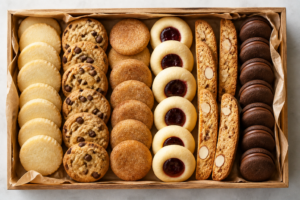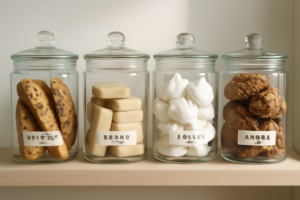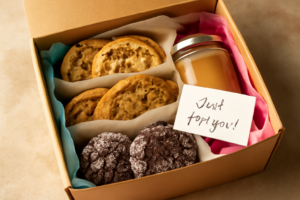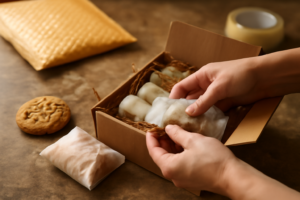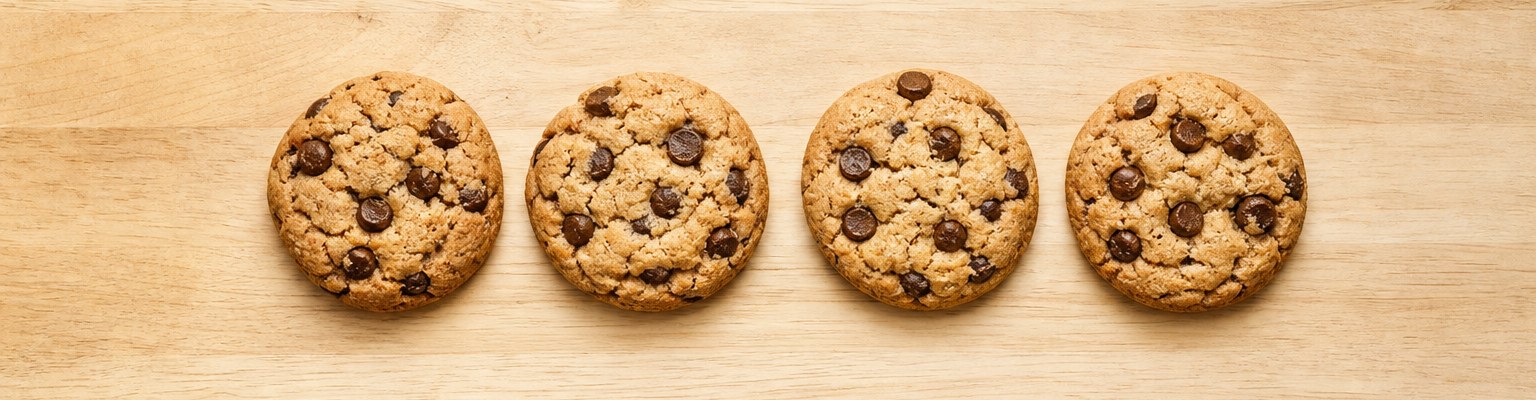
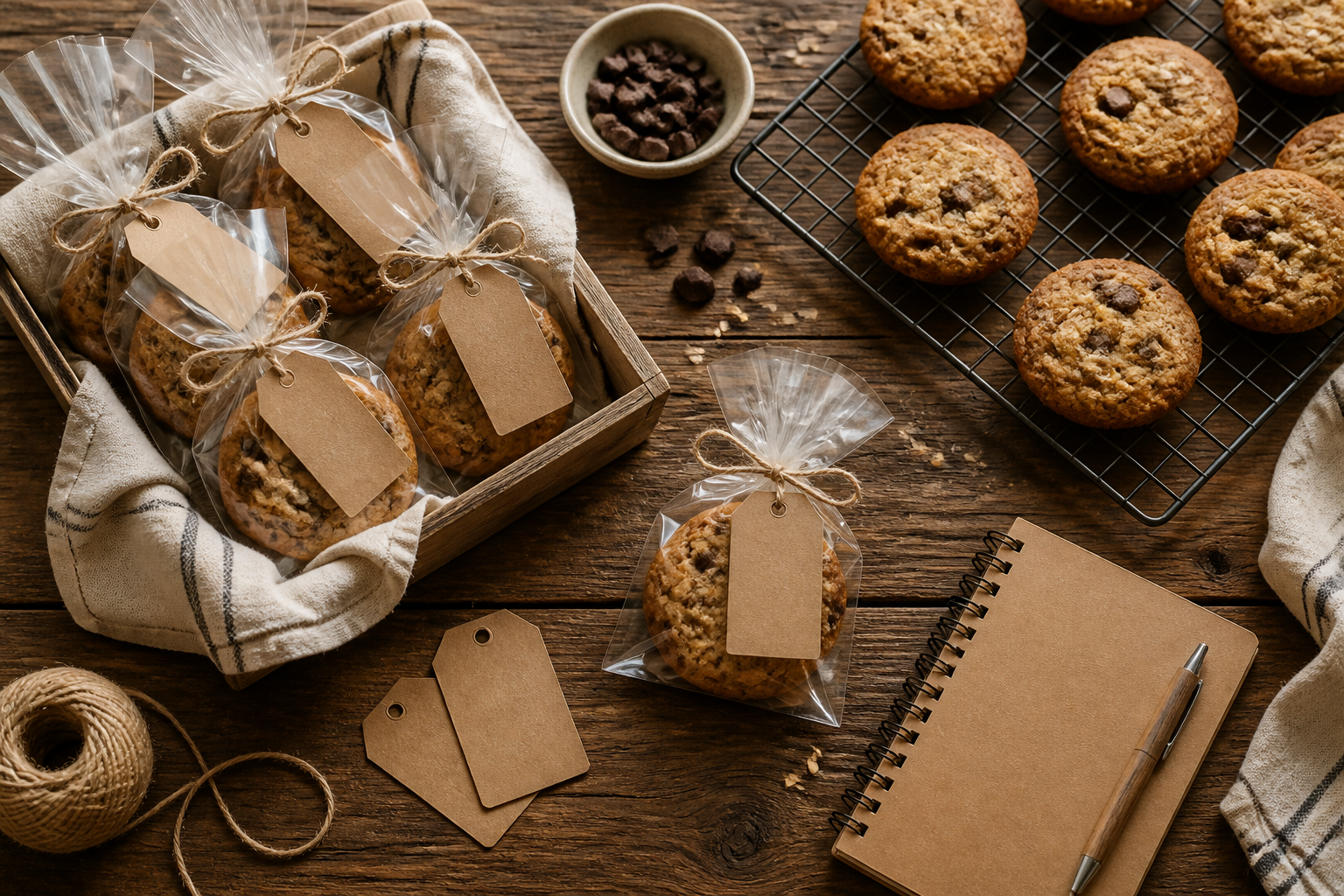

People find this site searching for “filled oatmeal cookie recipe for sale,” and until now they landed on a recipe post that never mentioned the word “sale” again. That is my fault, so let me fix it. Selling cookies from home is legal in every US state under some version of a cottage food law, but the details vary so wildly that a rule true in Texas can be flatly illegal in New Jersey. Before I go one sentence further: I am a baker, not a lawyer. I have tested a lot of doughs and read a lot of state ag department PDFs, but nothing here is legal advice. You must verify your own state’s rules with your state department of agriculture or health department before you sell a single cookie.
What I can give you is the shape of the questions, so that when you call your county health department you know what to ask and understand the answer.
What cottage food law actually is
Commercial food production normally requires a licensed commercial kitchen: three-compartment sink, separate handwashing station, commercial-grade equipment, regular inspections. That is tens of thousands of dollars before you sell your first sugar cookie.
Cottage food laws carve out an exemption. The reasoning is straightforward food-safety math: certain foods are low enough risk that a home kitchen is an acceptable place to make them. Foodborne pathogens need moisture to multiply. A baked cookie has had most of its free water driven off in the oven, and the sugar that remains binds much of what is left. Sugar is hygroscopic — it grabs water molecules and holds them so tightly that bacteria cannot use them. That is why a shortbread sits on a counter for two weeks and a cheesecake does not.
Regulators call this water activity, and cookies sit comfortably in the safe zone. As a result, baked goods are the single most commonly permitted cottage food category in the country. However, “permitted” comes with conditions, and those conditions are where states diverge dramatically.
The six categories of rule that vary by state
When you look up your state’s law, you are looking for answers in six buckets. Every state addresses all six, and every state answers them differently.
1. Annual revenue cap
Most states cap how much cottage food revenue you can earn in a year before you must move into a licensed facility. Some states have no cap at all. Some have a tiered structure where a lower number keeps you unregistered and a higher number requires a permit. I am deliberately not printing any figures here, because they get amended and I do not want you planning a business around a stale number from a blog post. Search your state’s cottage food statute and find the current figure yourself.
One thing worth knowing: caps are almost always on gross sales, not profit. If you gross a large number and keep very little of it, the cap still applies to the big number.
2. Where you may sell
This is the rule that surprises people most. States commonly distinguish between:
- Direct-to-consumer — farmers markets, roadside stands, church bazaars, sales from your own home. Almost universally allowed.
- Online orders with local pickup or delivery — allowed in many states, sometimes with the condition that you hand over the product in person.
- Shipping within your state — permitted in some states, prohibited in others.
- Shipping across state lines — this is the big one. Cottage food laws are state laws, and a state cannot authorize you to sell into another state. Interstate commerce generally pulls you under federal jurisdiction.
- Wholesale to retail shops or restaurants — usually prohibited under cottage food exemptions, because the food leaves your hands and gets resold by a third party.
I want to be blunt about the interstate question, because Instagram is full of home bakers mailing cookies nationwide. Many of them are operating in a gray zone they have not researched. If shipping out of state is central to your plan, that is the first call you make, not the last.
3. Which foods qualify
The organizing principle is simple: shelf-stable and low-moisture is almost always yes, anything requiring refrigeration is almost always no. Cookies, brownies, quick breads, granola, jams with tested pH, hard candy — generally fine. Cheesecake, custard pies, anything with cream cheese or fresh dairy filling, buttercream containing perishable dairy — generally not.
States publish approved lists and prohibited lists. Read both. Some states also regulate specific ingredients regardless of the finished product, so if you are working with alcohol, fresh fruit purees, or nut butters, look those up individually.
4. Permit or registration
Some states require nothing beyond following the labeling rules. Others require you to register your operation, and others require an actual permit with an application fee and a renewal cycle. The fee ranges from nothing to a few hundred dollars depending on where you live. Check whether it is issued at the state level or by your county — in several states, the county health department is the office you actually deal with.
5. Kitchen inspection
A minority of states inspect the home kitchen. Where inspections happen, they tend to look at whether you have a sanitary work surface, adequate refrigeration for ingredient storage, no pets in the kitchen during production, and separation between your production and your family’s daily cooking. Rented apartments sometimes create complications here — check whether your state requires the kitchen to be in a residence you own.
6. Food handler certification
Many states require a food safety course. These are typically online, take a couple of hours, and cost less than a bag of good chocolate. Even where it is not required, I would take one. I learned more about cross-contamination in that course than in fifteen years of home baking.
Where to actually look it up
Start with your state department of agriculture. If they do not handle it, it will be the state department of health, and they will tell you. Search the exact phrase “[your state] cottage food law site:.gov” to skip the blog posts and land on the statute. Then call your county health department and confirm, because counties occasionally layer additional requirements on top. Two phone calls, maybe forty minutes total.
Why cookies are close to the perfect cottage food product
I have made and sold brownies, quick breads, and one disastrous run of lemon bars. Cookies win, and not by a small margin.
They are shelf-stable by default, which means they clear the qualifying-food hurdle in essentially every state. They are portion-controlled, so pricing per unit is intuitive for the customer. They stack, which halves your packaging volume. They survive transport — I have driven a hundred boxes of chocolate chip cookies over rough road and lost maybe two to breakage.
Margin is the real argument. Flour, sugar, butter, and eggs are cheap relative to what a decorated or well-made cookie commands. A batch that costs me a few dollars in ingredients produces two to three dozen units that sell for meaningfully more than that. Very few home-legal foods have that ratio.
One more thing: cookies fail gracefully. An underbaked cheesecake is garbage. An underbaked cookie is a chewy cookie, and someone will prefer it. That forgiveness matters enormously when you are scaling from two dozen to fifteen dozen and your oven is not cooperating.
The cream-filled trap
This site has a lot of cream-filled content, and I need to be direct about it. The plain cookie is almost certainly legal for you to sell. The filling may not be.
Here is the food science. A traditional Oreo-style filling is essentially fat and powdered sugar — shortening, confectioners’ sugar, a splash of flavoring. There is very little free water in it, and the sugar concentration is high enough to lock down what water exists. That filling is often shelf-stable and often permitted.
Now swap in cream cheese, or heavy cream, or an Italian meringue buttercream with fresh dairy. You have introduced water and protein into an environment that no longer has enough sugar to bind it. That is a growth medium. The same logic applies to lemon curd, whipped ganache, custard, and anything with fresh fruit puree stirred through.
The practical consequence: my bakery-style cream-filled cookies are a gift-and-family recipe, not automatically a sale recipe. If you want to sell filled cookies, take your specific filling formula to your state authority and ask whether it qualifies. In my experience they will ask about the dairy content and whether the product requires refrigeration at any point.
I tested a shortening-and-powdered-sugar filling against a cream cheese version side by side, both left at room temperature. At 72 hours the shortening filling was indistinguishable from fresh. The cream cheese version was visibly weeping at 36 hours and I would not have handed it to a stranger at 48. That test told me everything I needed to know about which one belongs on a market table.
Labeling: the six elements
Nearly every state requires the same core elements. Exact formatting and font-size rules vary, so pull your state’s label template — most publish one.
- Product name. Descriptive and honest. “Brown Butter Chocolate Chip Cookies,” not “Margaret’s Best.”
- Full ingredient list, in descending order by weight. Weigh your recipe. If butter outweighs flour, butter is listed first. Sub-ingredients get parentheses: “chocolate chips (sugar, chocolate liquor, cocoa butter, soy lecithin, vanilla).”
- Allergen declaration. The major allergens — wheat, milk, eggs, soy, tree nuts, peanuts, sesame, fish, shellfish. Most bakers use a “Contains:” line after the ingredients.
- Net weight. In both US customary and metric. Weigh the finished packaged product, not the dough.
- Your business name and physical address. Some states allow a registration number instead of a home address — ask, especially if privacy concerns you.
- The home kitchen disclosure. A statement that the product was made in a home kitchen not subject to state inspection.
That last one matters more than people realize. States specify the exact wording, and it differs. To give you a sense of the shape without misleading you: as an example, one state’s statute requires a line noting the food was made in a home kitchen that is not inspected by the department of health, and requires it in a minimum font size. That is one state’s phrasing, not a national standard. Copy your state’s language verbatim, including capitalization.
Pricing: the arithmetic nobody does
The most common mistake in home baking businesses is pricing at ingredient cost plus a little. It feels fair. It is actually a decision to work for free, and it is why so many cookie businesses quietly fold after a year of exhausting Saturdays.
Here is the method, worked through with real numbers from one of my batches.
Step one: cost of goods per batch
Weigh everything and price it against what you actually paid. My brown butter chocolate chip batch, which yields 24 cookies at 55g each:
- 340g butter — $3.40
- 400g all-purpose flour — $0.60
- 300g brown sugar + 100g granulated — $1.10
- 2 eggs — $0.70
- 340g chocolate — $4.20
- Vanilla, salt, baking soda — $0.60
Total ingredients: $10.60. Divided by 24 cookies, that is $0.44 per cookie.
If you sold those at $1.25 each you would feel like you tripled your money. You did not. You have not paid yourself, your packaging, your oven, or the market.
Step two: add the costs you forgot
Packaging: a cello bag, a sticker label, and a tie run me about $0.35 per cookie for individually wrapped singles. Overhead — electricity, parchment, dish soap, the amortized cost of my permit and insurance — I allocate at roughly 10% of ingredient cost, so $0.04. Market fee: my booth costs $40 for a day where I realistically sell 300 cookies, which is $0.13 per cookie.
Running total before labor: $0.44 + $0.35 + $0.04 + $0.13 = $0.96.
Step three: pay yourself
The batch takes me 45 minutes hands-on including scaling, mixing, portioning, baking, and cleanup. Packaging 24 cookies adds 12 minutes. Call it one hour per batch. At $22/hour — modest for skilled work — that is $22 across 24 cookies, or $0.92 per cookie in labor.
True cost: $0.96 + $0.92 = $1.88 per cookie. That $1.25 price point was losing me 63 cents on every single cookie, and I would have needed to sell more of them to lose more money.
Step four: the multiplier
Now apply a margin so the business can absorb a rained-out market, a burned tray, or a butter price spike. I use 1.6× on true cost. That gives $1.88 × 1.6 = $3.01, and I round to $3.00.
If $3.00 makes you flinch, sit with the flinch. A large bakery cookie downtown costs more than that and is worse. Your discomfort is about your own worth, not your market’s willingness to pay. That said, if your local market genuinely will not bear $3.00, the answer is to reduce cost — buy chocolate in bulk, bake bigger batches, use flat boxes of a dozen instead of individual bags — not to cut your wage.
Copy that arithmetic exactly with your own numbers. Ingredients, packaging, overhead, venue fee, labor, then multiplier.
Packaging and shipping
Assuming your state permits shipping, choose your product for the journey. Dense, low-moisture cookies with structural integrity — biscotti, shortbread, thick drop cookies, gingersnaps — arrive intact. Thin, brittle, or delicately decorated ones do not. I lay out the full list in the cookies that survive the mail, and every one of those has been through a real postal system.
Shelf life is a business problem, not just a quality one. If a customer opens the box on day five and the cookie is stale, you have lost them regardless of how good it was on day one. My breakdown of which cookie types last longest maps almost perfectly onto which ones make good sale products — higher sugar and fat, lower free water, better staying power.
Presentation drives repeat orders more than I expected. Specifically, the difference between a plain bag and a properly assembled box changed my reorder rate noticeably at the same price. The techniques in my guide to packaging cookies so people actually notice transfer directly to retail — just remember to build the cost into your per-unit math.
What selling did to my baking
Honest answer: it took something from me, and it gave something back.
The loss came first. Baking had been the thing I did when I was overwhelmed by everything else. Once it had a deadline and a customer, it became one more thing that could go wrong. I remember scraping a tray of overbaked snickerdoodles into the bin at 11pm before a Saturday market and feeling genuine dread about a cookie. That had never happened to me before.
Volume also flattens curiosity. When you make the same three recipes eighty times, you stop asking questions about them. My testing notebook went quiet for most of a year.
What I gained was rigor. Selling forced me to weigh things I had eyeballed for a decade, and I discovered my “one cup of flour” varied by nearly 20 grams depending on my mood. Consistency requirements made me a genuinely better baker. I also learned my recipes at a depth casual baking never demanded — how they behave scaled to six batches, how they hold at 48 hours, which ones tolerate a humid day.
My compromise now: I sell a short, fixed menu of things I have tested to exhaustion, and I keep a separate part of my week for baking with no buyer attached. That separation is what protected the joy. If you are considering selling cookies from home, build that boundary in from the start rather than trying to recover it later. And make your two phone calls to the state and county before you make anything else.
About This Article

Written by Margaret Chen. Margaret Chen is a home baker and recipe developer with over 15 years of experience perfecting cookie recipes through rigorous testing and detailed experimentation. She tests every recipe multiple times, documents every variable, and applies the same rigor professional bakers use, with the warmth and accessibility of home baking. More about this site.
Scope and limits. Margaret is a home baker and recipe developer with no formal culinary training. Follow current food safety guidance for egg handling, storage, and anything you are serving to other people.
Verify this against a primary source
Specifics change, and your situation may differ from the one described here. These are the authorities worth checking directly:
- USDA FoodData Central — ingredient composition and nutrition data
- FoodSafety.gov — safe handling, storage and egg safety