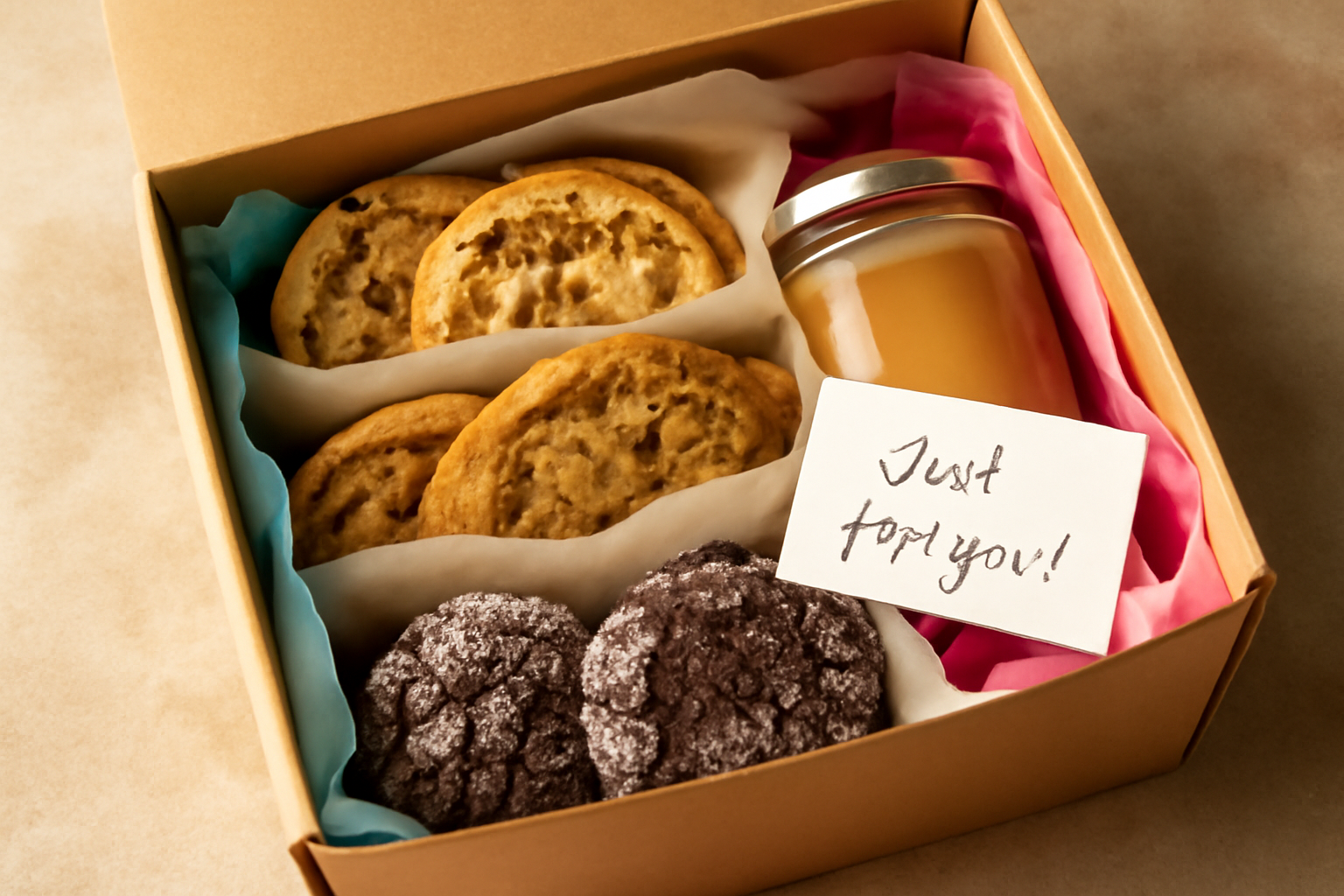

A care package isn’t just a smaller, more casual version of a holiday cookie box. It’s going to a specific person, in a specific situation, on a timeline that usually matters more than you’d think. The “best shipping cookie” on paper can still be the wrong choice if it ignores who’s actually opening the box — a deployed service member with no fridge and a six-week mail delay, a college student buried in finals who won’t check the mail room for two days, or a grieving friend who doesn’t have the bandwidth for anything elaborate.
I’ve shipped more than 200 boxes of homemade cookies over the past decade-plus, and a good chunk of those went to exactly these three situations: military and deployment addresses, college dorms, and friends going through loss. What I learned is that the baking science stays the same, but the planning around it changes completely depending on who’s on the receiving end.
This guide is built around that idea. Instead of one generic “here’s what ships well” list, I’m breaking it down by recipient — military, college, and sympathy care packages — with what to bake, what to skip, how to pack around each situation’s real-world constraints, and when to ship. Let’s get into it.
Why a Care Package Isn’t Just a Smaller Gift Box
The underlying rules of what survives shipping don’t change: low moisture, dense structure, and a fat content that keeps cookies from either drying out or turning greasy. I’ve written up the full science and my complete tested recipe list separately in Best Cookies for Shipping as Gifts, and my full packing method — the immobilize, cushion, and seal process I use on every box — is in How to Ship Homemade Cookies Without Breaking. I’d start there if you haven’t already.
What’s different about a care package is everything around the cookie: the transit time you can actually count on, whether anyone’s checking the mail regularly, and what tone is appropriate for the moment. Here’s how that plays out for the three situations I ship for most.
Military and Deployment Care Packages
What to Bake
For military mail, I stick almost exclusively to the longest-lasting cookies I make: biscotti, classic shortbread, and gingersnaps. All three come from my tested recipes in the full recipe guide, and I chose them for this specific use case because they hold up through conditions a domestic shipment never sees: extreme heat in some deployment locations, transit that can stretch to several weeks rather than a few days, and zero guarantee of climate-controlled storage once the box arrives at a unit.
- Biscotti — my top pick for deployment. Nearly zero moisture means it’s essentially immune to heat and long transit times.
- Classic shortbread — dense and stable, and it doesn’t rely on any component (icing, filling) that degrades in heat.
- Gingersnaps — the spices and molasses hold flavor well past the three-week mark, and they actually taste better after a few weeks in transit, not worse.
I avoid anything chocolate-dipped or chocolate-coated for shipments headed anywhere hot — standard chocolate melts and re-sets into a dull, streaky mess well before it reaches 90°F, and there’s no way to know what temperature that box is sitting at in transit or in storage once it lands.
Packing and Mail Restrictions
APO/FPO addresses route through the domestic postal system, but they’re still subject to restrictions that don’t apply to a normal shipment. Skip anything alcohol-soaked (rum balls, bourbon fruitcake) and any liquid-based gift add-ons — some are restricted outright, and customs handling for OCONUS addresses adds delay and risk of confiscation. Stick to solid, shelf-stable baked goods and you avoid the issue entirely.
Because handling is rougher and the trip is longer, I double up on protection compared to a domestic box: individually wrap cookies (not just paired back-to-back), add an extra silica gel packet for humidity, and use a rigid inner tin rather than a bag. If you’re shipping to a hot climate, pack cookies in the center of the box, surrounded by cushioning on all sides, rather than against an outer wall that absorbs more heat.
Timing
Military mail can take anywhere from two to six weeks depending on the destination, so plan around the longest realistic estimate, not the average one. If you’re shipping for a holiday, check your service branch’s published mail-by deadlines — they’re typically set weeks earlier than domestic holiday cutoffs, and missing them means the box arrives after the moment it was meant for. When I’m not sure of exact timing, I bake toward the long-shelf-life end (biscotti over anything softer) and size the box for a whole unit to share rather than one person, since care packages often get passed around.
College Student Care Packages
What to Bake
Domestic shipping to a dorm is a much shorter, gentler trip than a military shipment, which opens things up a little. I still lean on shortbread, biscotti, and gingersnaps as the reliable core, but I’ll add individually-sized cookies that are easy to grab between classes or during a study break — the goal is something a stressed-out student can eat one-handed without a plate. Individually wrapped portions matter more here than for any other audience on this list, because dorm cookies get shared with roommates and hallmates fast.
The Dorm Mail Room Problem
Here’s the thing nobody accounts for: a package can sit in a dorm mail room for one to three extra days after it technically “arrives,” especially during finals week when students are the least likely to check email notifications or make time for a mail room trip. That’s not a shipping delay — it’s a pickup delay, and it doesn’t show up in tracking. Build in that buffer by choosing cookies with 10+ days of shelf life rather than cutting it close with something at the 4-to-5-day end of the range.
Timing
Aim to land the package the week before finals, not during it — students need the boost before the crunch, not a box sitting unopened in a mail room during the crunch itself. Avoid shipping right before a scheduled home visit or the start of a break, since an empty dorm means an even longer pickup delay on top of the mail room lag. If you don’t know the exact schedule, ask — most colleges publish finals and break dates, and it takes two minutes to check against your ship date.
Sympathy and Grief Care Packages
Keep It Simple, Not Impressive
This is the one place where I deliberately don’t reach for my most elaborate recipes. A decorated, hand-piped sugar cookie is a lovely thing to send for a birthday; it can feel oddly performative when someone is grieving. I stick to plain, familiar comfort cookies — shortbread, simple oatmeal, gingersnaps — nothing that requires the recipient to admire craftsmanship they don’t have the emotional energy for right now. The point isn’t to impress. It’s to give someone something easy and good to eat during a week when cooking, or even deciding what to eat, feels like too much.
What to Leave Out
Skip novelty flavors and anything that reads as festive or celebratory. Keep the quantity modest — a large box can feel like one more thing to deal with, especially if the household is already receiving food from several directions. If you don’t know the recipient well, assume you don’t know their dietary restrictions either; a plain shortbread or oatmeal cookie is a safer bet than something nut-heavy or unusual. And keep any card short and low-pressure — a line or two that doesn’t require a reply is kinder than an card that feels like it’s waiting for a response.
Timing Matters More Than People Expect
The first week or two after a loss is usually flooded with casseroles, flowers, and visitors. The real gap I’ve noticed — and the reason I now often wait — is three to six weeks out, once everyone else’s attention has moved on but the grief hasn’t. A care package that arrives during that quieter stretch tends to mean more than one more thing added to an already crowded first week.
Quick Reference: Which Cookie for Which Care Package
| Cookie | Military | College | Sympathy |
|---|---|---|---|
| Classic shortbread | Yes | Yes | Yes |
| Biscotti | Yes — top pick | Yes | Only if familiar to recipient |
| Gingersnaps | Yes | Yes | Yes |
| Chocolate-dipped anything | No — heat risk | Fine domestically | Skip — feels festive |
| Decorated/iced cutouts | Skip — fragile, long transit | Fine for birthdays | Skip — too elaborate |
For the full tested recipes behind every cookie in that table, see Best Cookies for Shipping as Gifts: 20 Recipes That Survive the Mail Every Time. For the packing method itself — the immobilize-insulate-seal process, the shake test, how much cushioning is actually enough — see How to Ship Homemade Cookies Without Breaking.
The Box I Use for Every Care Package
A flimsy box and a wad of tissue paper aren’t going to cut it for a care package that has to survive a mail room, a customs stop, or three weeks in a mail truck — you need rigid structure and actual depth to create a real buffer zone between your cookies and however roughly that box gets handled along the way.
What works
- The 9×6×4 inch depth gives you room to layer cookies with packing material on all sides — I can fit 2–3 layers of wrapped cookies with bubble wrap cushioning, and there’s actually space for things to shift without touching the walls.
- The corrugated walls are legitimately sturdy; I’ve watched these boxes survive being stacked under other packages at the post office without collapsing inward.
- The black exterior looks intentional and polished when it arrives — recipients feel like they’re getting something special, not just a plain cardboard box, which matters for a care package meant to feel personal.
What doesn’t
- You do need to pack them intelligently — the box itself won’t save poorly wrapped cookies, so you still can’t skip the bubble wrap, parchment, and padding layers.
- At 30 boxes per pack, they take up real storage space, so this only makes sense if you’re genuinely planning to ship multiple care packages (not a one-off gift).
I second-guessed whether a sturdier box was really necessary or just an excuse to buy more stuff, until I packed two identical orders using one of these boxes and a thinner competitor’s box side-by-side — the cookies in the Lmuze box arrived noticeably less cracked. Lmuze Small Black Shipping Boxes (9x6x4 inches, Pack of 30)