
Classic Peach Pie with Lattice Top: Peel Them, Use Tapioca
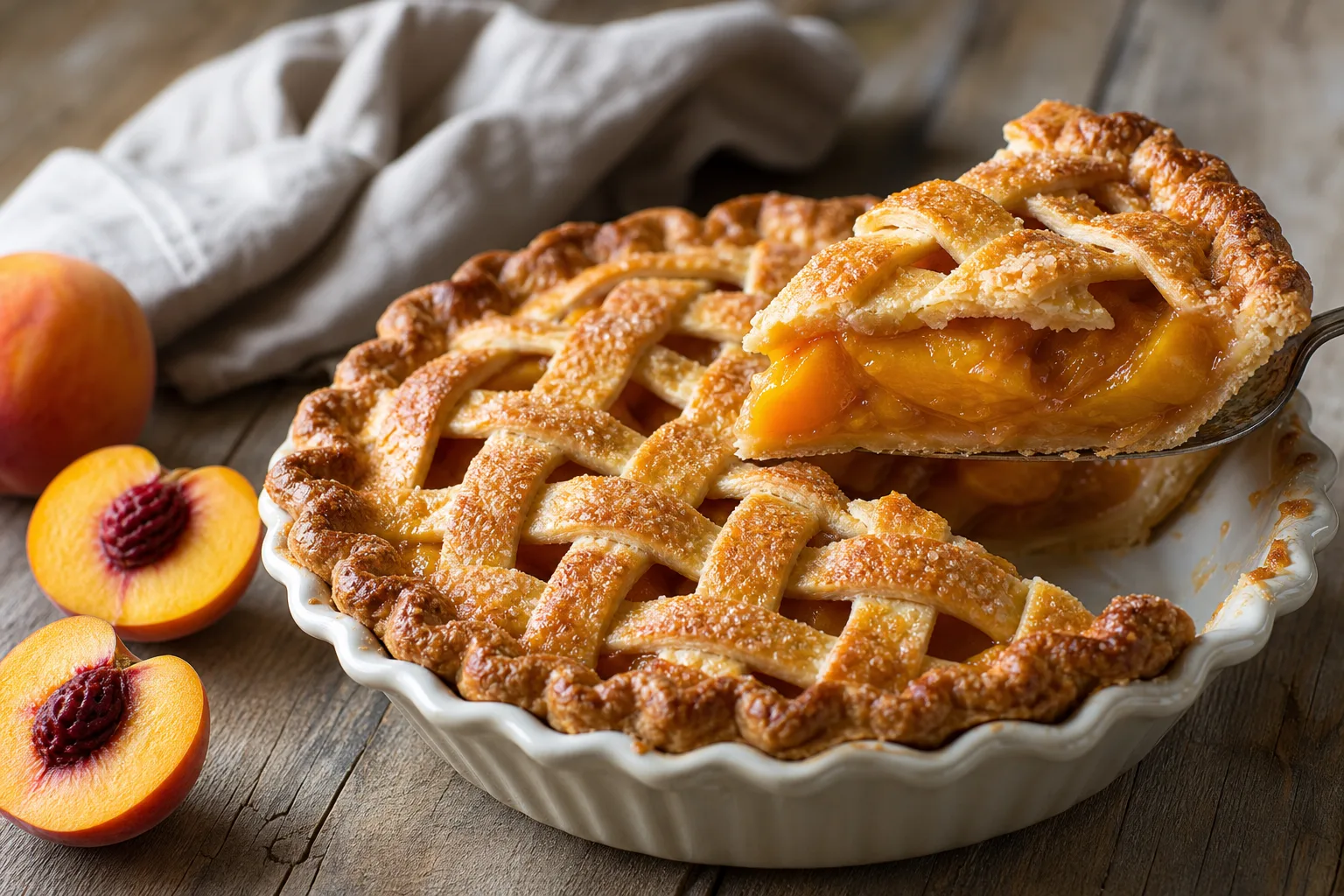
Classic lattice peach pie with a clear, sliceable filling. Blanch-peel peaches in 40 seconds and thicken with tapioca so it sets without slumping.
Ingredients
- 2 1/2 cups (315 g) all-purpose flour
- 1 tablespoon granulated sugar
- 1 teaspoon fine salt
- 1 cup (2 sticks) cold unsalted butter, cut into 1/2-inch cubes
- 6 to 8 tablespoons ice water
- A large pot of water at a rolling boil
- A large bowl of ice water
- 3 1/2 pounds ripe but still-firm peaches (about 7 medium)
- 2/3 cup granulated sugar, plus 1 to 2 tablespoons more if the peaches are tart
- 1/4 cup packed light brown sugar
- 3 1/2 tablespoons tapioca starch (also sold as tapioca flour)
- 1 tablespoon fresh lemon juice
- 1/4 teaspoon fine salt
- 1/2 teaspoon vanilla extract
- 2 tablespoons cold unsalted butter, diced
- 1 large egg beaten with 1 tablespoon milk
- 1 tablespoon coarse sugar
Instructions
- Make the dough. Whisk the flour, sugar and salt. Toss in the butter and press each cube flat between your fingertips into shaggy flakes. Stir in 6 tablespoons of ice water with a fork, adding more by the tablespoon until the dough holds when squeezed. Divide into two pieces, one slightly larger, flatten into discs, wrap and chill for at least 1 hour.
- Set up the peeling station. Bring the pot of water to a rolling boil and fill a large bowl with ice water. Cut a shallow X through the skin on the bottom of each peach.
- Blanch the peaches. Lower 2 or 3 at a time into the boiling water for 40 seconds (30 for very soft peaches, up to 60 for firm ones). Lift them with a slotted spoon straight into the ice water for 1 minute. Slip the skins off with your fingers, starting at the X. Return any stubborn peach to the boiling water for 15 seconds.
- Build the filling. Halve and pit the peaches and cut them into 1/2-inch wedges. Toss with both sugars, lemon juice, salt and vanilla, and let stand 15 minutes until juice pools. Sprinkle the tapioca over the fruit, toss until there are no dry streaks, and let stand 10 minutes more.
- Roll the dough. Roll the larger disc to a 12-inch round, fit it into a 9-inch deep-dish pie plate and trim to a 1-inch overhang. Roll the second disc and cut ten strips about 3/4 inch wide. Chill the shell and the strips on a parchment-lined tray for 15 minutes. Put a rack on the lowest position with a rimmed baking sheet on it and heat the oven to 425°F.
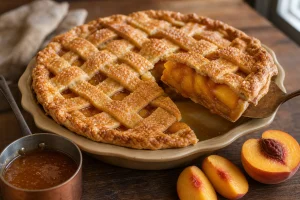
- Fill and weave. Pile in the peaches and every drop of juice, and dot with the diced butter. Lay five strips across the pie, fold back every other one, lay a perpendicular strip, and unfold. Repeat, folding back the opposite strips each time, until the lattice is woven. Trim the strips, fold the bottom overhang over the ends and crimp. Chill the pie for 20 minutes.
- Bake. Brush the lattice with the egg wash and sprinkle with coarse sugar. Set the pie on the hot baking sheet and bake at 425°F for 20 minutes, until the edges turn golden. Reduce the oven to 375°F and bake 40 to 45 minutes more, tenting with foil if the crust browns too fast.
- Check the doneness cue. The pie is ready when big, slow, glossy bubbles break through the center of the lattice, not just at the edges. If you only see edge bubbling, give it another 10 minutes.
- Cool completely. Let the pie cool on a rack for at least 4 hours. The tapioca gel finishes setting as it cools, so slicing sooner will always look runny. Cut with a sharp knife and wipe it between slices.
Notes
- Makes one 9-inch deep-dish double-crust pie. Buy about 3 1/2 pounds of peaches to end up with roughly 3 pounds (about 6 1/2 cups) of peeled slices.
The first peach pie I made looked magnificent for about thirty seconds. Then I cut into it, and the filling slid across the plate in a pale, cloudy puddle, trailing ribbons of peach skin like wet paper. The flavor was fine. The texture was two separate problems: the skins and the thickener.
Both are easy to fix. Peel the peaches by blanching them for 40 seconds, then thicken with tapioca instead of cornstarch. After side-by-side tests with cornstarch, flour and tapioca, tapioca is the one I use every time. It keeps the juice clear and glossy and holds a clean slice.
Why This Works
Tapioca starch turns peach juice into a clear, soft gel that starts thickening early in the bake and tolerates the fruit’s acid, where cornstarch tends to go opaque and slump. Pair that with peaches that have been blanched and peeled, so there is no skin left to curl into tough strips, and the filling slices cleanly and tastes purely of peach.
Ingredients
Makes one 9-inch deep-dish double-crust pie. Buy about 3 1/2 pounds of peaches to end up with roughly 3 pounds (about 6 1/2 cups) of peeled slices.
For the Crust
- 2 1/2 cups (315 g) all-purpose flour
- 1 tablespoon granulated sugar
- 1 teaspoon fine salt
- 1 cup (2 sticks) cold unsalted butter, cut into 1/2-inch cubes
- 6 to 8 tablespoons ice water
For Peeling the Peaches
- A large pot of water at a rolling boil
- A large bowl of ice water
For the Filling
- 3 1/2 pounds ripe but still-firm peaches (about 7 medium)
- 2/3 cup granulated sugar, plus 1 to 2 tablespoons more if the peaches are tart
- 1/4 cup packed light brown sugar
- 3 1/2 tablespoons tapioca starch (also sold as tapioca flour)
- 1 tablespoon fresh lemon juice
- 1/4 teaspoon fine salt
- 1/2 teaspoon vanilla extract
- 2 tablespoons cold unsalted butter, diced
To Finish
- 1 large egg beaten with 1 tablespoon milk
- 1 tablespoon coarse sugar
Only Have Cornstarch?
Use the same 3 1/2 tablespoons, whisked into the sugars before you toss them with the peaches so it doesn’t clump. Bake until the filling bubbles thickly in the center, because cornstarch needs full heat, and expect a slightly cloudier, firmer set.
How to Make It
Prep: 50 minutes | Bake: 65 minutes | Cool or chill: 4 hours | Serves: 8 slices
- Make the dough. Whisk the flour, sugar and salt. Toss in the butter and press each cube flat between your fingertips into shaggy flakes. Stir in 6 tablespoons of ice water with a fork, adding more by the tablespoon until the dough holds when squeezed. Divide into two pieces, one slightly larger, flatten into discs, wrap and chill for at least 1 hour.
- Set up the peeling station. Bring the pot of water to a rolling boil and fill a large bowl with ice water. Cut a shallow X through the skin on the bottom of each peach.
- Blanch the peaches. Lower 2 or 3 at a time into the boiling water for 40 seconds (30 for very soft peaches, up to 60 for firm ones). Lift them with a slotted spoon straight into the ice water for 1 minute. Slip the skins off with your fingers, starting at the X. Return any stubborn peach to the boiling water for 15 seconds.
- Build the filling. Halve and pit the peaches and cut them into 1/2-inch wedges. Toss with both sugars, lemon juice, salt and vanilla, and let stand 15 minutes until juice pools. Sprinkle the tapioca over the fruit, toss until there are no dry streaks, and let stand 10 minutes more.
- Roll the dough. Roll the larger disc to a 12-inch round, fit it into a 9-inch deep-dish pie plate and trim to a 1-inch overhang. Roll the second disc and cut ten strips about 3/4 inch wide. Chill the shell and the strips on a parchment-lined tray for 15 minutes. Put a rack on the lowest position with a rimmed baking sheet on it and heat the oven to 425°F.
- Fill and weave. Pile in the peaches and every drop of juice, and dot with the diced butter. Lay five strips across the pie, fold back every other one, lay a perpendicular strip, and unfold. Repeat, folding back the opposite strips each time, until the lattice is woven. Trim the strips, fold the bottom overhang over the ends and crimp. Chill the pie for 20 minutes.
- Bake. Brush the lattice with the egg wash and sprinkle with coarse sugar. Set the pie on the hot baking sheet and bake at 425°F for 20 minutes, until the edges turn golden. Reduce the oven to 375°F and bake 40 to 45 minutes more, tenting with foil if the crust browns too fast.
- Check the doneness cue. The pie is ready when big, slow, glossy bubbles break through the center of the lattice, not just at the edges. If you only see edge bubbling, give it another 10 minutes.
- Cool completely. Let the pie cool on a rack for at least 4 hours. The tapioca gel finishes setting as it cools, so slicing sooner will always look runny. Cut with a sharp knife and wipe it between slices.
Don’t Over-Blanch
Past a minute in boiling water the outer layer of the peach starts to cook and turns mealy. Time it, and move the peaches to ice water immediately. A two-minute distraction at the stove costs you the texture of the fruit.
Can You Make This Pie Ahead?
Yes — Here Is the Timeline
Yes. This pie is actually better baked a day ahead, since it needs four hours to set anyway. Make the dough up to two days ahead, bake the pie the day before, and keep it loosely covered at room temperature.
The dough keeps in the refrigerator for two days or in the freezer for a month; thaw it overnight in the fridge. Do not assemble the pie with raw peaches hours before baking. The sugar keeps drawing out juice, and the bottom crust turns damp.
A baked pie keeps loosely covered at room temperature for one day, then refrigerated for up to three more. Rewarm slices or the whole pie at 325°F for 15 to 20 minutes to refresh the crust. A baked pie also freezes well, wrapped tightly, for up to a month; thaw overnight in the refrigerator.
How to Blanch-Peel Peaches in 40 Seconds
Peach skin looks harmless raw, but it never softens in the oven. After an hour at 375°F it is still there, tough and faintly astringent, and it separates from the fruit in long strips that wrap around your fork.
A vegetable peeler works on firm peaches, but firm peaches are the wrong ones for pie. A properly ripe peach is soft enough that the peeler gouges the flesh, and you lose juice with every pass. Blanching leaves the fruit intact.
The window is narrow. Boiling water loosens the skin by heating only the thin layer of flesh under it, and 40 seconds is long enough for that and short enough that the peach itself stays raw. I go 30 seconds for peaches that give under a thumb, 40 for ripe but springy, and 60 for firm. Past a minute the outer flesh starts to cook and turns mealy, and it never recovers in the pie.
The ice bath matters as much as the boil. Without it, residual heat keeps traveling inward and cooks the fruit you were trying to protect. A full minute in ice water stops that, and the skin then slides off under your thumb, starting at the scored X, often in one piece.
A skin that clings in patches usually means an underripe peach. Give it another 15 seconds in the water.
Why Tapioca Beats Cornstarch in Peach Pie
Peaches release a lot of juice, so filling is mostly a juice-management problem. The thickener has to turn roughly a cup and a half of thin liquid into a gel that stays put on a cut slice.
I made this pie with cornstarch more than once. It thickens, but the gel sets up opaque, so the filling looks milky instead of glowing amber. It also needs near-boiling heat to reach full strength, and the center of a pie is the last place to get there, so pull the pie a little early and the middle slumps. The fruit’s acid tends to weaken a cornstarch gel over a long bake as well.
Tapioca starch, which comes from cassava root, gives a clear, glossy, slightly soft gel that lets peach juice look like peach juice. It starts thickening at a lower temperature, so the filling is gelling well before the crust finishes baking, and it copes with acidic fruit. It also freezes and reheats without going grainy. The downside is that too much, or a very long bake, turns it gummy and stringy, which is why the amount here is measured.
Flour is the old standby and the worst of the three for peaches. It takes about twice as much to do the same job, clouds the juice, and leaves a faint raw-dough taste.
Add the tapioca after the peaches have stood for 15 minutes. Sprinkled onto juicy fruit it dissolves evenly; dumped onto dry peaches it clumps into white lumps that bake into gummy spots.
Adjusting the Thickener and Reading the Bake
Peaches vary. A dead-ripe summer peach can give up nearly twice the juice of one that is merely ripe. I treat 3 1/2 tablespoons as the baseline for 3 pounds of peeled fruit, go to 4 for peaches that drip when sliced, and drop to 3 for firm ones that barely release juice after 15 minutes of standing.
Watch the bubbles. Early in the bake they are small, fast and watery, near the edges. When the pie is ready, big slow bubbles heave up through the center of the lattice and the juice looks like glossy warm syrup. Bubbling only at the edges means another 10 minutes, with foil over the crust if it is browning.
Most runny slices come from underbaking or cutting too soon, not from too little tapioca. The gel finishes setting as the pie cools, so a warm pie always looks loose. Gummy and stringy means too much starch or too long in the oven. Cloudy means cornstarch.
Margaret’s Tip
Score the X before the water boils, and blanch only two or three peaches at a time. Crowding the pot drops the water below a boil, and the 40-second timing stops working.
Questions People Ask
Do I really have to peel peaches for pie?
I would. Peach skin stays tough through a full bake and comes away from the fruit in strings that catch in your teeth. It also dulls the color of the filling. Blanching takes about 15 minutes for seven peaches, which is less effort than most people expect.
What if the skins won’t slide off after blanching?
The peach is probably underripe. Return it to the boiling water for another 15 seconds, then back into ice water. If it still clings, finish with a paring knife and accept that firm peaches also make a firmer, less juicy pie.
Can I use frozen or canned peaches?
Frozen sliced peaches work well. Use 3 pounds straight from the freezer, raise the tapioca to 4 tablespoons because they shed more water, and bake 10 to 15 minutes longer. Canned peaches are softer: drain three 29-ounce cans well, cut the granulated sugar to 1/3 cup, and expect a looser, sweeter filling.
Why is my pie still runny even though I used tapioca?
Check two things. Did you see big, slow bubbles in the center of the lattice before pulling it? And did the pie cool for a full 4 hours? Tapioca only reaches full strength once it has been properly hot and then fully cooled. If both are true, your peaches were extra juicy, so use 4 tablespoons next time.
About This Article

Written by Margaret Chen. Margaret Chen is a home baker and recipe developer with over 15 years of experience perfecting cookie recipes through rigorous testing and detailed experimentation. She tests every recipe multiple times, documents every variable, and applies the same rigor professional bakers use, with the warmth and accessibility of home baking. More about this site.
Scope and limits. Margaret is a home baker and recipe developer with no formal culinary training. Follow current food safety guidance for egg handling, storage, and anything you are serving to other people.
Verify this against a primary source
Specifics change, and your situation may differ from the one described here. These are the authorities worth checking directly:
- USDA FoodData Central — ingredient composition and nutrition data
- FoodSafety.gov — safe handling, storage and egg safety