
Cherry Crumb Pie: One Crust, No Weaving
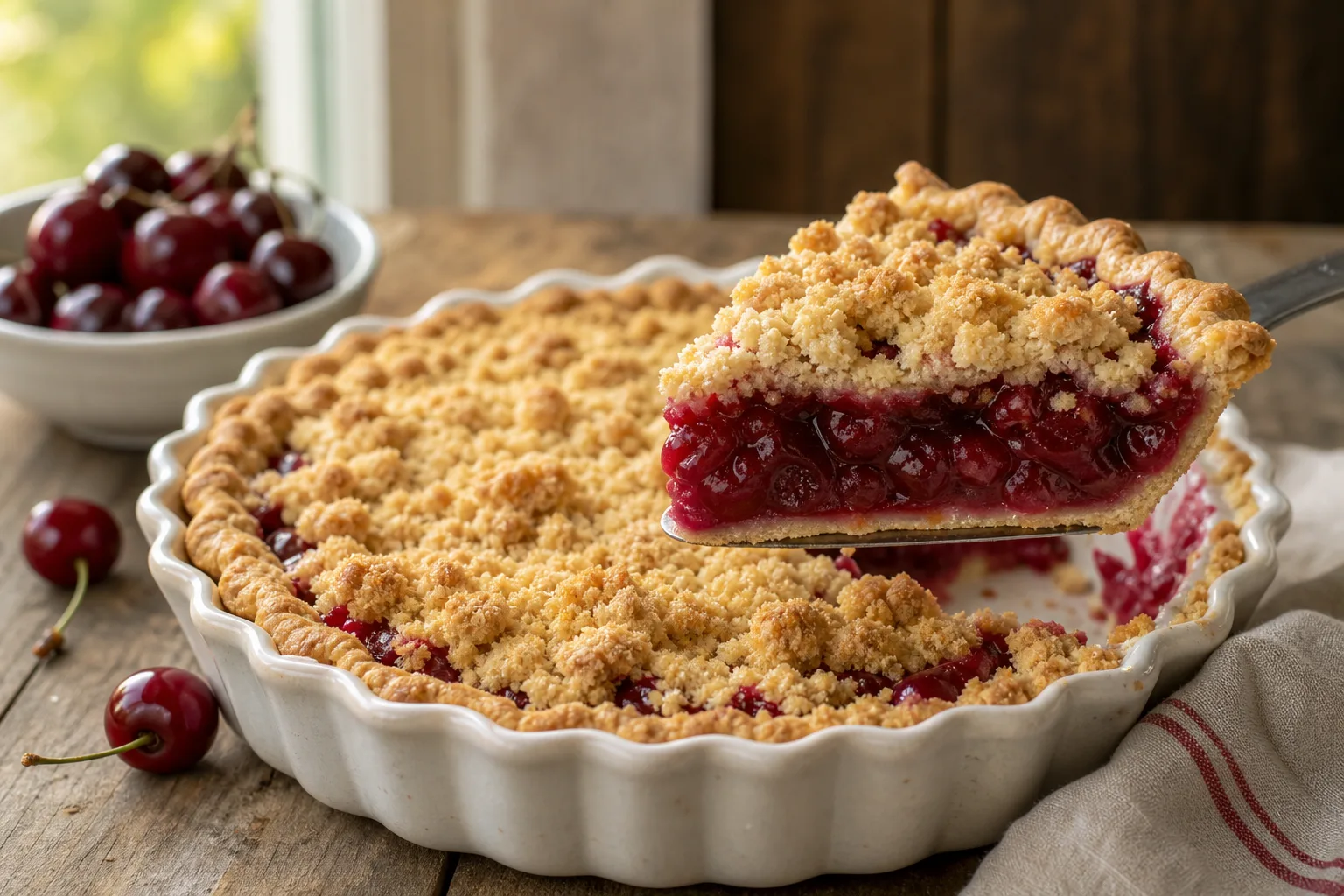
Cherry crumb pie with one bottom crust and a buttery crumb top that lets steam escape, so a very juicy filling sets instead of flooding the slice.
Ingredients
- 1 1/4 cups all-purpose flour
- 1/2 teaspoon salt
- 1 tablespoon granulated sugar
- 1/2 cup (1 stick) cold unsalted butter, cut into small cubes
- 3 to 4 tablespoons ice water
- 2 pounds sour or sweet cherries, pitted (about 5 cups)
- 2/3 cup granulated sugar, or 1/2 cup if using sweet cherries
- 1/4 cup cornstarch
- 1/4 teaspoon salt
- 1/2 teaspoon almond extract (optional)
- 1 tablespoon lemon juice
- 1 tablespoon cold butter, cut into small bits
- 1 cup all-purpose flour
- 1/2 cup packed light brown sugar
- 1/4 cup granulated sugar
- 1/2 teaspoon ground cinnamon
- 1/4 teaspoon salt
- 1/2 cup (1 stick) unsalted butter, melted and slightly cooled
Instructions
- Make the crust. Whisk the flour, salt and sugar together, then work in the cold butter with your fingertips or a pastry blender until the largest pieces are the size of peas. Sprinkle in the ice water a tablespoon at a time, tossing until the dough just holds together when pinched. Shape it into a disk, wrap it, and chill for at least 1 hour.
- Roll the dough on a floured surface into a 12-inch circle, about 1/8 inch thick. Ease it into a 9-inch pie plate, trim the overhang to 1 inch, fold it under, and crimp the edge. Freeze the shell for 20 minutes while the oven heats.
- Place a rack in the lower third of the oven and heat to 425°F. Put a rimmed baking sheet on the rack to heat as well. It catches drips and gives the bottom crust a hot surface to start on.
- Make the filling. Toss the pitted cherries with the sugar, cornstarch, salt, almond extract and lemon juice. Let them sit for 10 minutes so the sugar begins to draw out juice and the cornstarch hydrates.
- Make the crumb. Stir the flour, both sugars, cinnamon and salt together, then pour in the melted butter and mix with a fork. Press handfuls into clumps and break them into pieces ranging from pea-sized to about the size of a walnut. Those larger clumps give you the craggy texture.
- Pour the cherries and all of their juice into the frozen shell and dot with the cold butter bits. Scatter the crumb evenly over the top, leaving no bare patches near the edge, but do not pack it down. Loose crumb is what lets steam through.
- Set the pie on the preheated baking sheet and bake at 425°F for 20 minutes, until the crumb starts to turn golden. Reduce the oven to 350°F and bake another 45 to 50 minutes. The pie is done when the juices bubble thickly and slowly through the crumb in the center, not just around the edges, and the topping is deep golden brown.
- If the crumb or crust edge is browning faster than the filling is bubbling, tent the pie loosely with foil for the last 20 minutes or so.
- Cool the pie on a wire rack for at least 4 hours before slicing. The cornstarch needs this time to finish setting, and a pie cut warm will run no matter how well you baked it.
Notes
- Built for a 9-inch standard (not deep-dish) pie plate and about 2 pounds of pitted cherries, which is roughly 5 cups.
The first cherry pie I ever made had a full top crust, and I was proud of it for about ten minutes. Then I cut into it. Cherry juice poured across the board, the bottom crust floated in it, and the lid sagged into a hollow where the filling had been. The fruit had cooked down by a third and left a gap under the dome.
Cherries are one of the juiciest fruits you can put in a pie. Sour cherries especially release a startling amount of liquid once they heat up. A solid top crust seals that liquid in with all its steam, which is exactly the opposite of what you want. A crumb topping solves the problem in a different way: it is a loose layer of butter, flour and sugar that steam passes straight through.
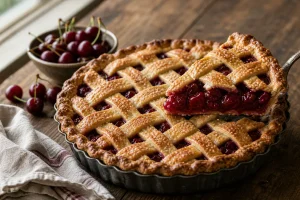
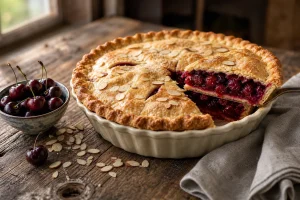
This is a one-crust pie. You roll out a single bottom crust, pile in the cherries, scatter the crumb over the top, and bake. There is no lattice to weave and no vents to cut. If you have been avoiding cherry pie because the top crust looks fussy, this is the version I would start with.
Why This Works
A solid top crust is a lid. It holds steam against the fruit, the filling stays loose and soupy, and the juice has nowhere to go but down into the bottom crust. A crumb topping is full of gaps, so steam leaves as fast as the cherries make it. The filling reduces and thickens in the oven instead of simmering under a cover, and the crumb itself bakes crisp because it is above the steam, not sitting in it.
Ingredients
Built for a 9-inch standard (not deep-dish) pie plate and about 2 pounds of pitted cherries, which is roughly 5 cups.
For the Crust
- 1 1/4 cups all-purpose flour
- 1/2 teaspoon salt
- 1 tablespoon granulated sugar
- 1/2 cup (1 stick) cold unsalted butter, cut into small cubes
- 3 to 4 tablespoons ice water
For the Filling
- 2 pounds sour or sweet cherries, pitted (about 5 cups)
- 2/3 cup granulated sugar, or 1/2 cup if using sweet cherries
- 1/4 cup cornstarch
- 1/4 teaspoon salt
- 1/2 teaspoon almond extract (optional)
- 1 tablespoon lemon juice
- 1 tablespoon cold butter, cut into small bits
For the Crumb Topping
- 1 cup all-purpose flour
- 1/2 cup packed light brown sugar
- 1/4 cup granulated sugar
- 1/2 teaspoon ground cinnamon
- 1/4 teaspoon salt
- 1/2 cup (1 stick) unsalted butter, melted and slightly cooled
Easy Swap
Sweet cherries work, but cut the sugar to 1/2 cup and add an extra tablespoon of lemon juice so the flavor does not go flat. Frozen pitted cherries also work. Do not thaw them first, toss them straight with the sugar mixture, and expect to add 10 minutes to the bake.
How to Make It
Prep: 40 minutes | Bake: 70 minutes | Cool or chill: 4 hours | Serves: 8 slices
- Make the crust. Whisk the flour, salt and sugar together, then work in the cold butter with your fingertips or a pastry blender until the largest pieces are the size of peas. Sprinkle in the ice water a tablespoon at a time, tossing until the dough just holds together when pinched. Shape it into a disk, wrap it, and chill for at least 1 hour.
- Roll the dough on a floured surface into a 12-inch circle, about 1/8 inch thick. Ease it into a 9-inch pie plate, trim the overhang to 1 inch, fold it under, and crimp the edge. Freeze the shell for 20 minutes while the oven heats.
- Place a rack in the lower third of the oven and heat to 425°F. Put a rimmed baking sheet on the rack to heat as well. It catches drips and gives the bottom crust a hot surface to start on.
- Make the filling. Toss the pitted cherries with the sugar, cornstarch, salt, almond extract and lemon juice. Let them sit for 10 minutes so the sugar begins to draw out juice and the cornstarch hydrates.
- Make the crumb. Stir the flour, both sugars, cinnamon and salt together, then pour in the melted butter and mix with a fork. Press handfuls into clumps and break them into pieces ranging from pea-sized to about the size of a walnut. Those larger clumps give you the craggy texture.
- Pour the cherries and all of their juice into the frozen shell and dot with the cold butter bits. Scatter the crumb evenly over the top, leaving no bare patches near the edge, but do not pack it down. Loose crumb is what lets steam through.
- Set the pie on the preheated baking sheet and bake at 425°F for 20 minutes, until the crumb starts to turn golden. Reduce the oven to 350°F and bake another 45 to 50 minutes. The pie is done when the juices bubble thickly and slowly through the crumb in the center, not just around the edges, and the topping is deep golden brown.
- If the crumb or crust edge is browning faster than the filling is bubbling, tent the pie loosely with foil for the last 20 minutes or so.
- Cool the pie on a wire rack for at least 4 hours before slicing. The cornstarch needs this time to finish setting, and a pie cut warm will run no matter how well you baked it.
Don’t Do This
Do not press the crumb down into a compact layer to make it look neat. Packed crumb behaves like a solid lid, and you are right back to trapped steam and a soupy center. Keep it loose and let it look rough.
Can You Make This Pie Ahead?
Not Fully — Here Is What You Can Prep
The dough, the crumb and the shell can all be staged days ahead, but the pie itself should be assembled and baked on the day you want to serve it, then cooled for several hours.
Pie dough keeps well in the refrigerator for up to 3 days, or in the freezer for a month if wrapped tightly. You can also roll and fit the crust into the pie plate, wrap the whole plate, and freeze it for up to a month. Bake from frozen with no thawing. The crumb topping also keeps: store it in an airtight container in the refrigerator for 3 days or the freezer for a month, and break it up with your fingers before using.
What I would not do is assemble the pie and leave it unbaked. Once the sugar and cornstarch meet the cherries, they start pulling juice out and the filling turns watery within an hour or two. That wet filling then soaks into the bottom crust before it ever reaches the oven. Keep the cherries tossed with the sugar mixture only until you are ready to fill and bake.
A baked pie holds at room temperature for the day, covered loosely, and is best that day. Leftovers go in the refrigerator for up to 3 days. The crumb softens a little in the cold, and you can crisp it by warming slices in a 325°F oven for 10 minutes.
Why a Crumb Top Suits Cherries
Think about what happens inside a pie as it bakes. The fruit heats, its cell walls break down, and it releases juice and water vapor. A fruit like apple is dense and gives off liquid slowly. Cherries are thin-skinned, full of water, and give it up quickly, so you get a lot of liquid at once, early in the bake.
With a solid top crust, all of that vapor is trapped. The pie behaves like a pressure-cooker with a loose lid. The filling stays at a simmer under the dough, juice has plenty of time to soak the bottom, and the top crust itself can steam from underneath and turn pale and gummy. Cutting vents helps, but a handful of slits is a small exit for a very wet pie.
A crumb topping has thousands of tiny gaps. Steam rises through it continuously, the surface of the filling is exposed to the oven’s dry heat, and the liquid reduces as it bakes. You are, in effect, reducing the filling in place while the crumb crisps above it.
This is also why crumb is the forgiving choice. If you misjudge the thickener by a spoonful, or your cherries are juicier than mine were, a crumb pie still tends to bake through to a sliceable result. A lidded pie with the same mistake is much more likely to collapse.
Margaret’s Tip
If your cherries are especially juicy, drain them in a colander for 10 minutes after tossing with sugar and add about half of the drained liquid back. You keep the flavor but cut the flood.
Building a Crumb That Stays Crisp
The crumb is where most people go wrong, so it is worth being specific. I use melted butter, not cold. Cold butter rubbed into flour gives you a sandy, short topping that is good on a streusel muffin. Melted butter coats the flour and sugar and lets you press the mixture into clumps, which bake into the craggy, crunchy pieces you want on a pie.
The ratio matters too. A crumb that is too buttery turns greasy and spreads into a sheet. One with too little butter stays dry and powdery and will not clump. At 1 cup of flour, 3/4 cup total sugar and a half cup of butter, I get a mixture that holds together when squeezed and breaks apart again when you crumble it.
Make clumps of different sizes. The fine crumb fills gaps and browns quickly. The bigger clumps stay a little chewy in the center and give the topping its character. Scatter them from a height so they land loosely, and cover the fruit all the way to the edge of the crust so no cherries are left exposed to scorch.
The brown sugar in the topping matters more than you would think. It adds moisture that keeps the crumb tender inside, and it caramelizes at the edges for a toffee-like crunch that plays well against tart cherries.
Don’t Do This
Do not skip the long cooling time because the pie smells ready. Cornstarch fills do not finish thickening until they cool. A pie sliced at the one-hour mark will look underbaked even if it is perfect.
Margaret’s Tip
Read the bubbles in the center of the pie, not at the edge. The edge always bubbles first because it is closest to the hot pan. When the middle is bubbling thickly and slowly, the cornstarch has fully activated and the filling will set.
Questions People Ask
Why is my cherry crumb pie runny?
Almost always one of three things: the pie was cut before it cooled for 4 hours, it did not bake long enough for the center to bubble thickly, or the cornstarch was too little for very juicy cherries. Wait for slow, thick bubbles in the middle, then cool fully. If your cherries are very wet, drain them briefly or add an extra teaspoon of cornstarch.
Can I use frozen cherries for crumb pie?
Yes. Use them straight from the freezer without thawing, toss with the sugar mixture, and pour into the crust right away. Thawed cherries give up their juice before the pie is in the oven and make the bottom crust soggy. Expect to bake about 10 minutes longer.
How do I keep the crumb topping from burning?
Tent the pie loosely with foil once the crumb is a deep golden color, usually around the 45 to 50 minute mark. Dropping the oven from 425°F to 350°F after the first 20 minutes also keeps it from darkening before the filling is done.
About This Article

Written by Margaret Chen. Margaret Chen is a home baker and recipe developer with over 15 years of experience perfecting cookie recipes through rigorous testing and detailed experimentation. She tests every recipe multiple times, documents every variable, and applies the same rigor professional bakers use, with the warmth and accessibility of home baking. More about this site.
Scope and limits. Margaret is a home baker and recipe developer with no formal culinary training. Follow current food safety guidance for egg handling, storage, and anything you are serving to other people.
Verify this against a primary source
Specifics change, and your situation may differ from the one described here. These are the authorities worth checking directly:
- USDA FoodData Central — ingredient composition and nutrition data
- FoodSafety.gov — safe handling, storage and egg safety