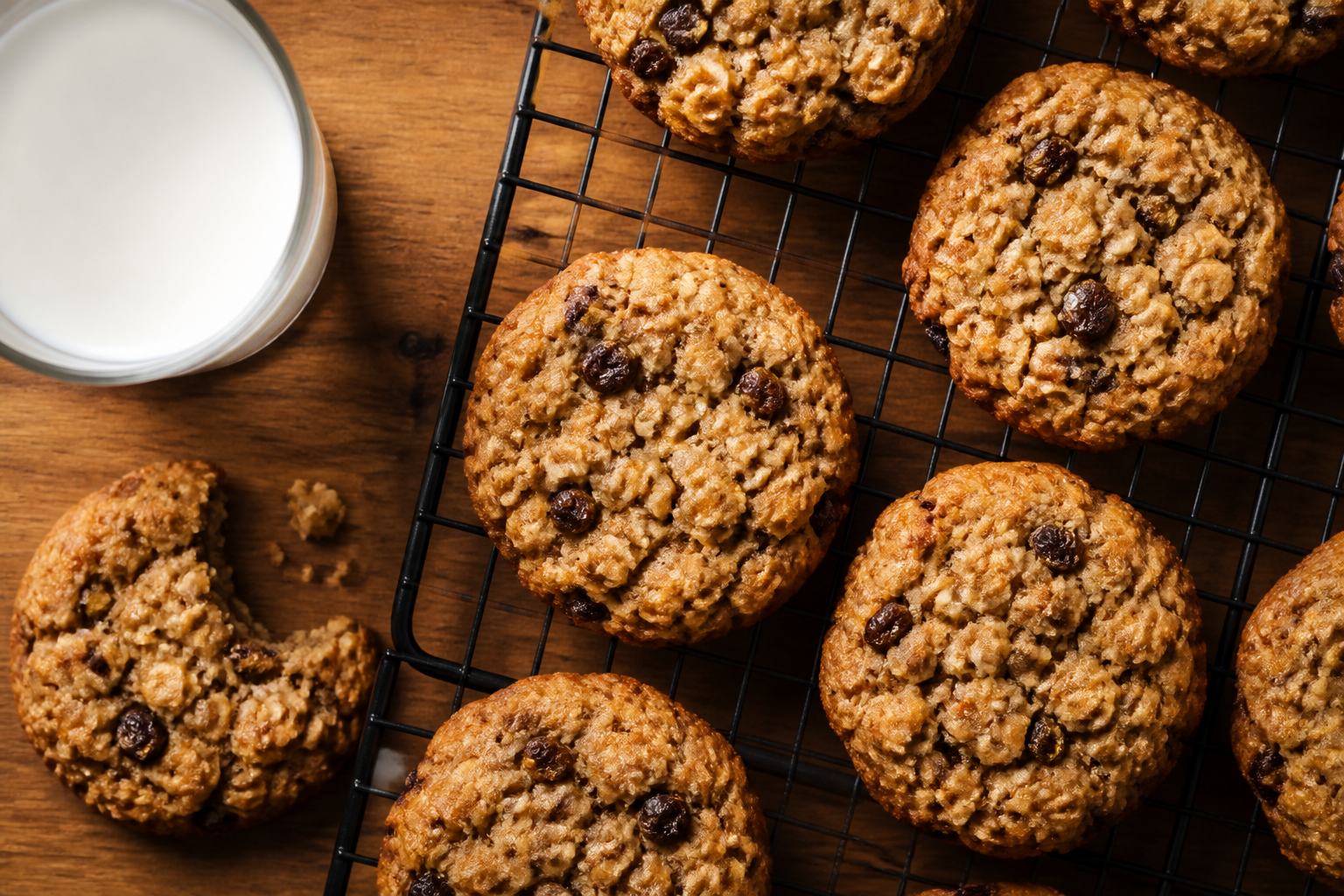

Classic Oatmeal Raisin Cookies
Chewy oatmeal cookies with plump raisins and warm cinnamon spice that stay soft for days.
Ingredients
- 1 cup (2 sticks) unsalted butter, room temperature
- 3/4 cup packed brown sugar
- 1/4 cup granulated white sugar
- 1 large egg
- 1 teaspoon vanilla extract
- 1 1/2 cups all-purpose flour
- 1 teaspoon baking soda
- 1/2 teaspoon salt
- 1 teaspoon ground cinnamon
- 1/8 teaspoon ground nutmeg
- 3 cups old-fashioned rolled oats
- 1 cup raisins
- Warm water or apple juice for plumping raisins
Instructions
- Place raisins in a small bowl and cover with warm water or apple juice.
- Let raisins soak for 5 to 10 minutes while you prepare other ingredients.
- Preheat oven to 350°F.
- Line baking sheets with parchment paper.
- In a large bowl, cream together room-temperature butter, brown sugar, and white sugar.
- Beat for 2 to 3 minutes until light and fluffy.
- Add egg and vanilla extract.
- Beat for 1 minute more.
- In a separate bowl, whisk together flour, baking soda, salt, cinnamon, and nutmeg.
- Add dry ingredients to butter mixture and stir until just combined.
- Fold in old-fashioned rolled oats gently.
- Drain raisins and pat dry with paper towel.
- Fold raisins into dough.
- If dough is too soft to scoop, refrigerate for 15 to 30 minutes.
- Using a cookie scoop, portion dough into 1.5-tablespoon portions.
- Space cookies 2 inches apart on prepared baking sheets.
- Bake for 10 to 12 minutes, until edges are golden and set but centers still look slightly underdone.
- Leave cookies on hot baking sheet for 2 to 3 minutes.
- Transfer to cooling rack.
Notes
- Use old-fashioned rolled oats, not quick or instant oats, for proper texture.
- Plumping raisins in warm water prevents them from pulling moisture from the dough.
- Pull cookies from oven when centers look slightly underdone; they finish baking on the hot sheet.
- Store in an airtight container at room temperature for up to 5 days.
If you’ve read my recipe for bakery-style oatmeal cookies without raisins, you already know I developed that one specifically for the raisin-haters in my life—and there are more of them than I expected. I stand by that recipe completely. It’s been tested dozens of times, and it delivers exactly what it promises: a chewy, buttery oatmeal cookie that proves raisins aren’t essential to greatness.
But here’s the truth: that raisin-free version is the departure. This is the original. This is the classic oatmeal raisin cookie recipe I grew up baking with my grandmother, the one my mother still makes every October, and the one I’ve spent fifteen years refining through meticulous testing. Every single oatmeal cookie I develop—every twist, every variation, every “better” version—gets judged against this one.
For me, the ideal classic oatmeal raisin cookie recipe has plump, sweet raisins that taste like they belong there, not an afterthought. It has a warm cinnamon embrace. Most importantly, it has a genuine chewy texture that persists for days, not a cakey or crispy bite that disappears after the first few hours.
If that sounds like the cookie you’ve been searching for, this is the post for you.
What Makes an Oatmeal Raisin Cookie “Classic”
The word “classic” isn’t accidental here. A truly classic oatmeal raisin cookie recipe is built on three non-negotiable foundations: the right oats, the right raisins, and the right spicing. Miss any one of these, and you have a good cookie. Hit all three, and you have something that tastes like home.
Let me start with oats—because I learned this the hard way.
Early in my recipe testing days, I made a batch using quick oats because I had them on hand. The batter looked fine. The cookies baked at the right temperature for the right time. But when I bit into one, it was mushy. Not chewy—mushy. The texture was almost pasty, like wet sand. The oats had broken down too much during mixing and baking, and there was zero structure left to give the cookie that satisfying bite.
I immediately switched to old-fashioned rolled oats, and the difference was immediate and stark. Rolled oats have more surface area intact than quick oats but retain their structure far better than instant oats do. When you use old-fashioned rolled oats in a chewy oatmeal raisin cookie recipe, each oat flake survives the bake relatively intact. That means texture. That means chew.
I use Quaker Old Fashioned Rolled Oats for almost every batch I make now. They’re reliable, widely available, and they’ve never let me down across hundreds of cookies. If you need a budget option, Bob’s Red Mill Organic Old Fashioned Rolled Oats performs beautifully too—I’ve tested both side by side.
Beyond oats, a classic oatmeal raisin cookie recipe relies on warm, gentle spicing. Cinnamon is essential—about one teaspoon per batch. A pinch of nutmeg (just 1/8 teaspoon) deepens the flavor without becoming noticeable or overwhelming. This isn’t a spice cookie. The spices are there to enhance the buttery, oaty base, not to shout.
Then come the raisins. This is where texture and flavor intersect in the most critical way.
The Chewy Texture Secret
If mushy oats taught me about structure, hard, leathery raisins taught me about moisture management. In my early attempts at a classic oatmeal raisin cookie recipe, I grabbed raisins straight from the box and tossed them into the dough. The cookies baked fine. But when I bit into one the next day, the raisins were tough and dry—almost inedible. They’d pulled moisture from the surrounding dough during baking, leaving little dry pockets around each raisin.
The science is straightforward: raisins are already dehydrated. When they’re baked into a warm cookie, they pull additional moisture from the dough around them to rehydrate themselves. The result is drier raisins and a drier cookie. The solution is equally simple: plump the raisins before baking.
I soak my raisins in warm water for 5 to 10 minutes before folding them into the dough. Sometimes I use warm apple juice instead—it adds a subtle sweetness that feels almost nostalgic. After soaking, I drain them completely (a fine-mesh strainer works perfectly) and pat them dry with a paper towel. Now they’re plump and hydrated. They won’t pull extra moisture from the dough. Instead, they’ll release that moisture slowly throughout baking and storage, actually contributing to the chewy texture of the finished cookie.
The second secret to chewy oatmeal raisin cookies is brown sugar. Specifically, using more brown sugar than white sugar. Brown sugar contains molasses, which adds both moisture and a subtle caramel flavor that encourages chewiness. In my recipe, I use 3/4 cup brown sugar and only 1/4 cup white sugar. White sugar promotes spread and crispness; brown sugar promotes chew and density.
The final secret is underbaking—but doing it strategically. I pull my cookies from the oven when the centers still look slightly underdone, almost like they need another 30 seconds. Then I let them rest on the hot baking sheet for 2 to 3 minutes. They continue baking gently from residual heat, which sets their structure without drying them out. This is how you get that perfect chewy center that stays chewy for days.
My Method Step by Step
Every classic oatmeal raisin cookie recipe lives or dies in its execution. Here’s exactly how I make mine.
I start by prepping the raisins: 1 cup of raisins go into a small bowl, covered with warm water or warm apple juice. I let them sit for 5 to 10 minutes while I gather the rest of my ingredients. Meanwhile, I preheat my oven to 350°F and line my baking sheets with parchment paper.
Next, I cream together butter and sugar. I use room-temperature butter (left on the counter for about an hour) and beat it with both the brown sugar and white sugar for about 2 to 3 minutes, until the mixture is light and fluffy. This is when air gets incorporated into the dough, which helps with both texture and rise. I add the egg and vanilla extract and beat for another minute.
In a separate bowl, I whisk together my dry ingredients: all-purpose flour, baking soda, salt, cinnamon, and nutmeg. I add this mixture to the butter mixture in a single addition and stir until just combined. I don’t overmix—that’s the mistake most home bakers make. Overmixing develops gluten, which makes cookies tough and cakey.
Now comes the oats. I fold in the old-fashioned rolled oats last, stirring gently until they’re fully incorporated. Then I drain the raisins (discarding the soaking liquid), pat them dry, and fold them in as well.
If the dough feels too soft to scoop, I refrigerate it for 15 to 30 minutes. A sturdy cookie scoop helps me portion the dough evenly—about 1.5 tablespoons per cookie. I space them about 2 inches apart on the prepared baking sheets.
Into the 350°F oven they go for 10 to 12 minutes. The exact timing depends on your oven, so watch for the visual cue: the edges should look set and lightly golden, but the centers should still look slightly underdone. They should look like they need another minute. Pull them now.
Leave the cookies on the hot baking sheet for 2 to 3 minutes. They’ll continue to bake and set. Then transfer them to a cooling rack. This is the moment when the magic happens—as they cool, the structure fully sets while the interior remains soft and chewy.
Classic Oatmeal Raisin Cookie Recipe
Yield: 36 to 40 cookies | Prep Time: 15 minutes | Bake Time: 10 to 12 minutes per batch
Common Mistakes I’ve Made
In fifteen years of baking, I’ve made every mistake possible with chewy oatmeal raisin cookies. Let me save you the trouble.
Using quick oats instead of old-fashioned rolled oats. I’ve mentioned this already, but it bears repeating: quick oats break down during mixing and baking, resulting in a mushy, pasty texture instead of the gentle chew you’re after. They also contribute less structural integrity to the dough. Stick with old-fashioned rolled oats every single time.
Skipping the raisin-plumping step. This is the second-most common mistake I see. Raisins added straight from the box will pull moisture from your dough, leaving hard, leathery raisins and a drier surrounding cookie. The 5 to 10 minute soak in warm water takes almost no extra time and transforms the final texture completely.
Overbaking past the ideal window. Even 2 minutes past the ideal baking time can shift your classic oatmeal raisin cookie recipe from chewy to cakey and dry. The cookies should look slightly underdone when you pull them from the oven. They finish baking on the hot sheet. This is not a suggestion—this is the difference between a great cookie and a disappointing one.
Using all white sugar instead of the brown-white combination. I understand the temptation to simplify, but brown sugar’s molasses content is essential to the chewy texture. Using all white sugar will give you a crisper, more spread-out cookie. Stick with the ratio: 3/4 cup brown, 1/4 cup white.
Overmixing the dough. Once you add the flour, mix until just combined—no more. Overmixing develops gluten, which toughens the cookie. You want a tender crumb, not a tough bite.
Why I Still Make the Raisin-Free Version, Too
I want to circle back to that raisin-free recipe I mentioned at the start, because I think it deserves an honest moment here.
I developed my bakery-style oatmeal cookie recipe without raisins for a specific reason: some people genuinely, deeply dislike raisins in their cookies. That’s not a character flaw. That’s a preference. And that recipe works beautifully for them. I’ve tested it dozens of times, and it stands up to this classic oatmeal raisin cookie recipe on its own merits.
But this—this chewy, raisin-studded version—is the original. It’s the recipe my grandmother taught my mother, and the one my mother taught me. Every oatmeal cookie I’ve ever created gets measured against it. Specifically, I ask myself: does this new version improve upon the classic, or am I just changing it for the sake of being different?
For the raisin haters, the answer is yes—the raisin-free version improves their experience because it gives them a cookie they’ll actually enjoy. For everyone else, this is the recipe I come back to. This is the one that tastes like home.
The Cookie That Started It All
My grandmother made these cookies every year around Thanksgiving and Christmas. She had a small farmhouse kitchen with an old electric oven that baked unevenly, so she rotated the baking sheets halfway through. Even with that awkward oven, the cookies were perfect—chewy, dotted with plump raisins, filled with the warm spice of cinnamon and nutmeg.
When I was old enough to help, she showed me the three things that mattered: the oats (always old-fashioned rolled oats), the raisins (always plumped in warm water), and the timing (always pulled from the oven when they looked slightly underdone). She never called it a “technique” or explained the science. She just showed me, year after year, until the method became muscle memory.
I still make this classic oatmeal raisin cookie recipe exactly the way she taught me. The recipe hasn’t changed in decades because it doesn’t need to. It was right the first time—not because my grandmother was a food scientist, but because she understood what made a cookie worth eating: good ingredients, treated with respect, and baked with attention to the exact moment they reached perfection.
I hope this recipe becomes part of your baking rotation the way it’s been part of mine. And I hope that someday, if you teach someone else to make these cookies, you’ll pass along the same three things my grandmother passed along to me: the importance of old-fashioned rolled oats, the magic of plumping raisins, and the courage to pull the cookies from the oven when they still look slightly underdone.
That’s how good cookies survive generations.