
Sour Cherry Pie With a Real Lattice Top
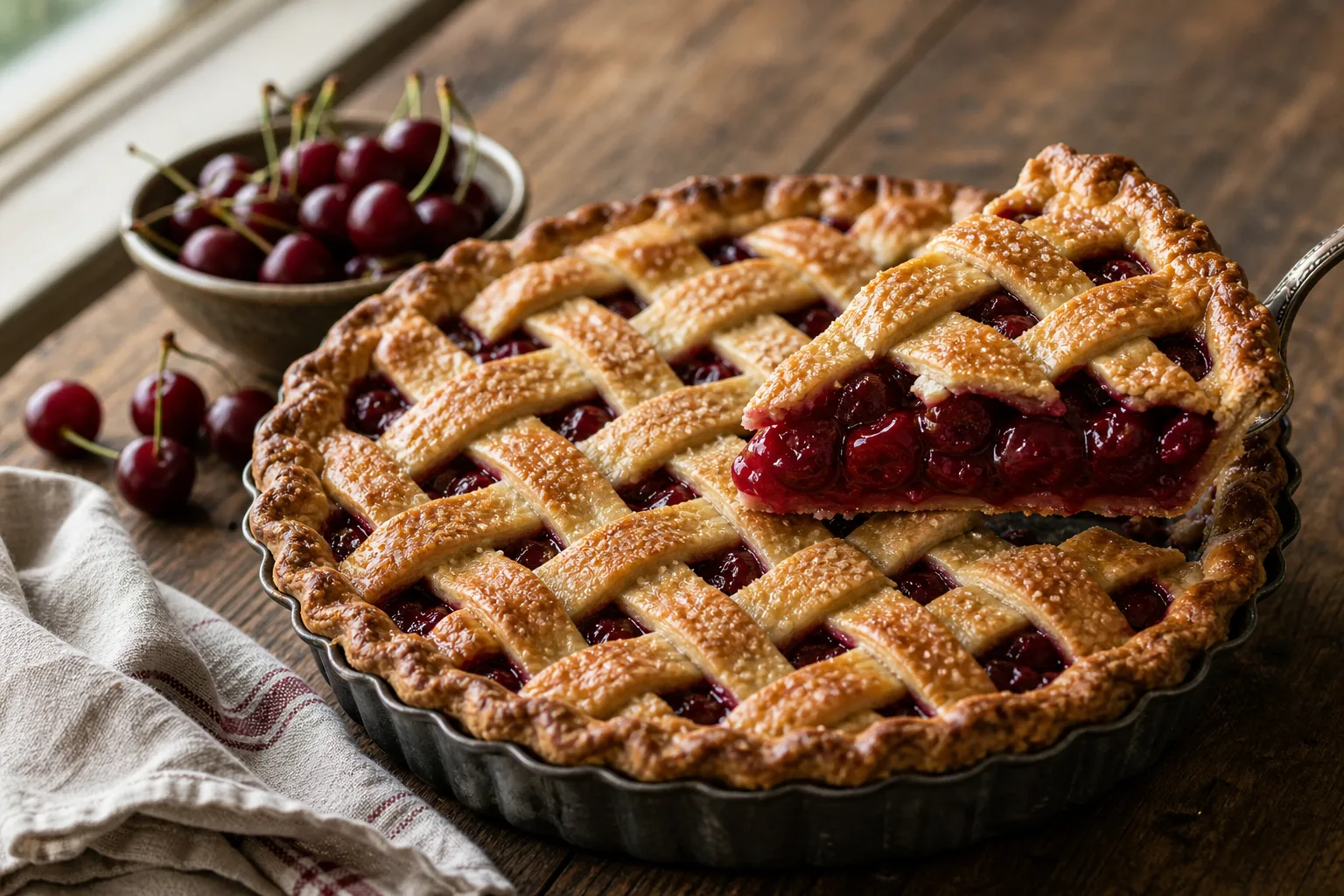
Sour cherry pie with a woven lattice that holds its shape, plus how to weave it and why tart cherries need less thickener than you'd expect.
Ingredients
- 2 1/2 cups (315 g) all-purpose flour, plus more for rolling
- 1 tablespoon granulated sugar
- 1 teaspoon fine salt
- 1 cup (2 sticks, 226 g) unsalted butter, very cold, cut into 1/2-inch cubes
- 6 to 8 tablespoons ice water
- 6 cups (about 2 1/2 pounds) pitted sour cherries, fresh or frozen and thawed
- 1 cup (200 g) granulated sugar
- 3 tablespoons cornstarch
- 1 tablespoon fresh lemon juice
- 1/4 teaspoon fine salt
- 1/4 teaspoon pure almond extract (optional)
- 1 tablespoon unsalted butter, cut into small bits
- 1 large egg beaten with 1 tablespoon water or milk
- 1 tablespoon coarse sugar
Instructions
- Make the dough: whisk the flour, sugar and salt together. Work in the cold butter with your fingertips or a pastry cutter until the largest pieces are the size of peas and some are flattened into flakes. Sprinkle in 6 tablespoons of ice water and toss with a fork, adding more a tablespoon at a time until the dough holds when squeezed. Divide into two discs, one slightly larger, wrap, and chill at least 1 hour.
- Macerate the cherries: toss the cherries with the sugar, lemon juice and salt in a large bowl and let them sit for 30 minutes, stirring once or twice, until a deep pool of juice collects at the bottom.
- Set the oven rack in the lower third and heat the oven to 425°F, with a rimmed baking sheet on the rack to catch drips and give the bottom crust a hot surface.
- Thicken the juice: drain the cherries through a sieve into a saucepan, pressing lightly. Whisk the cornstarch into the juice, bring to a simmer over medium heat, and cook for 3 to 4 minutes, whisking, until glossy and noticeably thick. Off the heat, stir in the almond extract if using, then fold the cherries back in. Let the filling cool while you roll the crust.
- Roll the larger disc on a floured surface to a 12-inch round about 1/8 inch thick. Ease it into a 9-inch pie pan, leaving about 1 inch of overhang, and refrigerate while you prepare the lattice.
- Cut the strips: roll the second disc into a rough 11 by 13-inch rectangle, 1/8 inch thick. Using a ruler and a pizza wheel, cut ten strips, each 1 inch wide. Slide them onto a parchment-lined baking sheet, keeping them flat and not overlapping if possible, and chill for 15 to 20 minutes until firm.
- Fill the chilled shell with the cherry mixture, mounding it slightly in the middle, and dot with the butter.
- Weave the lattice: lay five strips across the pie, parallel and about 1/2 inch apart. Fold back the second and fourth strips to the center. Lay a strip across the middle, perpendicular to the others, then unfold the two strips over it. Now fold back the first, third and fifth strips, lay the next perpendicular strip about 1/2 inch from the first, and unfold. Repeat outward to one side, then rotate the pie and finish the other side. Refrigerate the finished pie for 15 minutes if the strips feel soft.
- Seal the edge: trim the strip ends so they hang over the rim by the same amount as the bottom crust, about 1 inch. Fold the bottom crust up and over the ends of the strips, pressing firmly to seal, then crimp. Brush the lattice and edge with the egg wash and sprinkle with the coarse sugar.
- Bake at 425°F for 20 minutes. Reduce the heat to 375°F and bake 40 to 45 minutes more, until the crust is deep golden and the filling bubbles slowly and thickly through the center gaps, not just at the edges. If the rim darkens too fast, shield it with foil.
- Cool the pie on a wire rack for at least 4 hours before slicing. The starch finishes setting as the filling cools, and a warm slice will run.
Notes
- Makes one 9-inch pie. You need about 2 1/2 pounds of sour cherries before pitting, or roughly 6 cups pitted.
The first lattice I ever wove looked lovely going into the oven and like a collapsed picket fence coming out. The strips had warmed on the counter, stretched when I lifted them, and sagged into the filling. The cherry juice, which I had not thickened properly, boiled up through the gaps and glued everything flat.
I have made this pie enough times now that both halves are routine: the weave and the filling. Two things decide whether it works. One is how you cut, chill and interlace the strips. The other is how much thickener you put into cherries that look far wetter than they actually behave.
This is a sour cherry pie, Montmorency if you can find them, with a sharp-edged lattice and a filling that slices cleanly and stays juicy. Everything below is about those two things, so you can stop guessing at either.
Why This Works
A lattice only looks good if the strips stay cold, flat and evenly spaced until the butter in them sets in the oven, and a sour cherry filling only slices if the starch fully thickens before the pie leaves it. Sour cherries release a flood of juice once sugar hits them, which tempts you to add far too much starch. Because the lattice lets steam escape, much of that liquid cooks off on its own. I pour off the juice, cook it down with a modest amount of cornstarch, and fold it back in, which gets a clean slice from about three tablespoons.
Ingredients
Makes one 9-inch pie. You need about 2 1/2 pounds of sour cherries before pitting, or roughly 6 cups pitted.
For the Crust
- 2 1/2 cups (315 g) all-purpose flour, plus more for rolling
- 1 tablespoon granulated sugar
- 1 teaspoon fine salt
- 1 cup (2 sticks, 226 g) unsalted butter, very cold, cut into 1/2-inch cubes
- 6 to 8 tablespoons ice water
For the Filling
- 6 cups (about 2 1/2 pounds) pitted sour cherries, fresh or frozen and thawed
- 1 cup (200 g) granulated sugar
- 3 tablespoons cornstarch
- 1 tablespoon fresh lemon juice
- 1/4 teaspoon fine salt
- 1/4 teaspoon pure almond extract (optional)
- 1 tablespoon unsalted butter, cut into small bits
To Finish
- 1 large egg beaten with 1 tablespoon water or milk
- 1 tablespoon coarse sugar
Easy Swap
Frozen sour cherries work well. Thaw them completely in a colander over a bowl, then add the collected juice to the maceration juice before thickening. Jarred sour cherries packed in water also work if you drain them thoroughly, but cut the sugar to 3/4 cup.
How to Make It
Prep: 45 minutes | Bake: 60 minutes | Cool or chill: 4 hours | Serves: 8 slices
- Make the dough: whisk the flour, sugar and salt together. Work in the cold butter with your fingertips or a pastry cutter until the largest pieces are the size of peas and some are flattened into flakes. Sprinkle in 6 tablespoons of ice water and toss with a fork, adding more a tablespoon at a time until the dough holds when squeezed. Divide into two discs, one slightly larger, wrap, and chill at least 1 hour.
- Macerate the cherries: toss the cherries with the sugar, lemon juice and salt in a large bowl and let them sit for 30 minutes, stirring once or twice, until a deep pool of juice collects at the bottom.
- Set the oven rack in the lower third and heat the oven to 425°F, with a rimmed baking sheet on the rack to catch drips and give the bottom crust a hot surface.
- Thicken the juice: drain the cherries through a sieve into a saucepan, pressing lightly. Whisk the cornstarch into the juice, bring to a simmer over medium heat, and cook for 3 to 4 minutes, whisking, until glossy and noticeably thick. Off the heat, stir in the almond extract if using, then fold the cherries back in. Let the filling cool while you roll the crust.
- Roll the larger disc on a floured surface to a 12-inch round about 1/8 inch thick. Ease it into a 9-inch pie pan, leaving about 1 inch of overhang, and refrigerate while you prepare the lattice.
- Cut the strips: roll the second disc into a rough 11 by 13-inch rectangle, 1/8 inch thick. Using a ruler and a pizza wheel, cut ten strips, each 1 inch wide. Slide them onto a parchment-lined baking sheet, keeping them flat and not overlapping if possible, and chill for 15 to 20 minutes until firm.
- Fill the chilled shell with the cherry mixture, mounding it slightly in the middle, and dot with the butter.
- Weave the lattice: lay five strips across the pie, parallel and about 1/2 inch apart. Fold back the second and fourth strips to the center. Lay a strip across the middle, perpendicular to the others, then unfold the two strips over it. Now fold back the first, third and fifth strips, lay the next perpendicular strip about 1/2 inch from the first, and unfold. Repeat outward to one side, then rotate the pie and finish the other side. Refrigerate the finished pie for 15 minutes if the strips feel soft.
- Seal the edge: trim the strip ends so they hang over the rim by the same amount as the bottom crust, about 1 inch. Fold the bottom crust up and over the ends of the strips, pressing firmly to seal, then crimp. Brush the lattice and edge with the egg wash and sprinkle with the coarse sugar.
- Bake at 425°F for 20 minutes. Reduce the heat to 375°F and bake 40 to 45 minutes more, until the crust is deep golden and the filling bubbles slowly and thickly through the center gaps, not just at the edges. If the rim darkens too fast, shield it with foil.
- Cool the pie on a wire rack for at least 4 hours before slicing. The starch finishes setting as the filling cools, and a warm slice will run.
Don’t Do This
Do not stretch the strips to reach the rim. Stretched dough snaps back in the oven, pulling the lattice out of shape and leaving gaps. If a strip is short, trim it to length and seal the ends under the edge.
Can You Make This Pie Ahead?
Yes — Here Is the Timeline
Bake the whole pie up to a day ahead and keep it loosely covered at room temperature, or freeze it fully assembled and unbaked, then bake straight from the freezer.
A baked pie actually improves overnight, because the filling finishes setting and the slices cut cleaner. Leave it loosely covered at room temperature for up to 24 hours. Past that, refrigerate it, and warm slices in a 325°F oven for 10 minutes to bring the crust back.
To freeze an unbaked pie, assemble and weave it, seal the edge, and freeze it uncovered on a baking sheet until solid, then wrap it well. Skip the egg wash until baking day. Bake from frozen at 425°F for 25 minutes, then at 375°F for about 55 minutes more, until the center gaps bubble thickly.
The dough keeps in the refrigerator for 2 days, and the cooked, thickened filling for 1 day. Cut strips can be chilled on parchment for several hours before weaving.
Cut Wide, Cut Cold: Getting the Strips Right
Lattice problems usually start before you weave anything. Roll the top dough to about 1/8 inch. Thinner than that and strips tear when you lift them. Thicker and the weave puffs up like a pillow and hides the cherries. A rough rectangle larger than the pie is all you need, since you are cutting straight lines anyway.
I cut ten strips, each 1 inch wide, using a ruler and a pizza wheel. That gives five across and five down, with gaps of about 1/2 inch, which is enough to show the filling and let steam out. Narrower strips look delicate but are fragile to handle and bake dry and hard. Strips wider than about 1 1/2 inches leave so few gaps that the pie behaves like it has a solid top, and the filling takes longer to reduce.
The step I used to skip is chilling the cut strips. Slide them onto parchment on a baking sheet and refrigerate for 15 to 20 minutes. Butter-firm dough bends cleanly and keeps its length. Warm dough stretches under its own weight as you lift it, and then shrinks back in the oven, which is what pulled my first lattice apart. If your kitchen is warm, chill the strips again for a few minutes halfway through the weave.
Why Sour Cherries Need Less Thickener Than the Bowl Suggests
After 30 minutes with the sugar, 2 1/2 pounds of cherries sit in a bowl that looks more like soup than pie filling. The instinct is to add five or six tablespoons of starch. I tested that early on, and the pie sliced neatly but the filling was gluey, dull and rubbery, with the cherry flavor muted.
The bowl overstates what the oven has to deal with. Much of that liquid is just water pulled out by the sugar. A lattice lets steam escape, so a good portion of that water cooks off as the pie bakes and the filling reduces on its own. A solid top crust traps all of it, which is why solid-top pies need more starch. If you swap this lattice for a solid top, add one more tablespoon.
My method is to drain the macerated cherries, then cook only that juice with the cornstarch on the stove until it turns glossy and thick, and fold the cherries back in. That does two things. It gelatinizes the starch before the pie goes in, so you are not relying on the oven to get there. Cornstarch needs to reach a boil to thicken fully, and a heavy filling inside a pie can take a long time to get there. It also lets you judge the thickness by eye. In my tests, two tablespoons slumped out of the slice, and five turned gummy. Three held the slice and still tasted like cherries.
The oven still has to finish the job, so watch for the right sign. Slow, thick bubbles breaking through the center gaps mean the filling has come to a boil, not just heated at the edges. If only the edges are bubbling, keep baking and shield the crust with foil.
Margaret’s Tip
A lattice lets steam out, but it also means the filling is exposed. Brush the strips with egg wash and set the pie on the preheated baking sheet. The sheet crisps the bottom crust and catches any cherry juice that bubbles over.
Questions People Ask
Why did my lattice strips tear when I lifted them?
Usually they were too thin, too warm, or both. Roll the dough to about 1/8 inch, cut the strips 1 inch wide, and chill them on parchment for 15 to 20 minutes before weaving. If a strip tears anyway, press the two pieces together and keep going. The weave hides the repair.
Should I change the thickener if I use a solid top instead of a lattice?
Add one extra tablespoon of cornstarch, for four in total. A solid top traps steam, so less liquid cooks off during baking. Cut several vents in the crust, and look for slow bubbling through them before taking the pie out.
Can I use sweet cherries instead of sour?
You can, but the pie changes. Sweet cherries have less acid, so cut the sugar to about 1/2 cup and raise the lemon juice to 2 tablespoons. They also release less juice, so the filling needs closer to 2 tablespoons of cornstarch. The flavor will be milder and less tart.
About This Article

Written by Margaret Chen. Margaret Chen is a home baker and recipe developer with over 15 years of experience perfecting cookie recipes through rigorous testing and detailed experimentation. She tests every recipe multiple times, documents every variable, and applies the same rigor professional bakers use, with the warmth and accessibility of home baking. More about this site.
Scope and limits. Margaret is a home baker and recipe developer with no formal culinary training. Follow current food safety guidance for egg handling, storage, and anything you are serving to other people.
Verify this against a primary source
Specifics change, and your situation may differ from the one described here. These are the authorities worth checking directly:
- USDA FoodData Central — ingredient composition and nutrition data
- FoodSafety.gov — safe handling, storage and egg safety