
Peach Crumb Pie: The Topping That Survives a Juicy Filling
A peach crumb pie where the topping stays crisp over a juicy filling. Here is why a thick butter crumb beats a thin one, and how to bake it.
Ingredients
- 1 1/4 cups all-purpose flour
- 1 teaspoon granulated sugar
- 1/2 teaspoon fine salt
- 1/2 cup (1 stick) cold unsalted butter, cut into 1/2-inch cubes
- 3 to 4 tablespoons ice water
- 1 1/2 cups all-purpose flour
- 2/3 cup packed light brown sugar
- 1/4 cup granulated sugar
- 1 teaspoon ground cinnamon
- 1/2 teaspoon fine salt
- 3/4 cup (1 1/2 sticks) cold unsalted butter, cut into 1/2-inch cubes
- 2 1/2 pounds ripe peaches (about 6 large), peeled, pitted and sliced 1/2 inch thick
- 1/2 cup granulated sugar
- 3 tablespoons cornstarch
- 1 tablespoon fresh lemon juice
- 1/4 teaspoon fine salt
- 1 teaspoon vanilla extract
- 1/4 teaspoon freshly grated nutmeg
Instructions
- Make the crust. Whisk the flour, sugar and salt in a large bowl. Work in the cold butter with your fingertips until the pieces range from pea-sized to small almond-sized. Sprinkle in the ice water 1 tablespoon at a time, tossing until the dough holds together when squeezed. Press into a disk, wrap, and chill at least 1 hour.
- Macerate the peaches. Toss the sliced peaches with the 1/2 cup sugar, lemon juice and salt. Let them sit 30 minutes, stirring once, until the bowl holds a generous amount of syrup.
- Shape the shell. Roll the chilled dough to a 12-inch round, fit it into the pie plate, trim to a 1/2-inch overhang, fold under and crimp. Freeze the shell for 30 minutes.
- Par-bake. Heat the oven to 400°F with a rack in the lower third and a rimmed baking sheet on it. Line the frozen shell with parchment, fill with pie weights or dried beans, and bake 15 minutes. Remove the weights and bake 5 minutes more, until the bottom looks dry and pale gold. Lower the oven to 375°F.
- Make the crumb. Whisk the flour, both sugars, cinnamon and salt. Add the cold butter and pinch it between your fingertips into clumps ranging from pea-sized to hazelnut-sized, leaving visible pieces of butter. Stop before it looks like sand. Refrigerate until needed.
- Thicken the filling. Drain the peaches over a saucepan, pressing lightly; you should collect roughly 1/2 to 3/4 cup of syrup. Whisk the cornstarch into the syrup, add the vanilla and nutmeg, and simmer over medium heat, whisking, 2 to 3 minutes, until thick and glossy. Fold it back into the peaches and let the filling cool 10 minutes so it does not melt the butter in the crumb.
- Assemble. Spoon the filling into the hot par-baked shell, mounding it slightly. Pile the crumb over the top, covering the filling right to the crust edge, and mound it about 1 inch higher in the center. Pat it lightly with your palm; do not press it down hard.
- Bake. Set the pie on the hot baking sheet and bake at 375°F for 55 to 65 minutes. If the crumb is browning faster than the filling is bubbling, tent the pie loosely with foil after 35 minutes. It is done when the crumb is deep golden and the filling is bubbling thickly where it shows at the edges and through gaps in the crumb.
- Cool completely. Move the pie to a wire rack and let it cool at least 4 hours before cutting. The filling finishes setting and the crumb crisps as the steam stops.
Notes
- Makes one standard 9-inch pie plate, about 1 1/2 inches deep. Buy about 2 1/2 pounds of ripe, fragrant peaches; weight matters more than count because sizes vary so much.
The first peach crumb pie I made looked perfect for about ten minutes. Then I cut into it, and the topping, which had come out of the oven crisp and sandy, had slumped into a gray, gummy layer sitting on the filling. The peaches were great. The crumb was the problem.
Peaches are the juiciest pie fruit I bake with, and a crumb topping sits directly in the path of everything they give off. Steam rises from the filling for an hour, and the crumb is the first thing it hits. My fix was not a new topping flavor. It was a thicker topping, built from butter that stays in pieces, over a filling I thicken before it ever goes in the crust.
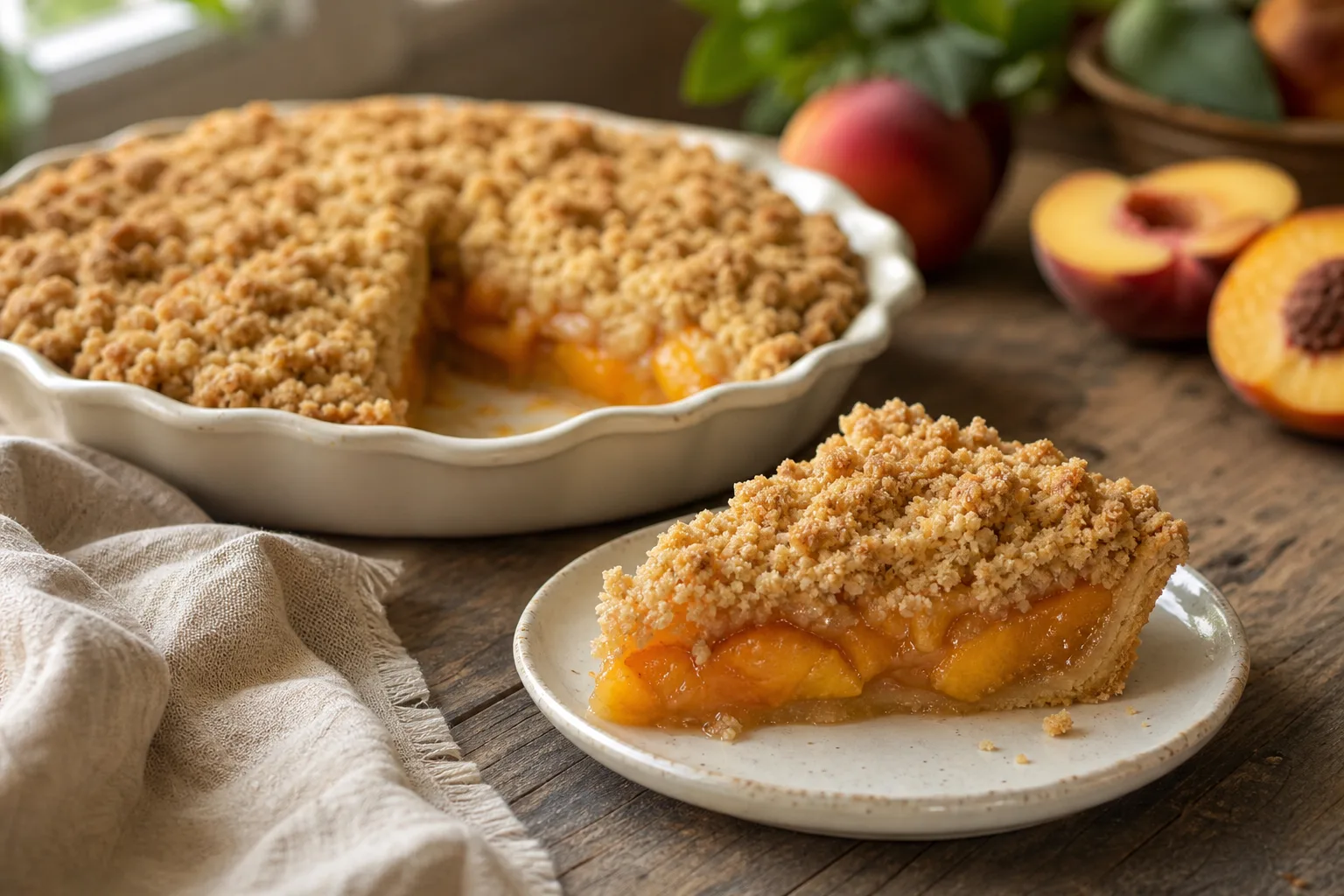
This pie is that fix. The crumb is deliberately generous, about an inch of it mounded in the center, because that depth is what keeps the surface crisp while the bottom layer takes the damage.
Why This Works
A crumb topping goes to paste when steam reaches dry flour before the butter around it has melted. Solid butter in the clumps repels that moisture, and a deep layer sacrifices only its underside, so the top stays crisp. A thin layer has nothing to sacrifice, so the whole thing hydrates at once.
Ingredients
Makes one standard 9-inch pie plate, about 1 1/2 inches deep. Buy about 2 1/2 pounds of ripe, fragrant peaches; weight matters more than count because sizes vary so much.
For the Crust
- 1 1/4 cups all-purpose flour
- 1 teaspoon granulated sugar
- 1/2 teaspoon fine salt
- 1/2 cup (1 stick) cold unsalted butter, cut into 1/2-inch cubes
- 3 to 4 tablespoons ice water
For the Crumb Topping
- 1 1/2 cups all-purpose flour
- 2/3 cup packed light brown sugar
- 1/4 cup granulated sugar
- 1 teaspoon ground cinnamon
- 1/2 teaspoon fine salt
- 3/4 cup (1 1/2 sticks) cold unsalted butter, cut into 1/2-inch cubes
For the Filling
- 2 1/2 pounds ripe peaches (about 6 large), peeled, pitted and sliced 1/2 inch thick
- 1/2 cup granulated sugar
- 3 tablespoons cornstarch
- 1 tablespoon fresh lemon juice
- 1/4 teaspoon fine salt
- 1 teaspoon vanilla extract
- 1/4 teaspoon freshly grated nutmeg
Easy Swap
Replace up to 1/4 cup of the crumb flour with old-fashioned oats for more chew. Keep it at that amount: oats soak up steam faster than flour does and soften sooner.
How to Make It
Prep: 40 minutes | Bake: 85 minutes | Cool or chill: 4 hours | Serves: 8 slices
- Make the crust. Whisk the flour, sugar and salt in a large bowl. Work in the cold butter with your fingertips until the pieces range from pea-sized to small almond-sized. Sprinkle in the ice water 1 tablespoon at a time, tossing until the dough holds together when squeezed. Press into a disk, wrap, and chill at least 1 hour.
- Macerate the peaches. Toss the sliced peaches with the 1/2 cup sugar, lemon juice and salt. Let them sit 30 minutes, stirring once, until the bowl holds a generous amount of syrup.
- Shape the shell. Roll the chilled dough to a 12-inch round, fit it into the pie plate, trim to a 1/2-inch overhang, fold under and crimp. Freeze the shell for 30 minutes.
- Par-bake. Heat the oven to 400°F with a rack in the lower third and a rimmed baking sheet on it. Line the frozen shell with parchment, fill with pie weights or dried beans, and bake 15 minutes. Remove the weights and bake 5 minutes more, until the bottom looks dry and pale gold. Lower the oven to 375°F.
- Make the crumb. Whisk the flour, both sugars, cinnamon and salt. Add the cold butter and pinch it between your fingertips into clumps ranging from pea-sized to hazelnut-sized, leaving visible pieces of butter. Stop before it looks like sand. Refrigerate until needed.
- Thicken the filling. Drain the peaches over a saucepan, pressing lightly; you should collect roughly 1/2 to 3/4 cup of syrup. Whisk the cornstarch into the syrup, add the vanilla and nutmeg, and simmer over medium heat, whisking, 2 to 3 minutes, until thick and glossy. Fold it back into the peaches and let the filling cool 10 minutes so it does not melt the butter in the crumb.
- Assemble. Spoon the filling into the hot par-baked shell, mounding it slightly. Pile the crumb over the top, covering the filling right to the crust edge, and mound it about 1 inch higher in the center. Pat it lightly with your palm; do not press it down hard.
- Bake. Set the pie on the hot baking sheet and bake at 375°F for 55 to 65 minutes. If the crumb is browning faster than the filling is bubbling, tent the pie loosely with foil after 35 minutes. It is done when the crumb is deep golden and the filling is bubbling thickly where it shows at the edges and through gaps in the crumb.
- Cool completely. Move the pie to a wire rack and let it cool at least 4 hours before cutting. The filling finishes setting and the crumb crisps as the steam stops.
Don’t Do This
Do not use melted butter in the crumb. It coats the flour in one pass and bakes into a flat, hard cookie lid with no gaps for steam to escape through.
Can You Make This Pie Ahead?
Yes — Here Is the Timeline
Bake the whole pie up to a day ahead, cool it completely, and keep it at room temperature loosely covered. Refresh it in a 350°F oven for 10 to 15 minutes before serving. Hold the crumb back from the filling until the moment of assembly if you are staging components instead.
The dough keeps in the refrigerator for 2 days or in the freezer for a month. The par-baked shell can be made the day before and kept loosely covered at room temperature. The raw crumb keeps refrigerated for 3 days, or frozen for a month, and can go straight from the freezer onto the filling.
A fully baked pie holds at room temperature for a day. In the refrigerator it keeps for 3 days, but condensation softens the crumb, so put the pie on a rack in a 350°F oven for 15 minutes to bring back the crunch. Do not wrap it tightly; plastic traps exactly the moisture you worked to keep out.
Why a Thin Crumb Turns to Paste
Peaches are mostly water, and a pie at 375°F spends an hour turning that water into steam and bubbling juice. Everything rises, and the underside of the topping is the first surface it meets.
Flour is dry starch. Wet it and it becomes paste. A thin crumb layer, the half inch or so that many recipes call for, is only a clump or two deep, so by the time the butter has melted, steam has reached flour at every point. The result is a gray, tacky layer that is crisp for ten minutes out of the oven and soft by the time the pie is sliced.
I tested this side by side with the same crust and filling and two different amounts of topping: about 3/4 cup of crumb mix on one pie and 2 1/2 cups on the other. The thin pie was pasty from edge to edge with no crunch at all. On the thick pie, only the bottom quarter inch was damp, and everything above it stayed sandy and crisp. That damp bottom layer is a sacrifice, and it is what protects the rest.
Building the Crumb: Cold Butter, Big Clumps, Real Depth
The butter does two jobs. While it is solid, the pieces coat the flour around them and repel water, and they melt late, in the upper layers where the oven heat is strongest. As they melt, that fat fries the flour and sugar into crisp golden clusters. Flour wrapped in fat hydrates slowly, which is the whole barrier.
Clump size is the second lever. Clumps from pea to hazelnut size leave gaps between them, and steam climbs through the gaps instead of being forced through a solid sheet. Sandy crumb packs tight, forms a lid, and traps steam against the flour. That is why I stop pinching while I can still see pieces of butter.
Depth is the third. For a 9-inch pie I use about 2 1/2 cups of crumb, mounded in the center. I also keep the sugar balance modest, 2/3 cup brown and 1/4 cup white against 1 1/2 cups of flour, because brown sugar draws moisture and a sweeter crumb softens faster.
Don’t Do This
Do not press the crumb down firmly onto the filling. Packing it closes the gaps that let steam out and turns the layer into a solid lid.
Baking and Cooling Without Wrecking the Barrier
Filling temperature matters more than it seems. A hot filling melts the butter in the crumb from below before the pie is even in the oven, so I let it cool for 10 minutes. Thickening the syrup in the saucepan also means less loose liquid steaming away under the topping during the bake.
I bake on a preheated sheet on a low rack, in a par-baked shell, so the bottom crust crisps and the filling bubbles from the bottom up instead of soaking downward. If the crumb darkens early I tent the pie loosely with foil, leaving the sides open so steam can still escape. A tightly sealed foil cover traps steam against the crumb.
Cooling is the hardest step and the one that matters most. As steam stops, the crumb dries and crisps, and the filling sets. I cut one pie after an hour and the filling ran across the plate and flooded the crumb; after four hours the slices held. Store the pie loosely covered, never wrapped tight.
Margaret’s Tip
If the pie has to travel, bake it a day ahead and warm it for 10 to 15 minutes in a 350°F oven on arrival. The warmth drives off the moisture the crumb picked up overnight.
Margaret’s Tip
Taste a pinch of the raw crumb. It should taste a little too sweet and a little too salty on its own, because the peaches dilute both.
Questions People Ask
Why is my crumb crisp on top but soft underneath?
A damp bottom layer is normal and is how the barrier works. Steam wets the crumb nearest the filling and the rest stays crisp. If the soft layer is more than about a quarter inch, the topping was too thin or too finely worked.
Can I use frozen peaches?
Yes. Thaw them completely in a colander and drain well. Toss with the sugar, lemon and salt, then follow the syrup step, adding 1 extra tablespoon of cornstarch. Frozen slices release more liquid than fresh, so the extra thickener is worth it.
Why did my crumb sink into the filling?
Usually the filling was still hot or too loose when the crumb went on, so the butter melted early and the topping slid in. Cool the thickened filling for 10 minutes and make sure the syrup was simmered until glossy.
Do I really need to par-bake the crust?
For this pie, yes. A raw bottom crust sits under a wet filling for an hour and stays pale and damp. Par-baking sets the crust so the filling bubbles on top of a dry surface, and the pie slices cleanly.
About This Article

Written by Margaret Chen. Margaret Chen is a home baker and recipe developer with over 15 years of experience perfecting cookie recipes through rigorous testing and detailed experimentation. She tests every recipe multiple times, documents every variable, and applies the same rigor professional bakers use, with the warmth and accessibility of home baking. More about this site.
Scope and limits. Margaret is a home baker and recipe developer with no formal culinary training. Follow current food safety guidance for egg handling, storage, and anything you are serving to other people.
Verify this against a primary source
Specifics change, and your situation may differ from the one described here. These are the authorities worth checking directly:
- USDA FoodData Central — ingredient composition and nutrition data
- FoodSafety.gov — safe handling, storage and egg safety