
Bourbon Brown Sugar Peach Pie: Cook the Bourbon Down First
A bourbon brown sugar peach pie that slices clean: simmer the bourbon with brown sugar into a syrup first so the filling sets and the flavor stays warm.
Ingredients
- 2 1/2 cups (315 g) all-purpose flour
- 1 tablespoon granulated sugar
- 1 teaspoon fine salt
- 1 cup (2 sticks, 226 g) cold unsalted butter, cut into 1/2-inch cubes
- 6 to 8 tablespoons ice water
- 1 tablespoon apple cider vinegar
- 1/3 cup bourbon
- 2/3 cup packed dark brown sugar
- 2 tablespoons unsalted butter
- 1/2 teaspoon vanilla extract
- 1/4 teaspoon fine salt
- 3 pounds ripe but firm peaches, unpeeled, pitted and sliced 1/2 inch thick
- 2 tablespoons fresh lemon juice
- 1/4 cup cornstarch
- 1 teaspoon ground cinnamon
- 1/4 teaspoon freshly grated nutmeg
- 1 large egg, beaten with 1 tablespoon water
- 1 tablespoon coarse sugar
Instructions
- Make the dough: whisk the flour, sugar and salt in a large bowl. Cut in the cold butter with your fingertips or a pastry cutter until it is mostly pea-sized with some flatter, almond-sized pieces. Stir the vinegar into 6 tablespoons of ice water and sprinkle it over the flour, tossing with a fork until the dough just holds together when squeezed. Add more water a tablespoon at a time only if it is crumbly.
- Divide the dough into two disks, one slightly larger for the bottom, wrap them, and chill for at least 1 hour, or up to 2 days.
- Make the syrup: combine the bourbon and brown sugar in a small saucepan over medium heat. Stir until the sugar dissolves, then simmer for 4 to 6 minutes, until the mixture has reduced by about half and looks glossy, with slow, thick bubbles. Take it off the heat and stir in the butter, vanilla and salt. Let it cool for 15 minutes; it will thicken further.
- Heat the oven to 425°F with a rack in the lower third and a rimmed baking sheet on the rack to catch drips and heat the pie bottom from underneath.
- Slice the peaches into a large bowl and toss with the lemon juice. Whisk the cornstarch, cinnamon and nutmeg together, sprinkle it over the fruit, then pour the cooled syrup over everything and fold gently until no dry cornstarch remains. Let it sit while you roll out the dough, no more than 15 minutes.
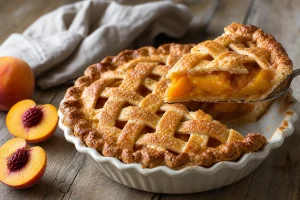
- Roll the larger disk to a 13-inch circle and fit it into a 9-inch pie dish, leaving the overhang. Roll the second disk to 12 inches and cut it into 1-inch strips for a lattice, or leave it whole and cut vents.
- Pile the filling into the shell, scraping in the syrup left at the bottom of the bowl. Weave the lattice or lay on the top crust, trim and crimp the edges, then chill the whole pie for 20 minutes so the butter firms up before baking.
- Brush the crust with the egg wash and sprinkle with coarse sugar. Set the pie on the hot baking sheet and bake at 425°F for 20 minutes, until the crust is just starting to color.
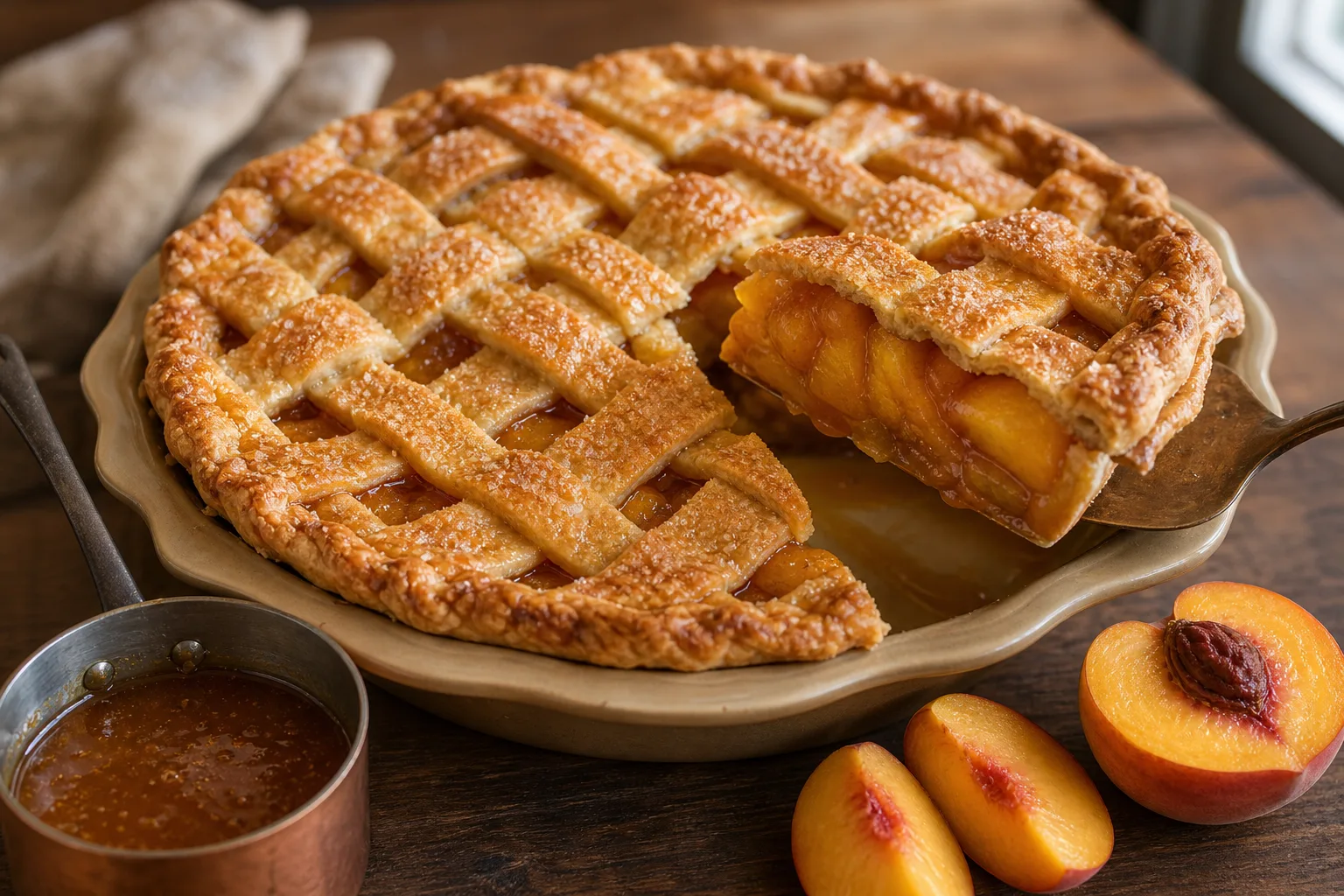
- Lower the oven to 375°F and bake another 40 to 45 minutes, tenting with foil if the edges darken too fast. The pie is done when the crust is deep golden brown and the filling bubbles thickly and slowly through the lattice, with the bubbles reaching the center, not just the edges.
- Cool the pie on a wire rack for at least 4 hours before slicing. The cornstarch finishes setting as the filling cools, and a warm slice will run no matter how well you did everything else.
Notes
- You need about 3 pounds of ripe, fragrant peaches, which is 6 to 8 medium. Slice them with the skins on. The pie bakes in a standard 9-inch pan, and the yield is 8 slices.
The first time I added bourbon to a peach pie, I did what most recipes say: a few glugs straight from the bottle into the bowl of fruit. The pie smelled wonderful coming out of the oven. Then I cut it, and a pale, boozy puddle ran across the plate while the bottom crust turned to wet cardboard. It also tasted sharp, like someone had stood a shot glass next to each slice.
Both problems had the same cause. Raw bourbon is about 40 percent alcohol and 60 percent water, and every tablespoon of it is added liquid in a filling that already has plenty. The harshness is the alcohol that never cooked off inside a pie that bakes for an hour but barely gets past the boiling point in the middle.
The fix took me three more pies to nail down, and it is simple: simmer the bourbon with the brown sugar into a syrup first, then toss that syrup with the peaches. You lose the water, you lose the raw edge, and you keep the vanilla, caramel and oak that made you want bourbon in the pie to begin with.
Why This Works
Reducing the bourbon with the brown sugar does two jobs at once. It boils off the water that would otherwise thin the filling and fight the thickener, and it drives out the sharp alcohol bite while concentrating the oak, vanilla and caramel notes into a syrup. Brown sugar’s molasses then adds a little acid and moisture-holding sugar, so you get a darker, more tender-set filling instead of a stiff, translucent one.
Ingredients
You need about 3 pounds of ripe, fragrant peaches, which is 6 to 8 medium. Slice them with the skins on. The pie bakes in a standard 9-inch pan, and the yield is 8 slices.
For the Crust
- 2 1/2 cups (315 g) all-purpose flour
- 1 tablespoon granulated sugar
- 1 teaspoon fine salt
- 1 cup (2 sticks, 226 g) cold unsalted butter, cut into 1/2-inch cubes
- 6 to 8 tablespoons ice water
- 1 tablespoon apple cider vinegar
For the Bourbon Syrup
- 1/3 cup bourbon
- 2/3 cup packed dark brown sugar
- 2 tablespoons unsalted butter
- 1/2 teaspoon vanilla extract
- 1/4 teaspoon fine salt
For the Filling
- 3 pounds ripe but firm peaches, unpeeled, pitted and sliced 1/2 inch thick
- 2 tablespoons fresh lemon juice
- 1/4 cup cornstarch
- 1 teaspoon ground cinnamon
- 1/4 teaspoon freshly grated nutmeg
For Finishing
- 1 large egg, beaten with 1 tablespoon water
- 1 tablespoon coarse sugar
Easy Swap
Rye whiskey works well here and gives a little more spice. If you would rather skip alcohol, replace the bourbon with 1/3 cup apple cider simmered with the sugar and 1 teaspoon of vanilla; reduce it the same way.
How to Make It
Prep: 45 minutes | Bake: 65 minutes | Cool or chill: 4 hours | Serves: 8 slices
- Make the dough: whisk the flour, sugar and salt in a large bowl. Cut in the cold butter with your fingertips or a pastry cutter until it is mostly pea-sized with some flatter, almond-sized pieces. Stir the vinegar into 6 tablespoons of ice water and sprinkle it over the flour, tossing with a fork until the dough just holds together when squeezed. Add more water a tablespoon at a time only if it is crumbly.
- Divide the dough into two disks, one slightly larger for the bottom, wrap them, and chill for at least 1 hour, or up to 2 days.
- Make the syrup: combine the bourbon and brown sugar in a small saucepan over medium heat. Stir until the sugar dissolves, then simmer for 4 to 6 minutes, until the mixture has reduced by about half and looks glossy, with slow, thick bubbles. Take it off the heat and stir in the butter, vanilla and salt. Let it cool for 15 minutes; it will thicken further.
- Heat the oven to 425°F with a rack in the lower third and a rimmed baking sheet on the rack to catch drips and heat the pie bottom from underneath.
- Slice the peaches into a large bowl and toss with the lemon juice. Whisk the cornstarch, cinnamon and nutmeg together, sprinkle it over the fruit, then pour the cooled syrup over everything and fold gently until no dry cornstarch remains. Let it sit while you roll out the dough, no more than 15 minutes.
- Roll the larger disk to a 13-inch circle and fit it into a 9-inch pie dish, leaving the overhang. Roll the second disk to 12 inches and cut it into 1-inch strips for a lattice, or leave it whole and cut vents.
- Pile the filling into the shell, scraping in the syrup left at the bottom of the bowl. Weave the lattice or lay on the top crust, trim and crimp the edges, then chill the whole pie for 20 minutes so the butter firms up before baking.
- Brush the crust with the egg wash and sprinkle with coarse sugar. Set the pie on the hot baking sheet and bake at 425°F for 20 minutes, until the crust is just starting to color.
- Lower the oven to 375°F and bake another 40 to 45 minutes, tenting with foil if the edges darken too fast. The pie is done when the crust is deep golden brown and the filling bubbles thickly and slowly through the lattice, with the bubbles reaching the center, not just the edges.
- Cool the pie on a wire rack for at least 4 hours before slicing. The cornstarch finishes setting as the filling cools, and a warm slice will run no matter how well you did everything else.
Don’t Do This
Do not stir the raw bourbon straight into the fruit. The water and alcohol in it add liquid the filling cannot absorb, and the alcohol will still taste sharp after an hour in the oven.
Can You Make This Pie Ahead?
Not Fully — Here Is What You Can Prep
The dough and the bourbon syrup both keep well, but the finished pie is best baked the day you serve it. Tossing the peaches and leaving the filling in the shell overnight draws out juice and softens the bottom crust.
The dough keeps in the refrigerator for 2 days or in the freezer for 2 months, wrapped tightly. Thaw frozen dough overnight in the refrigerator. The bourbon syrup can be made up to 3 days ahead and refrigerated in a jar; warm it for 20 seconds in the microwave so it pours, then cool it again before using.
Do not slice or toss the peaches more than 15 minutes before they go into the shell. Salt and sugar pull juice from the fruit, and the cornstarch starts to hydrate and clump if it sits.
A fully baked pie keeps loosely covered at room temperature for the first day, then in the refrigerator for up to 3 days. Reheat slices or the whole pie at 325°F for 15 to 20 minutes to bring back some crispness in the crust, though it never quite matches the first day.
Why Raw Bourbon Ruins the Filling
A peach pie filling is a balancing act between fruit juice, sugar and a thickener. Peaches are already about 88 percent water, and as they heat they give up most of it. The cornstarch has to gel all of that juice, and it has a finite capacity. Any extra liquid, such as two or three tablespoons of bourbon, pushes it past the limit and shows up as a thin, running filling.
Bourbon is roughly 60 percent water by volume, so even a modest pour adds real liquid. It also contains alcohol, which does boil off at a lower temperature than water, but the middle of a pie does not stay hot long enough or reach a high enough temperature to drive it all out. The leftover alcohol reads as a raw, medicinal sting on the back of your tongue, and it covers the peach flavor instead of enhancing it.
The syrup solves both problems on the stove, where you can see and control it. As the bourbon and sugar simmer, steam carries off the water and most of the alcohol. What remains is concentrated vanilla, toasted oak and caramel flavor, dissolved in melted brown sugar. You are using the bourbon as a flavoring and not as a liquid.
Don’t Do This
Never reduce the bourbon with the burner on high and walk away. Alcohol vapor can flare over a gas flame. Keep the heat at medium, and keep your face and hair back when you first add the bourbon.
What Brown Sugar Does to the Set
Brown sugar is white sugar with molasses added back, and dark brown has more of it, roughly 6 to 7 percent by weight. Molasses is hygroscopic, meaning it holds onto water, and it is slightly acidic. In a pie filling that translates into three practical differences.
First, the filling stays a little softer and more tender. White sugar pulls juice out of fruit and then dissolves into a thin syrup, while brown sugar’s molasses keeps that syrup thicker and stickier, so the set is more like a jammy glaze than a stiff gel. Second, the filling browns and caramelizes more deeply, which is why this pie looks darker and tastes closer to a cobbler. Third, the mild acidity can slightly weaken starch gels over a long bake, which is one more reason to use a full 1/4 cup of cornstarch and to cool the pie completely before cutting.
Light brown sugar also works, but you will notice a milder, less toffee-like flavor. I settled on dark brown after side-by-side pies: the dark version tasted like it had always belonged with the bourbon, while the light version tasted like peach pie with a drink poured over it.
Margaret’s Tip
Pack the brown sugar firmly into the measuring cup and level it. Loosely spooned brown sugar can be 20 percent short, and the syrup will reduce to less than you need.
Reading the Syrup and the Filling
Once you know what the syrup should look like, the rest of the pie is forgiving. At the 4-minute mark, the bubbles are large and fast. At 5 to 6 minutes, they get smaller and slower and the surface turns glossy, with a faint caramel smell and no alcohol sting when you carefully waft it. That is the moment to take it off the heat. The butter stirred in at the end rounds the edges and adds a little gloss to the finished filling.
Cooling the syrup matters. Pouring a hot syrup over raw peaches starts cooking the fruit and softens the slices before the pie even goes in the oven, and it can make the cornstarch clump on contact. Wait until it is warm to the touch, not hot, then fold it through.
In the oven, trust the bubbling more than the clock. Cornstarch needs to reach about 203°F to gel fully, which happens when the filling bubbles slowly and steadily in the center of the pie. If the bubbles are only at the edges, the middle is still thin, so keep baking and tent the crust with foil. The filling will look looser than you expect while hot and tighten up dramatically over the four hours it rests.
Margaret’s Tip
Watch the syrup like caramel, not like soup. When you drag a spoon through the pan and the track closes slowly, it is ready. Past that point it will seize into candy as it cools, and you will have to re-melt it with a spoonful of water.
Questions People Ask
Do I need to peel the peaches for this pie?
No. Ripe peach skin softens in the oven and adds a little color and tartness to the filling. The skins nearly disappear after an hour of baking, and you save a lot of time at the sink. If your peaches have thick, fuzzy skin, rub them with a clean towel before slicing.
Will the pie still taste like bourbon after the alcohol is reduced?
Yes, in a gentler way. The alcohol is what cooks off, but the vanilla, caramel and oak compounds stay in the syrup. You get a warm, round background flavor that makes the peaches taste more peachy, not a boozy kick.
Why is my filling still runny after cooling?
Most often the pie came out before the filling bubbled in the center, or it was cut too soon. The cornstarch needs to hit a full simmer and then cool for 4 hours to set. Using unripe or very juicy peaches without the full amount of cornstarch can also leave it loose.
Can I use frozen peaches instead of fresh?
You can, but thaw them in a colander for about 30 minutes and discard the liquid that drains off, then pat them dry. Frozen peaches release more water than fresh ones, so I would increase the cornstarch to 5 tablespoons.
About This Article

Written by Margaret Chen. Margaret Chen is a home baker and recipe developer with over 15 years of experience perfecting cookie recipes through rigorous testing and detailed experimentation. She tests every recipe multiple times, documents every variable, and applies the same rigor professional bakers use, with the warmth and accessibility of home baking. More about this site.
Scope and limits. Margaret is a home baker and recipe developer with no formal culinary training. Follow current food safety guidance for egg handling, storage, and anything you are serving to other people.
Verify this against a primary source
Specifics change, and your situation may differ from the one described here. These are the authorities worth checking directly:
- USDA FoodData Central — ingredient composition and nutrition data
- FoodSafety.gov — safe handling, storage and egg safety