
Classic Pecan Pie: What the Corn Syrup Is Actually Doing
Classic pecan pie with a smooth, glossy, never-grainy filling. Learn what corn syrup actually does, why deleting it fails, and how to bake a clean slice.
Ingredients
- 1 1/4 cups all-purpose flour
- 1 tablespoon granulated sugar
- 1/2 teaspoon fine salt
- 1/2 cup (1 stick) cold unsalted butter, cut into small cubes
- 3 to 4 tablespoons ice water
- 3 large eggs, at room temperature
- 3/4 cup packed light brown sugar
- 1 cup light corn syrup
- 1/4 cup (4 tablespoons) unsalted butter, melted and slightly cooled
- 1 tablespoon bourbon or vanilla extract
- 1 teaspoon pure vanilla extract
- 1/2 teaspoon fine salt
- 1 1/2 cups pecan halves, toasted
- 1/2 cup pecan halves, for arranging on top
Instructions
- Make the dough: whisk the flour, sugar and salt together, then rub in the cold butter with your fingertips until you have pea-sized pieces. Sprinkle in the ice water 1 tablespoon at a time, tossing with a fork, until the dough just holds together when squeezed. Pat into a disk, wrap, and chill for at least 1 hour.
- Heat the oven to 375°F with a rack in the lower third. Roll the dough into a 12-inch circle on a floured surface and fit it into a 9-inch deep pie pan. Trim the overhang to 1 inch, fold it under, and crimp. Freeze the shell for 20 minutes.
- Blind bake the shell: line the frozen crust with parchment, fill with pie weights or dried beans, and bake for 20 minutes. Remove the parchment and weights and bake 5 minutes more, until the bottom looks dry and pale gold. Leave the oven on.
- Toast the 1 1/2 cups of pecans on a sheet pan for 6 to 8 minutes, until fragrant. Let them cool, then roughly chop them.
- Make the filling: whisk the eggs in a large bowl just until broken up. Add the brown sugar, corn syrup, melted butter, bourbon, vanilla and salt, and whisk gently until smooth. Stop as soon as there are no streaks. Heavy whisking beats in air that puffs up and cracks as the pie cools.
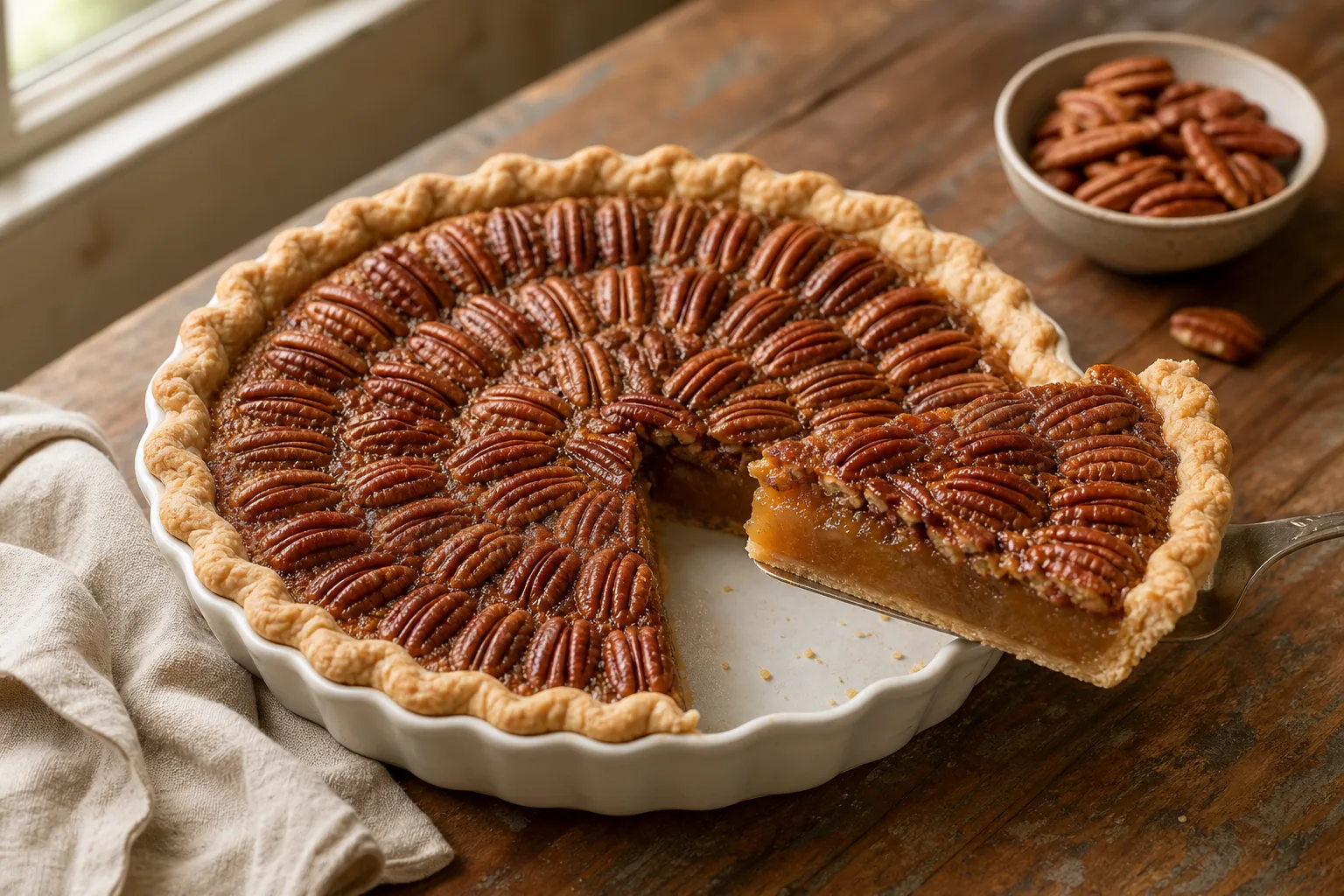
- Scatter the chopped pecans over the warm crust. Pour the filling over them, then arrange the remaining pecan halves in rings on top. They will float up and settle as it bakes.
- Bake at 375°F for 45 to 55 minutes. After 25 minutes, tent the edges of the crust with foil if they are browning too fast. The pie is done when the edges are set and puffed and the center jiggles slightly like firm gelatin, not like liquid.
- Cool on a wire rack for at least 3 hours before slicing. The filling finishes setting as it cools, and a warm slice will run. Serve at room temperature.
Notes
- This makes one deep 9-inch pie, about 8 slices. Use a standard 9-inch pan about 1 1/2 inches deep, not a shallow one.
The first pecan pie I ever made looked perfect coming out of the oven and felt like wet sand when I cut it. The filling was gritty, with a sugary crunch that had nothing to do with the nuts. I assumed I had overbaked it, so I pulled the next one earlier. That one was grainy and runny. The third was grainy again.
It took me a long time to figure out that I was not fighting an oven problem. I was fighting sugar. Pecan filling is mostly sugar and butter held together by eggs, and sugar crystals are very good at coming back. The corn syrup in the classic recipe is not there to make the pie sweeter. It is there to keep those crystals from forming.
This is the version I make now, along with a clear explanation of what is going wrong when a pecan pie turns grainy. Once you understand it, you will know why recipes that simply delete the corn syrup tend to fail, and you will be able to tell a good pecan pie recipe from a risky one just by reading the ingredient list.
Why This Works
Table sugar is sucrose, and sucrose wants to crystallize. When you melt it with butter and bake it, the dissolved sugar is sitting in a very crowded, supersaturated solution, and any stray crystal or rough spot gives it a place to start growing. Corn syrup is mostly glucose, and glucose molecules physically get in the way of sucrose lining up into crystals. That is the entire job. The sweetness is almost incidental, because corn syrup is actually less sweet than white sugar.
Ingredients
This makes one deep 9-inch pie, about 8 slices. Use a standard 9-inch pan about 1 1/2 inches deep, not a shallow one.
For the Crust
- 1 1/4 cups all-purpose flour
- 1 tablespoon granulated sugar
- 1/2 teaspoon fine salt
- 1/2 cup (1 stick) cold unsalted butter, cut into small cubes
- 3 to 4 tablespoons ice water
For the Filling
- 3 large eggs, at room temperature
- 3/4 cup packed light brown sugar
- 1 cup light corn syrup
- 1/4 cup (4 tablespoons) unsalted butter, melted and slightly cooled
- 1 tablespoon bourbon or vanilla extract
- 1 teaspoon pure vanilla extract
- 1/2 teaspoon fine salt
- 1 1/2 cups pecan halves, toasted
- 1/2 cup pecan halves, for arranging on top
Easy Swap
Dark corn syrup works in place of light and gives a deeper, more molasses-like flavor. Use the same amount. Both are mostly glucose, so the anti-crystal effect is identical.
How to Make It
Prep: 30 minutes | Bake: 55 minutes | Cool or chill: 3 hours | Serves: 8 slices
- Make the dough: whisk the flour, sugar and salt together, then rub in the cold butter with your fingertips until you have pea-sized pieces. Sprinkle in the ice water 1 tablespoon at a time, tossing with a fork, until the dough just holds together when squeezed. Pat into a disk, wrap, and chill for at least 1 hour.
- Heat the oven to 375°F with a rack in the lower third. Roll the dough into a 12-inch circle on a floured surface and fit it into a 9-inch deep pie pan. Trim the overhang to 1 inch, fold it under, and crimp. Freeze the shell for 20 minutes.
- Blind bake the shell: line the frozen crust with parchment, fill with pie weights or dried beans, and bake for 20 minutes. Remove the parchment and weights and bake 5 minutes more, until the bottom looks dry and pale gold. Leave the oven on.
- Toast the 1 1/2 cups of pecans on a sheet pan for 6 to 8 minutes, until fragrant. Let them cool, then roughly chop them.
- Make the filling: whisk the eggs in a large bowl just until broken up. Add the brown sugar, corn syrup, melted butter, bourbon, vanilla and salt, and whisk gently until smooth. Stop as soon as there are no streaks. Heavy whisking beats in air that puffs up and cracks as the pie cools.
- Scatter the chopped pecans over the warm crust. Pour the filling over them, then arrange the remaining pecan halves in rings on top. They will float up and settle as it bakes.
- Bake at 375°F for 45 to 55 minutes. After 25 minutes, tent the edges of the crust with foil if they are browning too fast. The pie is done when the edges are set and puffed and the center jiggles slightly like firm gelatin, not like liquid.
- Cool on a wire rack for at least 3 hours before slicing. The filling finishes setting as it cools, and a warm slice will run. Serve at room temperature.
Don’t Do This
Do not replace the corn syrup with extra white sugar or more brown sugar to cut sweetness. That removes the very ingredient that stops crystals, and you will get a gritty, sandy filling.
Can You Make This Pie Ahead?
Not Fully — Here Is What You Can Prep
The dough and the blind-baked shell can be done ahead, but the filled pie is best the day it is baked, or at most the day after. Make the dough up to 2 days ahead or freeze it for a month, and hold the filling until baking day.
Pie dough keeps for 2 days in the refrigerator and up to a month in the freezer, wrapped tightly. You can also fit it into the pan and freeze the shell, then blind bake straight from frozen. That takes care of the most time-consuming part.
The filling itself is the part I would not stage. Once the eggs and sugar are combined, they start to settle and the sugar begins to pull moisture, and a filling that has sat overnight bakes up less evenly. Mix it fresh and pour it into the shell right before it goes in the oven.
A fully baked pie keeps loosely covered at room temperature for 1 day, then in the refrigerator for up to 4 days. The crust softens a little in the refrigerator, so I give a chilled slice 10 minutes on the counter before eating. If you refrigerate it, the filling will firm up and slice more cleanly than it does warm.
What Grainy Pecan Pie Actually Is
When a pecan pie turns gritty, people usually blame the bake, so they shorten it or lower the oven. That is the wrong diagnosis. Grainy filling is sugar that has dissolved and then re-formed into crystals as the pie cooled. It is a chemistry problem, not a timing one.
Here is the setup. A pecan filling holds a huge amount of sugar compared to the liquid in it. Eggs and butter contribute only a little water, so almost all the sugar is dissolved in a very small amount of liquid. That is a supersaturated solution, which is a fancy way of saying it is holding more sugar than it can comfortably keep dissolved once it cools. Supersaturated sugar is unstable. Give it a rough spot, a speck of undissolved sugar, or just enough time, and it snaps back into crystals.
Those crystals are what you feel on your tongue. The filling looks fine, the flavor is fine, and the texture is sand. I made this mistake four times in a row before I understood that nothing about the oven was at fault.
How to tell it is crystallization
If the filling is sweet and set but gritty, that is crystallization. If it is loose and wet in the center, that is underbaking. They look nothing alike once you cut a slice, and they need opposite fixes.
What Corn Syrup Does That Sugar Cannot
Corn syrup is mostly glucose, along with some larger chains of glucose. Sugar is sucrose, which is one glucose molecule bonded to one fructose molecule. When sucrose crystals grow, those molecules stack neatly like bricks. Glucose in the mix is the wrong shape to join that stack, so it sits between the sucrose molecules and blocks them from lining up. Confectioners call this an interfering agent. It is the same reason caramel makers add a spoonful of corn syrup before they cook sugar.
That is why corn syrup is the single most important ingredient in this pie, even though it is the one people most want to skip. It is also less sweet than white sugar, so it is not delivering sweetness. A cup of corn syrup keeps a filling smooth in a way a cup of extra sugar never could. In fact, more sugar makes the problem worse, because you are adding to the crowding rather than breaking it up.
Brown sugar helps a little too. It contains molasses and a small amount of invert sugar, which is sucrose that has already been split into glucose and fructose. That is why I use brown sugar here and not all white. But brown sugar alone is not enough to carry a filling this sugary, and I have seen the grainy result when it is asked to.
Don’t Do This
Do not boil the filling on the stove to dissolve the sugar first. It is not needed, and it raises the risk of scrambled egg. Whisk gently and let the oven do the work.
Why Recipes That Just Delete the Corn Syrup Fail
You will see recipes that promise a corn-syrup-free pecan pie and simply swap in more brown sugar or granulated sugar. I tried this side by side with the classic version, same pan, same oven, same bake time. The version with extra sugar was visibly duller on top and grainy in the center, and by the second day it had gone fully gritty.
The issue is that deleting corn syrup does not just remove a sweetener. It removes the thing doing the structural work. A recipe that leaves it out has to put something back in, and that something has to interfere with crystallization. Honey, maple syrup and golden syrup all work because they contain invert sugar, but that is a different pie with different flavor, and it is a separate question from this one.
So if you are reading a recipe that cuts the corn syrup and offers no replacement for its job, treat it with suspicion. The same goes for recipes that reduce the total sugar to compensate. Less sugar helps with crystallization only if it also changes the ratio of sugar to liquid, and in a pie with this little liquid, it rarely does.
If you want it less sweet
Keep the full amount of corn syrup and cut the brown sugar by 2 tablespoons instead. You protect the texture and trim the sweetness. Toasting the pecans and adding the bourbon also make it taste less sugary.
Margaret’s Tip
Wipe any sugar crystals off the side of your mixing bowl before you pour. A single stray crystal can seed the whole filling, so scrape cleanly and pour from a bowl that is smooth, not crusty.
Questions People Ask
Why is my pecan pie grainy?
Grainy pecan pie is sugar that has re-crystallized as the filling cooled. It happens when there is not enough invert sugar, usually glucose from corn syrup, to block the sucrose molecules from stacking into crystals. A gritty texture with a fully set filling is a crystallization problem, not an underbaking one.
Can I leave the corn syrup out of pecan pie?
Not without replacing what it does. Corn syrup is there to prevent crystals, not to add sweetness. If you simply delete it or add more sugar, the filling will likely turn grainy. Ingredients with invert sugar can fill the role, but they change the flavor, so it is better to use corn syrup for a classic result.
How do I know when pecan pie is done?
The edges should be set and puffed, and the center should jiggle slightly like firm gelatin when you nudge the pan. It will keep setting as it cools. If the center ripples like liquid, it needs more time. If the whole surface is rigid and cracked, it has gone too far.
Why did my pecan pie crack on top?
Cracking usually comes from beating too much air into the eggs or from overbaking. Whisk the filling only until smooth, and pull the pie while the center still has a gentle jiggle. A pie that cools slowly at room temperature, away from drafts, is also less likely to crack.
About This Article

Written by Margaret Chen. Margaret Chen is a home baker and recipe developer with over 15 years of experience perfecting cookie recipes through rigorous testing and detailed experimentation. She tests every recipe multiple times, documents every variable, and applies the same rigor professional bakers use, with the warmth and accessibility of home baking. More about this site.
Scope and limits. Margaret is a home baker and recipe developer with no formal culinary training. Follow current food safety guidance for egg handling, storage, and anything you are serving to other people.
Verify this against a primary source
Specifics change, and your situation may differ from the one described here. These are the authorities worth checking directly:
- USDA FoodData Central — ingredient composition and nutrition data
- FoodSafety.gov — safe handling, storage and egg safety