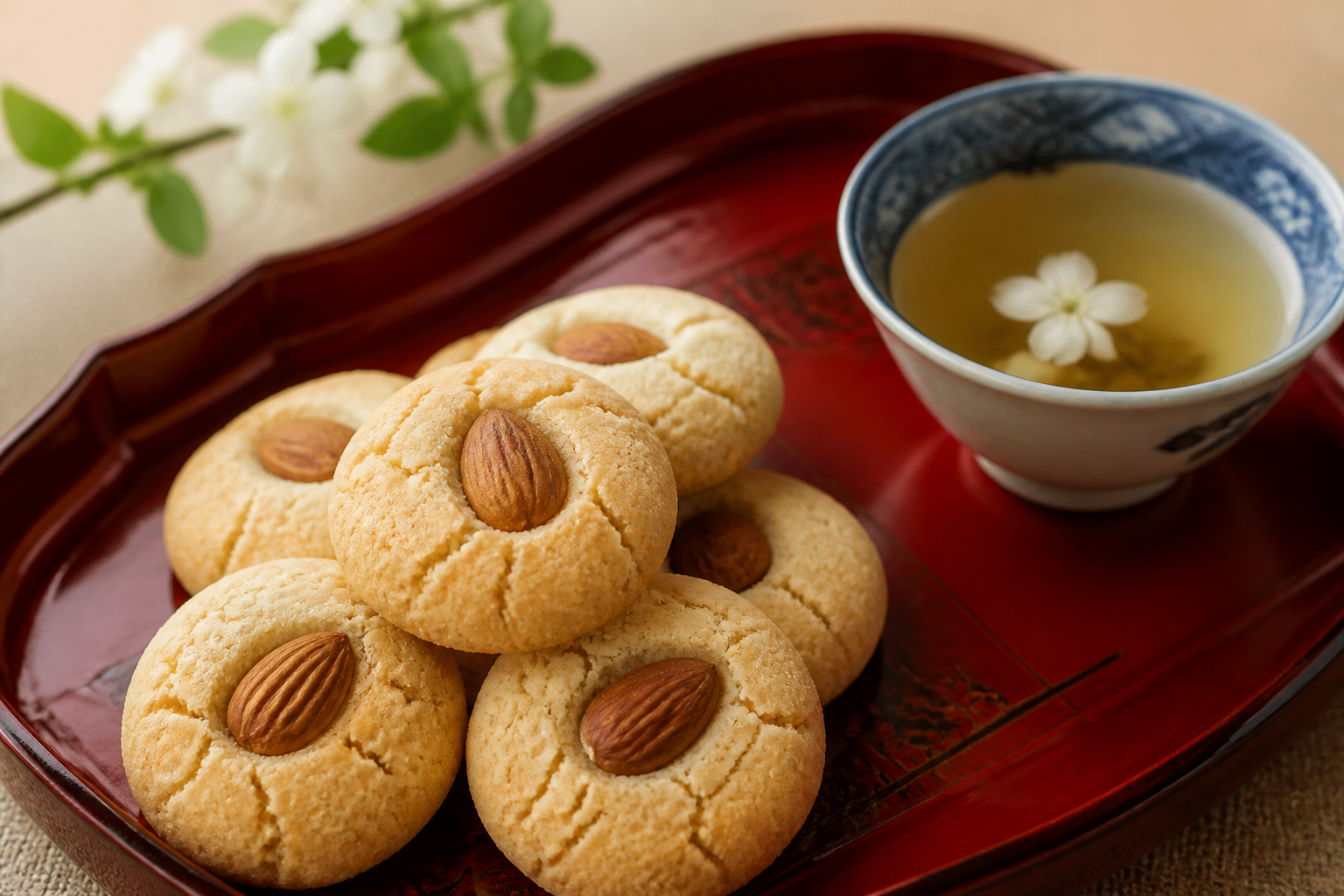
Chinese almond cookies are a beloved staple at dim sum restaurants and family celebrations across Asia and beyond. But what makes them so special? After 30 batches of experimenting, tweaking, and occasionally throwing my hands up in frustration, I’ve discovered that the magic lies in understanding their history, appreciating their symbolism, and mastering the surprisingly technical details that separate a mediocre batch from one that makes people ask for the recipe.
The History and Symbolism Behind Chinese Almond Cookies
Chinese almond cookies aren’t just a delicious treat—they’re steeped in cultural meaning. Traditionally served during Chinese New Year and other celebrations, these cookies symbolize prosperity, good fortune, and family togetherness. The round shape represents completeness and wholeness, while the almond itself has been valued in Chinese cuisine for centuries for both its flavor and perceived health benefits.
The cookies themselves trace back to Cantonese baking traditions, where they were crafted in bakeries and made for special occasions. What’s fascinating is how they’ve remained relatively unchanged in their core ingredients and technique for generations—a testament to how perfectly balanced the recipe truly is. When made well, they’re the kind of cookie that tastes like it came from a professional bakery, not your home kitchen.
The Great Lard vs. Butter Debate
This is where my 30-batch journey really began. Traditional Chinese almond cookies use lard, which creates a texture that’s slightly crispier on the outside while remaining tender within. When I first started making these cookies, I instinctively reached for butter—it’s what I know, and it’s what most Western bakers use.
But I kept getting feedback that something was “off.” The cookies weren’t quite as delicate. They didn’t have that characteristic slight crunch. That’s when I decided to experiment with lard, and suddenly, everything clicked.
Why? Butter contains water (15-17%), while lard is pure fat. The water creates steam during baking, which can lead to slightly more spread and a softer final texture. Butter also has different fatty acid composition, resulting in a different crystal structure.
The advantage: Butter is accessible, familiar, and acceptable to a wider audience. The cookies are still excellent.
If you’re uncomfortable using lard, don’t skip this recipe entirely. Butter works perfectly well—your cookies will simply have a slightly softer crumb and marginally more spread. Many successful bakeries around the world make these cookies with butter exclusively. The difference is subtle enough that most people won’t notice, but bakers certainly will.
The Almond Extract That Finally Gave Me That Authentic Bakery Flavor
After 30 batches, I learned that almond extract is the backbone of these cookies—but not all extracts are created equal. A weak or artificial-tasting extract can make your entire batch taste flat and one-dimensional, no matter how perfect your lard-to-flour ratio is.
What works
- The flavor is genuinely potent without being cloying—I use less than I expected and still get that deep, recognizable almond character that makes people ask “what is that flavor?”
- It doesn’t fade or turn chemical-tasting after the cookies cool, which happened with grocery store brands I’ve tried before.
- The bottle size is generous enough that it actually lasts through multiple batches without feeling wasteful, even though pure extract is pricey.
What doesn’t
- It costs significantly more than imitation extract, so this isn’t the budget ingredient in your recipe.
- You have to hunt for it—not every grocery store carries pure almond extract in stock, though Asian markets and online usually do.
I doubted it was worth the extra expense until batch 12, when I compared cookies made with imitation versus pure extract side by side and realized the difference was the reason I’d felt something was “off” all along. That’s when I ordered Watkins Pure Almond Extract and never looked back.
The Recipe: Chinese Almond Cookies
What You’ll Need
- 1½ cups (180g) all-purpose flour
- 1 cup (100g) blanched almond flour
- ½ cup (113g) lard or butter, softened to room temperature
- ¾ cup (150g) granulated sugar
- 1 large egg
- 1 teaspoon (5ml) pure almond extract
- 1 teaspoon (5g) baking powder
- ¼ teaspoon (1g) baking soda
- ¼ teaspoon (2g) salt
- Whole blanched almonds for topping (about 18–20)
How I Make Them, Step by Step
- Preheat your oven to 350°F (175°C). Use an oven thermometer to verify the actual temperature—this is one of those details that makes the difference.
- In a medium bowl, whisk together the all-purpose flour, almond flour, baking powder, baking soda, and salt. Set aside.
- In a large bowl, cream together the lard (or butter) and sugar until the mixture is light and fluffy, about 2–3 minutes. This incorporates air and sets you up for delicate cookies.
- Beat in the egg and pure almond extract until fully combined. The mixture should be smooth and emulsified.
- Gently fold the dry ingredients into the wet ingredients using a spatula or wooden spoon. Mix just until the dough comes together—overmixing develops gluten and makes cookies tough instead of delicate.
- Divide the dough into 18–20 equal portions and roll each one into a 1- to 1½-inch ball. If the dough is sticky, lightly wet your hands.
- Place the dough balls on parchment-lined baking sheets, spacing them about 2 inches apart.
- Gently flatten each ball with the bottom of a glass or your palm to about ½-inch thick. Press a whole almond into the center of each cookie—it’s not just decoration, but becomes slightly caramelized and adds authentic flavor.
- Bake for 18–20 minutes, until the edges are light golden brown and the tops are set. They should look lightly baked, not dark. A minute or two over can swing them from perfect to overdone.
- Remove from the oven and let the cookies cool on the baking sheet for 5 minutes before transferring to a wire rack to cool completely.
Yield: About 18–20 cookies. Prep time: 15 minutes. Bake time: 18–20 minutes.
Common Mistakes to Avoid
Over 30 batches, I made every mistake in the book. Here are the ones that cost me the most:
- Overmixing the dough: This develops gluten, which makes the cookies tough instead of delicate. Mix just until the dough comes together.
- Oven temperature guessing: Use an oven thermometer. Even if your oven says 350°F, it might actually be 340°F or 365°F. This affects spread and browning dramatically.
- Skipping the almond on top: That whole almond pressed into the center isn’t decoration—it’s functional. It becomes slightly caramelized and adds authentic flavor and visual appeal.
- Baking too long: These cookies are done when golden brown, typically 12-15 minutes. A minute or two over can swing them from perfect to overdone.
This post contains affiliate links. As an Amazon Associate, I earn from qualifying purchases at no extra cost to you.