
Toasted Coconut Chess Pie: The Cornmeal Is the Point
Toasted coconut chess pie with a crackly sugar crust. Learn what cornmeal and vinegar actually do in the filling, plus how to toast the coconut first.
Ingredients
- 1 unbaked 9-inch pie crust, homemade or store-bought, fitted into a standard 9-inch pie pan and chilled
- 3/4 cup sweetened shredded coconut
- 1/2 cup (1 stick) unsalted butter, melted and cooled slightly
- 1 1/2 cups granulated sugar
- 1 tablespoon fine yellow cornmeal
- 1 tablespoon all-purpose flour
- 1/4 teaspoon fine salt
- 3 large eggs, at room temperature
- 1/4 cup whole milk
- 1 tablespoon distilled white vinegar
- 1 teaspoon pure vanilla extract
Instructions
- Position an oven rack in the lower third and heat the oven to 350°F. Put a rimmed baking sheet on that rack so it heats along with the oven. Set the chilled, unbaked pie shell on the counter while you work.
- Spread the coconut on a separate small baking sheet in a thin, even layer. Toast it for 5 to 7 minutes, stirring once halfway, until most of the shreds are golden and the edges are deep brown. Watch it closely near the end, because coconut goes from toasted to burnt in under a minute. Let it cool completely.
- In a large bowl, whisk the sugar, cornmeal, flour and salt together until no lumps of flour remain. Mixing the dry ingredients first spreads the cornmeal evenly through the sugar so you do not get gritty pockets later.
- Pour in the cooled melted butter and whisk until the mixture looks like wet sand. The butter should be warm to the touch at most, not hot, or it will start to cook the eggs in the next step.
- Add the eggs one at a time, whisking just until each disappears into the mixture. Whisk in the milk, vinegar and vanilla. Stop as soon as the filling is smooth, because beating in a lot of air creates a foamy, puffed top that collapses into a pitted surface instead of a clean crackle.
- Fold in the cooled toasted coconut with a spatula. Pour the filling into the unbaked pie shell. Most of the coconut will float up and gather near the surface, which is exactly what you want for a toasty top.
- Set the pie on the preheated baking sheet and bake for 45 to 50 minutes. The top should be deep golden brown with a thin, crackly surface, and the center should wobble slightly like set gelatin when you nudge the pan. If the edges of the crust or the coconut darken too fast, tent the pie loosely with foil for the last 15 minutes.
- Cool the pie on a wire rack for at least 2 hours before slicing. The filling finishes setting as it cools, and a warm slice will ooze instead of holding its shape. Serve at room temperature or lightly chilled.
Notes
- This makes one 9-inch pie in a standard (not deep-dish) pan, with about 3/4 cup of toasted coconut folded into the filling.
The first chess pie I ever made came out of the oven looking perfect and tasted like sweet scrambled eggs sitting in a pool of sugar syrup. The top was glossy and flat, the filling was gritty in one corner and runny in another, and I could not work out what I had done wrong, because the ingredient list is about as short as a pie recipe gets.
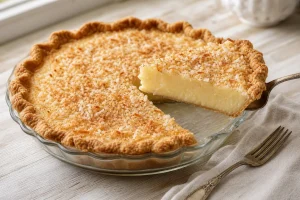
What I eventually figured out is that chess pie is not a custard with a different name. Its short list of pantry ingredients is doing very specific jobs, and two of them, a spoonful of cornmeal and a splash of vinegar, are the reason a good chess pie tastes like itself. Leave them out and you have a sugar custard. Include them and you get a dense, buttery, almost fudgy filling under a thin sugar crust that cracks when you press a fork into it.
This version adds coconut, but only after I toast it first, because raw coconut baked inside a wet filling turns pale and chewy and tastes like very little. Toasting takes five minutes and changes the whole pie. The rest of this post is about why each of those small decisions matters.
Why This Works
The cornmeal does two jobs at once: it holds the sugar-and-butter filling together as a dense, sliceable body, and a fraction of it floats up during baking and dries into the thin, crackly sugar crust on top. The vinegar does the opposite job, cutting through a filling that is mostly sugar and butter so it tastes bright and rounded instead of flat and cloying.
Ingredients
This makes one 9-inch pie in a standard (not deep-dish) pan, with about 3/4 cup of toasted coconut folded into the filling.
For the Crust
- 1 unbaked 9-inch pie crust, homemade or store-bought, fitted into a standard 9-inch pie pan and chilled
For the Filling
- 3/4 cup sweetened shredded coconut
- 1/2 cup (1 stick) unsalted butter, melted and cooled slightly
- 1 1/2 cups granulated sugar
- 1 tablespoon fine yellow cornmeal
- 1 tablespoon all-purpose flour
- 1/4 teaspoon fine salt
- 3 large eggs, at room temperature
- 1/4 cup whole milk
- 1 tablespoon distilled white vinegar
- 1 teaspoon pure vanilla extract
Easy Swap
No white vinegar? Use apple cider vinegar in the same amount. The flavor is a touch fruitier and still cuts the sweetness. Lemon juice also works at the same quantity, but it makes the filling a little more tangy than traditional chess pie.
How to Make It
Prep: 30 minutes | Bake: 50 minutes | Cool or chill: 2 hours | Serves: 8 slices
- Position an oven rack in the lower third and heat the oven to 350°F. Put a rimmed baking sheet on that rack so it heats along with the oven. Set the chilled, unbaked pie shell on the counter while you work.
- Spread the coconut on a separate small baking sheet in a thin, even layer. Toast it for 5 to 7 minutes, stirring once halfway, until most of the shreds are golden and the edges are deep brown. Watch it closely near the end, because coconut goes from toasted to burnt in under a minute. Let it cool completely.
- In a large bowl, whisk the sugar, cornmeal, flour and salt together until no lumps of flour remain. Mixing the dry ingredients first spreads the cornmeal evenly through the sugar so you do not get gritty pockets later.
- Pour in the cooled melted butter and whisk until the mixture looks like wet sand. The butter should be warm to the touch at most, not hot, or it will start to cook the eggs in the next step.
- Add the eggs one at a time, whisking just until each disappears into the mixture. Whisk in the milk, vinegar and vanilla. Stop as soon as the filling is smooth, because beating in a lot of air creates a foamy, puffed top that collapses into a pitted surface instead of a clean crackle.
- Fold in the cooled toasted coconut with a spatula. Pour the filling into the unbaked pie shell. Most of the coconut will float up and gather near the surface, which is exactly what you want for a toasty top.
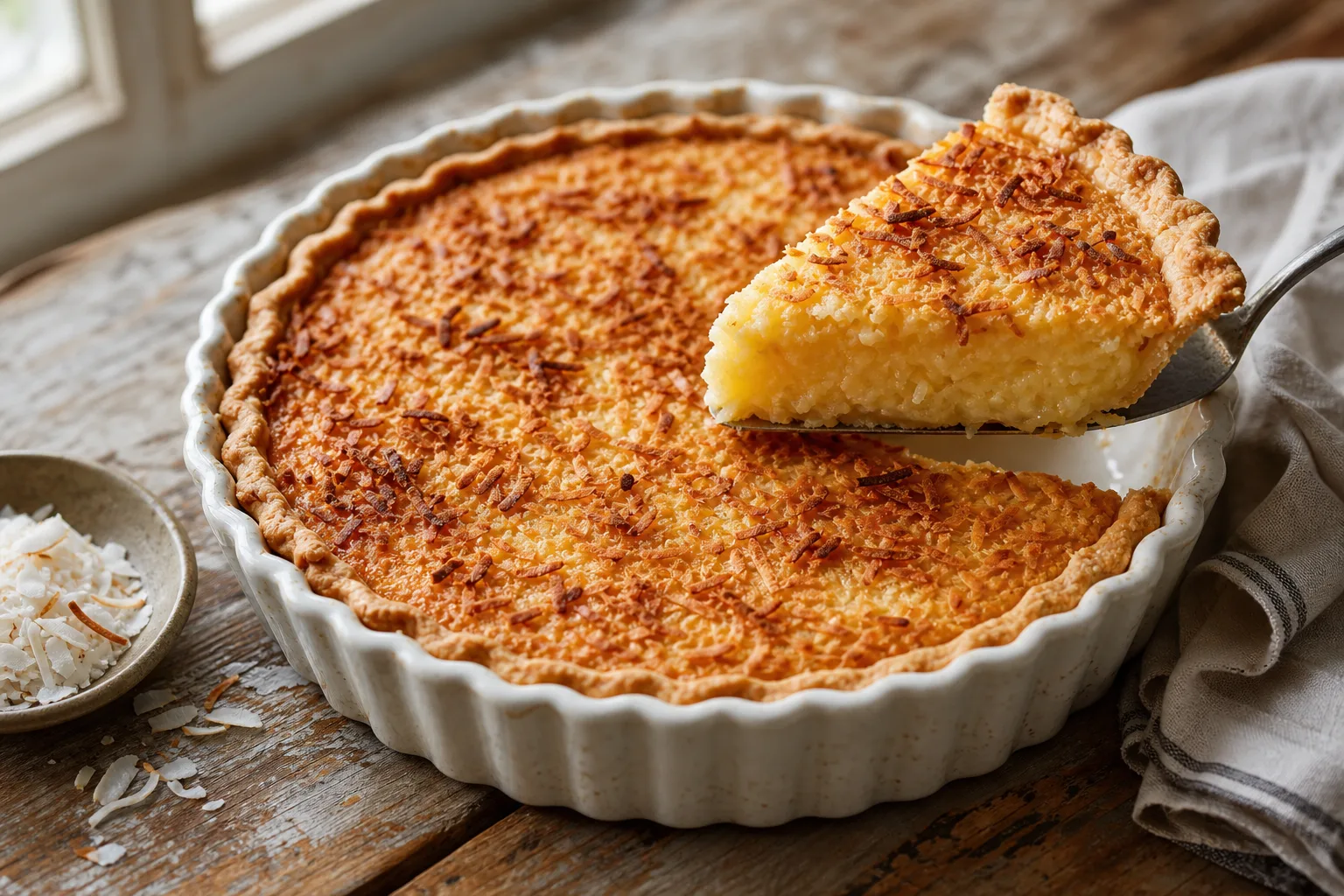
- Set the pie on the preheated baking sheet and bake for 45 to 50 minutes. The top should be deep golden brown with a thin, crackly surface, and the center should wobble slightly like set gelatin when you nudge the pan. If the edges of the crust or the coconut darken too fast, tent the pie loosely with foil for the last 15 minutes.
- Cool the pie on a wire rack for at least 2 hours before slicing. The filling finishes setting as it cools, and a warm slice will ooze instead of holding its shape. Serve at room temperature or lightly chilled.
Don’t Do This
Do not pour hot melted butter into the sugar and eggs. Warm butter is fine, but hot butter scrambles the eggs on contact and leaves tiny cooked flecks in the filling that you can never whisk back out.
Can You Make This Pie Ahead?
Not Fully — Here Is What You Can Prep
You can toast the coconut up to three days ahead and make the crust ahead, but the assembled pie is best baked and cooled the same day, because the crackly top softens in the refrigerator.
The toasted coconut keeps well in an airtight container at room temperature for three days. The unbaked crust can be fitted into its pan, wrapped tightly and refrigerated for two days or frozen for a month. Fill and bake it straight from the refrigerator or freezer without thawing.
Once the pie is baked and fully cooled, it holds at room temperature for the rest of the day and can go in the refrigerator overnight, covered loosely. The flavor is actually a little better after a night, since the butter and vanilla settle in. The cost is the top: the thin sugar crust absorbs moisture in the cold and loses its crackle, so it ends up tender rather than crisp.
I do not recommend assembling the filling and holding it in the refrigerator before baking. The cornmeal starts absorbing liquid as it sits, and the baked pie turns out denser and slightly pasty.
What Cornmeal Actually Does in Chess Pie
Chess pie recipes vary wildly, and some leave out the cornmeal entirely, using only a spoonful of flour. I tested this pie both ways, side by side, and the difference was easy to taste and see. With flour alone, the filling was smooth and a little gummy. With cornmeal, the filling had a very slightly sandy, tender body that held a clean slice, and the edge of each slice looked cut rather than smeared.
The cornmeal works in two places. Inside the pie, its fine granules absorb some of the liquid from the eggs and butter and swell, acting as a gentle structure that keeps the filling from being loose without making it rubbery the way extra flour or eggs would. At the surface, a small amount rises with the bubbling sugar and dries into a thin, brittle layer. That layer is the crackle. It is not a meringue and it is not a caramelized sugar crust like crème brûlée; it is a sugar-and-cornmeal skin that shatters under a fork.
Use fine yellow cornmeal, the kind sold as table-grind or labeled fine. Coarse stone-ground cornmeal or polenta never fully softens in a 50-minute bake, and you end up with distinct gritty bits in each bite. If all you have is medium-grind, run a tablespoon of it through a spice grinder for a few pulses first. White cornmeal works fine as well; it just gives a slightly paler filling.
One tablespoon is the right amount for a standard 9-inch pie. I have made it with two, thinking more would give a better crust, and the filling turned dry and crumbly, closer to a cake than a pie.
Margaret’s Tip
Whisk the cornmeal into the sugar before anything wet goes in. Cornmeal dumped into liquid clumps, and those clumps do not dissolve in the oven.
Toasting the Coconut First, and Getting the Crackle
Raw shredded coconut baked inside a wet filling does not toast. It sits in a bath of egg and sugar, steams, and comes out pale, soft and faintly rubbery. The pie ends up tasting sweet and mildly coconutty at best. Toasting the coconut separately for five to seven minutes drives off moisture and browns the natural sugars and oils in the shreds, so they bring a deep, nutty flavor and a slight chew that holds up through the bake.
Cool the coconut completely before it goes into the filling. Warm coconut softens the butter-sugar mixture and can melt the surface of the sugar, which changes the texture of the top. Sweetened shredded coconut toasts faster than unsweetened because of the added sugar, so reduce the time by a minute or so if you are using unsweetened flaked coconut, and add a tablespoon of extra sugar to the filling to compensate.
Because the coconut floats, the top of the pie ends up as a layer of toasted shreds embedded in the sugar-cornmeal crackle. Some of the shreds brown further in the oven and turn almost chocolate-colored at the edges. That is fine, and it is part of the flavor, but if the top is darkening before the center is set, tent it with foil rather than pulling the pie early.
The doneness cue is the wobble. Nudge the pan: the outer two inches should be firm and the very center should shiver as a single mass. Pulled at that point, the pie finishes setting while it cools. A chess pie baked until the center is completely rigid is overbaked, and it will crack across the top in deep fissures and taste dry and overly eggy.
Don’t Do This
Do not slice the pie warm. Chess filling is liquid sugar and butter held together by egg and cornmeal, and it only sets fully once it has cooled to room temperature, which takes about two hours.
Margaret’s Tip
Rotate the pie once, about 25 minutes in, if your oven has hot spots. A chess top browns unevenly more easily than most pies because of the sugar, and a quick half-turn gives you an even crackle from edge to edge.
Questions People Ask
Why did my chess pie crack across the top?
A few shallow cracks are normal and part of the crackly surface. Deep fissures usually mean the pie was overbaked or the oven ran too hot. Pull it when the center still wobbles slightly, and cool it away from drafts.
Can I leave out the cornmeal?
You can substitute an extra tablespoon of flour, and the pie will still taste good, but the texture changes. The filling turns smoother and a little gummier, and you lose most of the crackly top. For a true chess pie, the cornmeal is what makes it.
Can I use unsweetened coconut?
Yes. Toast it for a minute less than sweetened, since it is lighter and browns quickly, and add one extra tablespoon of sugar to the filling. The flavor will be slightly less sweet and the toasted notes a bit more pronounced.
About This Article

Written by Margaret Chen. Margaret Chen is a home baker and recipe developer with over 15 years of experience perfecting cookie recipes through rigorous testing and detailed experimentation. She tests every recipe multiple times, documents every variable, and applies the same rigor professional bakers use, with the warmth and accessibility of home baking. More about this site.
Scope and limits. Margaret is a home baker and recipe developer with no formal culinary training. Follow current food safety guidance for egg handling, storage, and anything you are serving to other people.
Verify this against a primary source
Specifics change, and your situation may differ from the one described here. These are the authorities worth checking directly:
- USDA FoodData Central — ingredient composition and nutrition data
- FoodSafety.gov — safe handling, storage and egg safety