
Lemon Meringue Pie: Stop the Weeping and the Beading
Lemon meringue pie with a clear fix for each failure: weeping from a cool filling, beading from overbaking. Tested, tall, sliceable.
Ingredients
- 1 1/4 cups all-purpose flour
- 1 tablespoon granulated sugar
- 1/2 teaspoon fine salt
- 1/2 cup (1 stick) cold unsalted butter, cut into small cubes
- 3 to 4 tablespoons ice water
- 1 1/4 cups granulated sugar
- 1/3 cup cornstarch
- 1/4 teaspoon fine salt
- 1 1/2 cups water
- 4 large egg yolks, lightly beaten
- 2 tablespoons unsalted butter
- 1 tablespoon finely grated lemon zest
- 1/2 cup fresh lemon juice
- 4 large egg whites, at room temperature
- 1/2 teaspoon cream of tartar
- 2/3 cup superfine sugar (or granulated sugar pulsed in a blender for 20 seconds)
- 1 teaspoon cornstarch
- 1/2 teaspoon vanilla extract
Instructions
- Make the dough. Whisk the flour, sugar and salt in a large bowl. Rub or cut in the cold butter until the pieces are the size of small peas. Sprinkle in 3 tablespoons of ice water, toss, and add more by the teaspoon until the dough holds when squeezed. Press into a disk, wrap, and chill for at least 1 hour.
- Shape and blind bake. Heat the oven to 400°F. Roll the dough to a 12-inch round, fit it into a 9-inch pie pan, trim and flute the edge, and freeze for 20 minutes. Line with parchment, fill with pie weights or dried beans, and bake 20 minutes. Remove the weights and bake another 8 to 10 minutes, until the bottom looks dry and the edge is deep golden. Lower the oven to 350°F and leave the shell in the pan.
- Cook the filling base. In a medium saucepan, whisk the sugar, cornstarch and salt, then whisk in the water until smooth. Cook over medium heat, whisking constantly, for 6 to 8 minutes, until the mixture thickens and bubbles. Keep it bubbling for 1 full minute so the cornstarch cooks through and loses its raw taste.
- Temper the yolks. Put the yolks in a bowl. Whisk about 1 cup of the hot mixture into them in a slow stream, then scrape it all back into the saucepan. Cook over medium-low for 2 minutes, whisking, until it is very thick. Off the heat, stir in the butter, zest and lemon juice until glossy. Pour into the warm shell and put the pie in the oven to stay hot while you make the meringue.
- Whip the meringue. In a clean, dry, grease-free bowl, beat the egg whites and cream of tartar until soft peaks form. Mix the cornstarch into the sugar, then add it 1 tablespoon at a time, beating well between additions. Continue until the meringue is stiff and glossy. Rub a little between your thumb and finger: it should feel smooth, with no grit. If you feel grains, keep beating a minute or two and test again. Beat in the vanilla.
- Top the pie while the filling is hot. The filling should be steaming when the meringue goes on, so work quickly. Pile the meringue on, then spread it all the way to the crust so it touches the edge with no gaps. Swoop it into peaks with the back of a spoon.
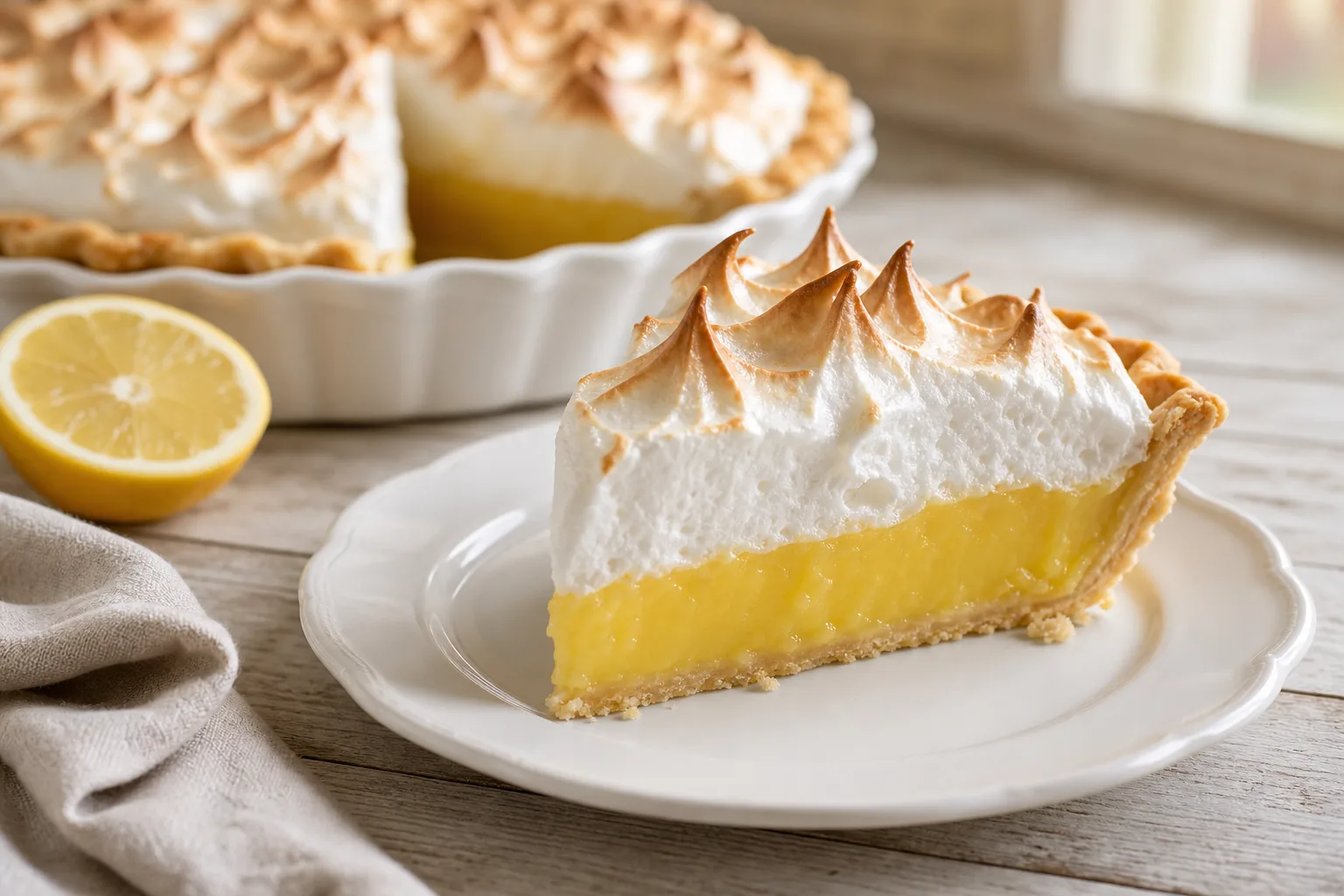
- Bake briefly. Bake at 350°F for 12 to 15 minutes, until the peaks are golden and the ridges are just colored. Pull the pie out when it looks pale gold, not deeply browned. It keeps coloring for a minute or two on the counter.
- Cool in two stages. Let the pie sit at room temperature, uncovered, for 1 hour. Then refrigerate for at least 3 hours, tented loosely so nothing touches the meringue. Slice with a clean, dry, hot knife, wiping it between cuts.
Notes
- Makes one 9-inch pie, about 8 slices. You need 3 to 4 lemons for the zest and 1/2 cup of juice. Use fresh juice, because bottled gives a flat, slightly bitter filling.
The first lemon meringue pie I was proud of looked perfect for about forty minutes. Then I cut into it and found a shallow pool of clear liquid sitting between the lemon and the meringue, and the meringue sliding off the filling like a wet hat. The next one had the opposite problem: tiny amber beads of syrup all over the top, sticky to the touch.
Those are two different failures, and I spent far too many pies treating them as one. Weeping is liquid underneath the meringue. Beading is syrup droplets on top. They have different causes, so they have different fixes, and fixing one does nothing for the other.
This recipe is built around both. The crust and filling are straightforward and reliable. The meringue method is where the work goes, and below I explain what is actually going wrong in each case so you can tell which problem you have and fix it.
Why This Works
Meringue bakes from the top down, so the underside barely cooks unless the filling is hot enough to cook it from below. Spread meringue on a cool filling and the bottom layer stays raw, its proteins let go of water, and that water pools underneath: weeping. Undissolved sugar makes it worse, because sugar grains pull moisture out of the foam. Beading is a separate event at the opposite end of the pie: bake the meringue too long or too hot, the proteins tighten and squeeze dissolved sugar out as syrup. Hot filling and fully dissolved sugar prevent weeping. A short, moderate bake prevents beading.
Ingredients
Makes one 9-inch pie, about 8 slices. You need 3 to 4 lemons for the zest and 1/2 cup of juice. Use fresh juice, because bottled gives a flat, slightly bitter filling.
For the Crust
- 1 1/4 cups all-purpose flour
- 1 tablespoon granulated sugar
- 1/2 teaspoon fine salt
- 1/2 cup (1 stick) cold unsalted butter, cut into small cubes
- 3 to 4 tablespoons ice water
For the Lemon Filling
- 1 1/4 cups granulated sugar
- 1/3 cup cornstarch
- 1/4 teaspoon fine salt
- 1 1/2 cups water
- 4 large egg yolks, lightly beaten
- 2 tablespoons unsalted butter
- 1 tablespoon finely grated lemon zest
- 1/2 cup fresh lemon juice
For the Meringue
- 4 large egg whites, at room temperature
- 1/2 teaspoon cream of tartar
- 2/3 cup superfine sugar (or granulated sugar pulsed in a blender for 20 seconds)
- 1 teaspoon cornstarch
- 1/2 teaspoon vanilla extract
Easy Swap
Short on superfine sugar? Run granulated sugar in a blender for about 20 seconds. The finer crystals dissolve faster into the whites, which directly reduces the chance of weeping.
How to Make It
Prep: 40 minutes | Bake: 55 minutes | Cool or chill: 3 hours | Serves: 8 slices
- Make the dough. Whisk the flour, sugar and salt in a large bowl. Rub or cut in the cold butter until the pieces are the size of small peas. Sprinkle in 3 tablespoons of ice water, toss, and add more by the teaspoon until the dough holds when squeezed. Press into a disk, wrap, and chill for at least 1 hour.
- Shape and blind bake. Heat the oven to 400°F. Roll the dough to a 12-inch round, fit it into a 9-inch pie pan, trim and flute the edge, and freeze for 20 minutes. Line with parchment, fill with pie weights or dried beans, and bake 20 minutes. Remove the weights and bake another 8 to 10 minutes, until the bottom looks dry and the edge is deep golden. Lower the oven to 350°F and leave the shell in the pan.
- Cook the filling base. In a medium saucepan, whisk the sugar, cornstarch and salt, then whisk in the water until smooth. Cook over medium heat, whisking constantly, for 6 to 8 minutes, until the mixture thickens and bubbles. Keep it bubbling for 1 full minute so the cornstarch cooks through and loses its raw taste.
- Temper the yolks. Put the yolks in a bowl. Whisk about 1 cup of the hot mixture into them in a slow stream, then scrape it all back into the saucepan. Cook over medium-low for 2 minutes, whisking, until it is very thick. Off the heat, stir in the butter, zest and lemon juice until glossy. Pour into the warm shell and put the pie in the oven to stay hot while you make the meringue.
- Whip the meringue. In a clean, dry, grease-free bowl, beat the egg whites and cream of tartar until soft peaks form. Mix the cornstarch into the sugar, then add it 1 tablespoon at a time, beating well between additions. Continue until the meringue is stiff and glossy. Rub a little between your thumb and finger: it should feel smooth, with no grit. If you feel grains, keep beating a minute or two and test again. Beat in the vanilla.
- Top the pie while the filling is hot. The filling should be steaming when the meringue goes on, so work quickly. Pile the meringue on, then spread it all the way to the crust so it touches the edge with no gaps. Swoop it into peaks with the back of a spoon.
- Bake briefly. Bake at 350°F for 12 to 15 minutes, until the peaks are golden and the ridges are just colored. Pull the pie out when it looks pale gold, not deeply browned. It keeps coloring for a minute or two on the counter.
- Cool in two stages. Let the pie sit at room temperature, uncovered, for 1 hour. Then refrigerate for at least 3 hours, tented loosely so nothing touches the meringue. Slice with a clean, dry, hot knife, wiping it between cuts.
Don’t Do This
Do not make the meringue first and let it wait while the filling cools. Meringue deflates and gets watery within minutes. Have the whites at room temperature and the bowl ready, and whip them while the filling is still on the stove.
Can You Make This Pie Ahead?
Not Fully — Here Is What You Can Prep
Make the dough up to 2 days ahead and bake the shell the day before, but make the filling and meringue on the day you serve. The filling has to be hot when the meringue goes on, which rules out a fully assembled make-ahead pie.
The dough keeps well, wrapped, in the refrigerator for 2 days or in the freezer for a month. The blind-baked shell keeps overnight at room temperature, loosely covered. Both stages are a good use of time and take real pressure off the day you assemble.
The filling is the part you cannot stage. If it cools before the meringue goes on, you are back to the raw underside and the weeping problem. Meringue also loses volume and gets sticky as it sits, so this pie is at its best the day it is baked.
Leftovers keep in the refrigerator for a day, loosely tented. The meringue gets a little softer and may weep a small amount by day two, and the crust loses crispness. I would not freeze it.
Weeping: The Liquid Under the Meringue
Weeping is the pool of clear or faintly yellow liquid between the filling and the meringue. It usually shows up when you cut the first slice, not before. There are two main causes, and in my pies they were usually both present at once.
The first is a cool filling. The meringue sits on the filling, and the bottom layer of foam only cooks if there is heat coming from below. A filling that has been sitting for half an hour is not hot enough to do that. The bottom of the meringue stays underbaked, its structure collapses, and the water in it drains out. The fix is purely about order of operations: have the meringue whipped and ready, and spread it onto filling that is still steaming.
The second cause is undissolved sugar. Sugar grains that did not melt into the egg whites attract water from the foam and leave small pockets of syrup, which run down and collect under the meringue. Superfine sugar, added slowly, a tablespoon at a time, with real beating between additions, avoids this. Then do the finger-rub test. Smooth means dissolved.
There is also a mechanical cause. If the meringue stops short of the crust, even by a quarter inch, it shrinks back as it bakes and leaves a gap, and the filling’s moisture escapes there. Spread it so it touches the crust all the way around. I think of it as sealing the pie.
Weeping Is Not a Runny Filling
If the lemon layer itself is soupy, that is an undercooked cornstarch problem, not a meringue problem. Weeping is a thin, clear layer of liquid between a set filling and the meringue. Check which one you have before changing anything.
Beading: The Amber Droplets on Top
Beading looks nothing like weeping. These are small, glossy, amber droplets scattered across the top of the meringue, sticky if you touch them. It is the reverse failure: the meringue was cooked too hard.
When meringue bakes too long or too hot, the egg proteins tighten and squeeze out the sugar syrup they were holding. The syrup rises to the surface and forms beads, which caramelize into amber. You are looking at an overbaking problem, and it is why a pie that looks perfectly toasted in the oven can still end up beaded.
The fix is a shorter, gentler bake. I use 350°F for 12 to 15 minutes and pull the pie when the peaks are pale gold. A deeply browned meringue is already past it. If your oven runs hot or the pie is on a high rack, check at 10 minutes. Put the pie on the middle rack so the top is not sitting close to the heating element.
A second cause of beading is humidity and condensation after baking. A pie put in the refrigerator while still warm, or covered with plastic wrap that touches the meringue, collects moisture on the surface, and that moisture dissolves some of the sugar and beads up. That is why I cool the pie uncovered at room temperature first, then chill it with a loose tent that does not touch the top.
Margaret’s Tip
Cover the chilled pie with an upturned large bowl or a tall cake dome instead of plastic wrap. The meringue stays untouched, and condensation has nowhere to sit on it.
Margaret’s Tip
Do the finger-rub test every time. It takes five seconds, and it is the single check that has saved me most often from a weeping pie. Grit means undissolved sugar. Beat longer.
Questions People Ask
Why is there liquid under my meringue?
That is weeping. The usual causes are spreading meringue onto a filling that had cooled, so the underside never cooked, and sugar that was not fully dissolved. Top the pie while the filling is steaming, add superfine sugar slowly, and rub a bit of meringue between your fingers to check for grit before spreading it.
Why are there brown, sticky beads on top of my meringue?
Those beads are sugar syrup squeezed out of overbaked meringue. Bake at 350°F for 12 to 15 minutes and take the pie out when it is pale gold. Also cool it uncovered at room temperature before refrigerating, because trapped condensation can make beads too.
Why does my meringue shrink away from the crust?
Meringue pulls back during baking if it was not anchored. Spread it so it touches the crust all the way around, with no gap, and press it lightly against the edge. That seals the filling and holds the meringue in place.
About This Article

Written by Margaret Chen. Margaret Chen is a home baker and recipe developer with over 15 years of experience perfecting cookie recipes through rigorous testing and detailed experimentation. She tests every recipe multiple times, documents every variable, and applies the same rigor professional bakers use, with the warmth and accessibility of home baking. More about this site.
Scope and limits. Margaret is a home baker and recipe developer with no formal culinary training. Follow current food safety guidance for egg handling, storage, and anything you are serving to other people.
Verify this against a primary source
Specifics change, and your situation may differ from the one described here. These are the authorities worth checking directly:
- USDA FoodData Central — ingredient composition and nutrition data
- FoodSafety.gov — safe handling, storage and egg safety