
Dutch Apple Pie: The Brown Sugar Crumb That Stays Crisp
Dutch apple pie with a brown sugar crumb built on a tested ratio by weight: 155 g flour, 113 g butter, 150 g brown sugar. Crisp, not pasty.
Ingredients
- 1 1/4 cups (160 g) all-purpose flour
- 1 teaspoon granulated sugar
- 1/2 teaspoon fine salt
- 1/2 cup (113 g) cold unsalted butter, cut into 1/2-inch cubes
- 3 to 4 tablespoons ice water
- 3 1/2 pounds (about 7 medium) apples, half Granny Smith and half Honeycrisp, peeled, cored and sliced 1/4 inch thick
- 1/3 cup (65 g) granulated sugar
- 2 tablespoons light brown sugar
- 2 tablespoons cornstarch
- 1 tablespoon lemon juice
- 1 teaspoon ground cinnamon
- 1/4 teaspoon ground nutmeg
- 1/4 teaspoon fine salt
- 1 1/4 cups (155 g) all-purpose flour, spooned and leveled
- 3/4 cup (150 g) light brown sugar, packed
- 1/2 cup (113 g) cold unsalted butter, cut into 1/2-inch cubes
- 1/2 teaspoon ground cinnamon
- 1/4 teaspoon fine salt
Instructions
- Make the crust. Whisk the flour, sugar and salt. Rub in the cold butter with your fingertips until the pieces are pea-sized, then sprinkle in the ice water a tablespoon at a time until the dough holds together when squeezed. Press into a disk, wrap, and refrigerate for at least 1 hour.
- Make the crumb while the dough chills. Whisk the flour, brown sugar, cinnamon and salt in a bowl, pressing out any sugar lumps. Add the cold butter cubes. Rub them in between your fingertips and thumbs, flattening the cubes, until the mixture looks like coarse wet sand with butter pieces no bigger than a hazelnut, about 3 minutes. Squeeze handfuls into clusters ranging from peas to marbles. Cover and refrigerate for at least 20 minutes.
- Shape the shell. Set a rack in the lower third of the oven, put a rimmed baking sheet on it, and heat to 425°F. Roll the dough into a 12-inch circle, fit it into a 9-inch deep-dish pie plate, trim to 1/2 inch past the rim, fold under and crimp. Freeze the shell for 10 minutes.
- Fill. Toss the apples with both sugars, cornstarch, lemon juice, cinnamon, nutmeg and salt. Pile them into the shell, mounding high in the center and pressing gently to close the biggest gaps.
- First bake. Set the pie on the hot baking sheet and bake at 425°F for 20 minutes, until the rim is set and just starting to color. Keep the crumb in the refrigerator until the moment you need it.
- Add the crumb. Pull the pie out and lower the oven to 375°F. Pile the chilled crumb over the apples all the way to the crust edge, about 3/4 inch deep at the center. Press it just enough that it will not roll off, no more. A loose, uneven pile bakes crisper than a packed, smooth one.
- Finish baking. Return the pie to the baking sheet and bake 40 to 45 minutes, until the crumb is deep golden brown, juices bubble at the edges, and a paring knife slides easily through the apples. If the crumb or rim darkens early, tent loosely with foil.
- Cool uncovered. Set the pie on a wire rack and leave it alone for at least 3 1/2 hours. The crumb crisps as it cools and the filling finishes setting. Cut early and you get hot juice and a soft topping.
Notes
- Makes one 9-inch deep-dish pie. Weigh the crumb ingredients if you can; the ratio is what makes this recipe work.
The first Dutch apple pie I made had a crumb that was somehow both pasty and powdery: a damp, doughy layer where it touched the apples and a dry, sandy drift on top that slid off every slice. I made it eleven more times that fall, changing one thing at a time, and almost every fix came back to the same place. It was not the apples or the oven. It was the ratio of flour to butter to brown sugar.
This post is about that ratio and very little else. Below you will find the exact crumb by weight, what happens when you push it wetter or drier, and the moment in the bake when it should go on. The pie underneath is a plain, high-mounded apple filling in a single crust. The crumb is the point.
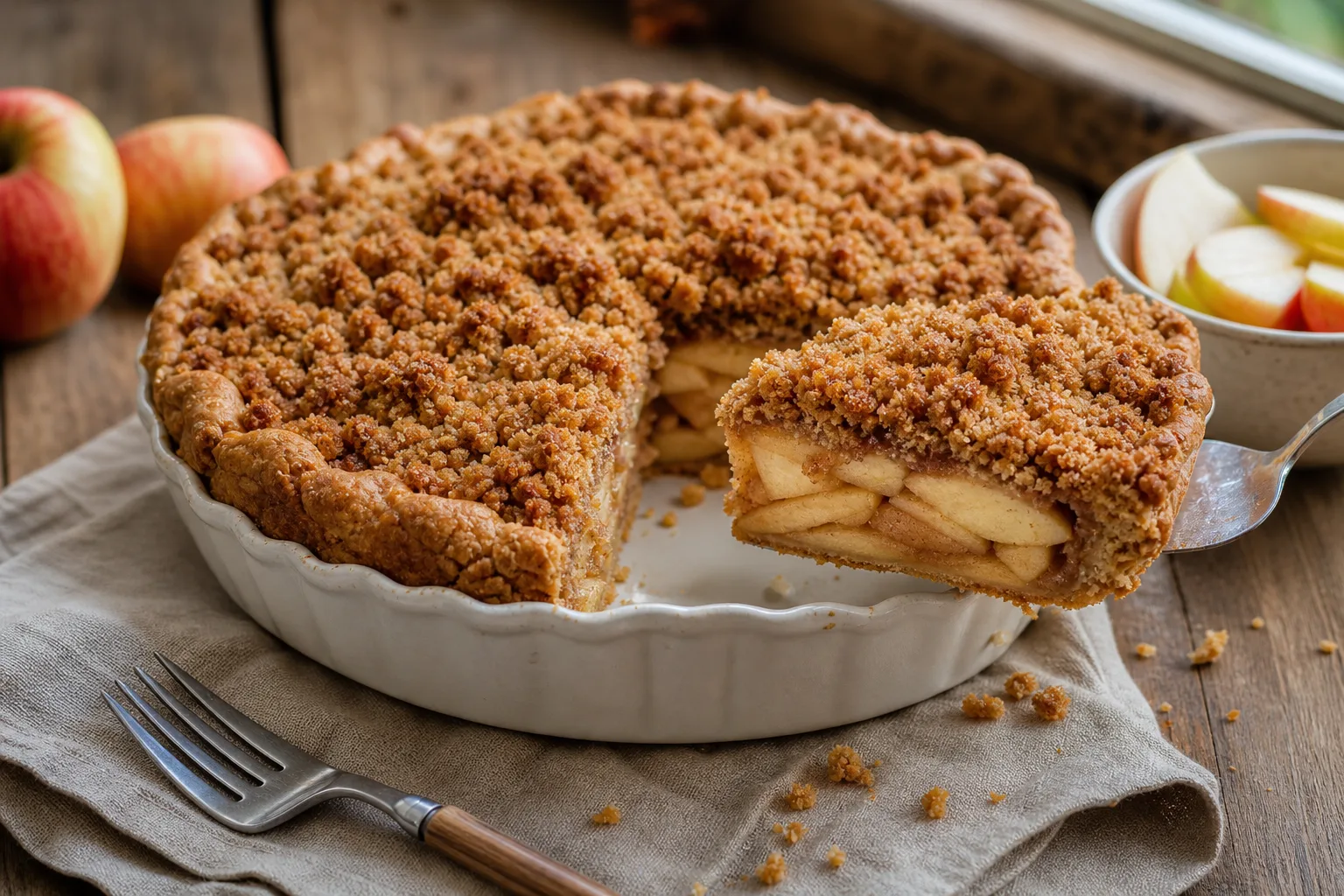
Get it right and the topping bakes into a golden, shattering lid that is still crunchy hours after the pie comes out of the oven. Get it wrong and you have made an expensive streusel soup.
Why This Works
A crumb stays crisp when butter coats the flour in small, separate pieces and the brown sugar has just enough moisture to bind them into clusters, but not enough to melt them into a paste. In my tests the sweet spot is butter at roughly 70 to 75 percent of the flour’s weight and brown sugar at roughly the same weight as the flour. Go wetter than that and the crumb clumps into a slab. Go drier and it powders. Everything else in this recipe exists to protect that balance.
Ingredients
Makes one 9-inch deep-dish pie. Weigh the crumb ingredients if you can; the ratio is what makes this recipe work.
For the Crust
- 1 1/4 cups (160 g) all-purpose flour
- 1 teaspoon granulated sugar
- 1/2 teaspoon fine salt
- 1/2 cup (113 g) cold unsalted butter, cut into 1/2-inch cubes
- 3 to 4 tablespoons ice water
For the Filling
- 3 1/2 pounds (about 7 medium) apples, half Granny Smith and half Honeycrisp, peeled, cored and sliced 1/4 inch thick
- 1/3 cup (65 g) granulated sugar
- 2 tablespoons light brown sugar
- 2 tablespoons cornstarch
- 1 tablespoon lemon juice
- 1 teaspoon ground cinnamon
- 1/4 teaspoon ground nutmeg
- 1/4 teaspoon fine salt
For the Brown Sugar Crumb
- 1 1/4 cups (155 g) all-purpose flour, spooned and leveled
- 3/4 cup (150 g) light brown sugar, packed
- 1/2 cup (113 g) cold unsalted butter, cut into 1/2-inch cubes
- 1/2 teaspoon ground cinnamon
- 1/4 teaspoon fine salt
Oats or Nuts
For a nuttier, more rustic crumb, replace 40 g (about 1/2 cup) of the flour with old-fashioned oats and keep the butter and sugar the same. Oats absorb a little fat, so the mixture will look slightly drier going on. That is expected. Or fold in 1/2 cup chopped pecans after the butter is rubbed in.
How to Make It
Prep: 35 minutes | Bake: 65 minutes | Cool or chill: 3.5 hours | Serves: 8 slices
- Make the crust. Whisk the flour, sugar and salt. Rub in the cold butter with your fingertips until the pieces are pea-sized, then sprinkle in the ice water a tablespoon at a time until the dough holds together when squeezed. Press into a disk, wrap, and refrigerate for at least 1 hour.
- Make the crumb while the dough chills. Whisk the flour, brown sugar, cinnamon and salt in a bowl, pressing out any sugar lumps. Add the cold butter cubes. Rub them in between your fingertips and thumbs, flattening the cubes, until the mixture looks like coarse wet sand with butter pieces no bigger than a hazelnut, about 3 minutes. Squeeze handfuls into clusters ranging from peas to marbles. Cover and refrigerate for at least 20 minutes.
- Shape the shell. Set a rack in the lower third of the oven, put a rimmed baking sheet on it, and heat to 425°F. Roll the dough into a 12-inch circle, fit it into a 9-inch deep-dish pie plate, trim to 1/2 inch past the rim, fold under and crimp. Freeze the shell for 10 minutes.
- Fill. Toss the apples with both sugars, cornstarch, lemon juice, cinnamon, nutmeg and salt. Pile them into the shell, mounding high in the center and pressing gently to close the biggest gaps.
- First bake. Set the pie on the hot baking sheet and bake at 425°F for 20 minutes, until the rim is set and just starting to color. Keep the crumb in the refrigerator until the moment you need it.
- Add the crumb. Pull the pie out and lower the oven to 375°F. Pile the chilled crumb over the apples all the way to the crust edge, about 3/4 inch deep at the center. Press it just enough that it will not roll off, no more. A loose, uneven pile bakes crisper than a packed, smooth one.
- Finish baking. Return the pie to the baking sheet and bake 40 to 45 minutes, until the crumb is deep golden brown, juices bubble at the edges, and a paring knife slides easily through the apples. If the crumb or rim darkens early, tent loosely with foil.
- Cool uncovered. Set the pie on a wire rack and leave it alone for at least 3 1/2 hours. The crumb crisps as it cools and the filling finishes setting. Cut early and you get hot juice and a soft topping.
Don’t Cup-Measure the Crumb
Dipping a measuring cup into the flour bag can pack in 175 g or more where this crumb wants 155 g. That is enough to tip the ratio into powder. Spoon and level the flour, or better, weigh it.
Can You Make This Pie Ahead?
Not Fully — Here Is What You Can Prep
Not as a finished pie. The dough and the crumb both hold beautifully, so stage those, then assemble and bake the pie on the day you plan to serve it. The crumb is the one component that does not suffer from waiting.
The dough disk keeps in the refrigerator for 2 days or in the freezer for a month. The crumb keeps in an airtight container for 3 days in the refrigerator or 3 months in the freezer. Put it on the partly baked pie straight from the freezer, no thawing. In my tests frozen crumb held its clusters even better, because the butter was stiffer going into the oven.
Do not fill the shell ahead. Raw apples start to release juice within the hour, and the shell turns damp before it ever sees heat. A fully baked pie keeps loosely covered at room temperature for about 2 days, but the crumb softens as the apples give off moisture. Refresh it on a rack at 350°F for 10 to 15 minutes. I avoid the refrigerator, which softens the crumb faster.
The Ratio by Weight: 155 Flour, 113 Butter, 150 Brown Sugar
Here is the whole crumb as a ratio: 155 g all-purpose flour, 113 g cold butter, 150 g light brown sugar. Divide each by the flour and you get 1 : 0.73 : 0.97. Butter is about three-quarters of the flour’s weight, and the sugar is almost exactly equal to it. In cups that reads as 1 1/4 cups flour, 1/2 cup (one stick) butter and 3/4 cup packed brown sugar, a perfectly familiar crumb. The weights are what make it repeatable.
I tested the ratio up and down in steps of about 10 percent, changing one ingredient per pie and keeping the apples, the pan and the oven the same. Butter at 90 percent of the flour’s weight baked into a flat, hard cap closer to a cookie than a crumb. Butter at 55 percent never clumped, stayed pale and sandy, and slid off the slices. Sugar well above the flour’s weight melted into a glassy sheet that stuck to the teeth. Sugar well below it baked pale and bready, with a floury taste. The window around the recipe’s numbers is narrow, and about 10 percent either way is where the texture starts to change.
Brown sugar is the quiet variable. It carries molasses, and molasses carries moisture, so a packed 3/4 cup can weigh anywhere from 140 to 180 g depending on how hard you pack it and how fresh the bag is. A hard, half-dried bag gives a drier crumb than the same cups of soft sugar. A scale settles all of that. This is the one recipe on the site where I would tell you to weigh instead of scoop.
When the Crumb Goes On, and How It Stays Crisp
Timing is the second half of the ratio. Put the crumb on at the start and it spends well over an hour in the oven. At 425°F it darkens past golden long before the apples are tender, and by the time you tent it the sugar has gone bitter. Put it on at the very end and it never fuses, sitting on the filling as loose crumbs instead of a lid. I add it at the 20-minute mark. The crust is set, so the crumb has something firm to sit on, and the oven drops to 375°F for a gentler 40 to 45 minutes.
Put it on cold. Chilled butter melts slowly, so the clusters keep their shape while the sugar caramelizes instead of slumping and pooling. Pile it loosely and resist the urge to pat it down. Packing turns it into one dense slab, which is the same failure as too much butter.
Crisp is also decided after the oven. Three and a half pounds of hot apples are giving off steam, and it has nowhere to go but up through the crumb. Cool the pie uncovered on a rack and the crumb dries as it cools, the sugar setting from caramel to glass. Cover it warm and you are steaming it. Once it is fully cool, leave it uncovered for the first few hours, then tent it loosely.
Margaret’s Tip
Squeeze a handful in your fist before it goes on the pie. It should hold its shape and break into a few clusters when you open your hand. If it falls apart like sand, work in 1 tablespoon of soft butter. If it smears on your palm, work in 2 tablespoons of flour and chill it again.
Questions People Ask
Can I use melted butter for the crumb?
You can, but it behaves differently. Melted butter coats all the flour at once, so the mixture comes together in large, dense clumps and bakes chewy and slightly greasy-feeling instead of crisp. In my side-by-side it made a chewier topping with fewer separate pieces. If you like that, use the same weight. For crisp, stay with cold butter.
Why did my crumb sink into the filling?
Usually because it went onto a raw, soft pie, or because it was warm and the butter melted before the crumb could set. Adding it after a 20-minute bake at 425°F gives it a firm surface, and chilling it keeps the pieces distinct. Mounding the apples high helps too.
Why is the crumb soft the next day?
Moisture moves. The apples underneath hold a lot of water, and over several hours it migrates up into the sugar in the crumb, which absorbs it readily. The refrigerator speeds this up. Re-crisp the pie or slices on a rack in a 350°F oven for 10 to 15 minutes.
About This Article

Written by Margaret Chen. Margaret Chen is a home baker and recipe developer with over 15 years of experience perfecting cookie recipes through rigorous testing and detailed experimentation. She tests every recipe multiple times, documents every variable, and applies the same rigor professional bakers use, with the warmth and accessibility of home baking. More about this site.
Scope and limits. Margaret is a home baker and recipe developer with no formal culinary training. Follow current food safety guidance for egg handling, storage, and anything you are serving to other people.
Verify this against a primary source
Specifics change, and your situation may differ from the one described here. These are the authorities worth checking directly:
- USDA FoodData Central — ingredient composition and nutrition data
- FoodSafety.gov — safe handling, storage and egg safety