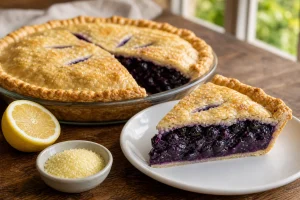

Classic Double-Crust Blueberry Pie: Thickening the Wettest Berry
A double-crust blueberry pie that actually holds a slice. Learn how much cornstarch a pound of berries needs and why mashing some of them matters.
Ingredients
- 2 1/2 cups (315 g) all-purpose flour, plus more for rolling
- 1 tablespoon granulated sugar
- 1 teaspoon fine salt
- 1 cup (2 sticks, 226 g) cold unsalted butter, cut into 1/2-inch cubes
- 6 to 8 tablespoons ice water
- 30 ounces (about 6 cups) fresh or frozen blueberries, divided
- 3/4 cup (150 g) granulated sugar
- 1/4 cup (30 g) cornstarch
- 2 tablespoons water
- 1 tablespoon fresh lemon juice
- 1/4 teaspoon fine salt
- 1 tablespoon cold unsalted butter, cut into small pieces
- 1 large egg, beaten with 1 tablespoon water
- 1 tablespoon coarse sugar
Instructions
- Make the dough. Whisk the flour, sugar and salt in a large bowl. Work in the butter with your fingertips or a pastry cutter until the largest pieces are the size of peas. Sprinkle in 6 tablespoons of ice water and toss with a fork; add more only until the dough holds together when squeezed. Divide into two discs, one slightly larger, wrap tightly and chill for at least 1 hour.
- Heat the oven to 425°F with a rack in the lower third and a rimmed baking sheet on the rack. The hot sheet starts browning the bottom crust right away and catches any drips.
- Make the thickened portion. Put 2 cups of the blueberries in a medium saucepan with the water, lemon juice, 1/4 cup of the sugar and the salt. Cook over medium heat, mashing with a spoon or potato masher as the berries soften, for about 4 minutes, until they have broken down into a loose, juicy purple mash.
- Whisk the cornstarch into the remaining 1/2 cup sugar so it disperses without lumps, then stir it into the hot mash. Keep cooking, stirring constantly, for 1 to 2 minutes until the mixture turns glossy, thickens noticeably and large bubbles break the surface slowly. Remove from the heat and let it cool for 10 minutes.
- Fold in the remaining 4 cups of whole berries gently, so most of them stay intact. The filling should look like whole berries suspended in a thick jam, with no free-flowing liquid pooling in the bowl.
- Roll out the larger disc on a floured surface to a 12-inch round, about 1/8 inch thick, and ease it into a 9-inch pie plate. Pour in the filling and dot with the butter. Roll the second disc, then cover the pie, trim and crimp the edges, and cut 5 or 6 slits in the top for steam. Chill the assembled pie for 15 minutes.
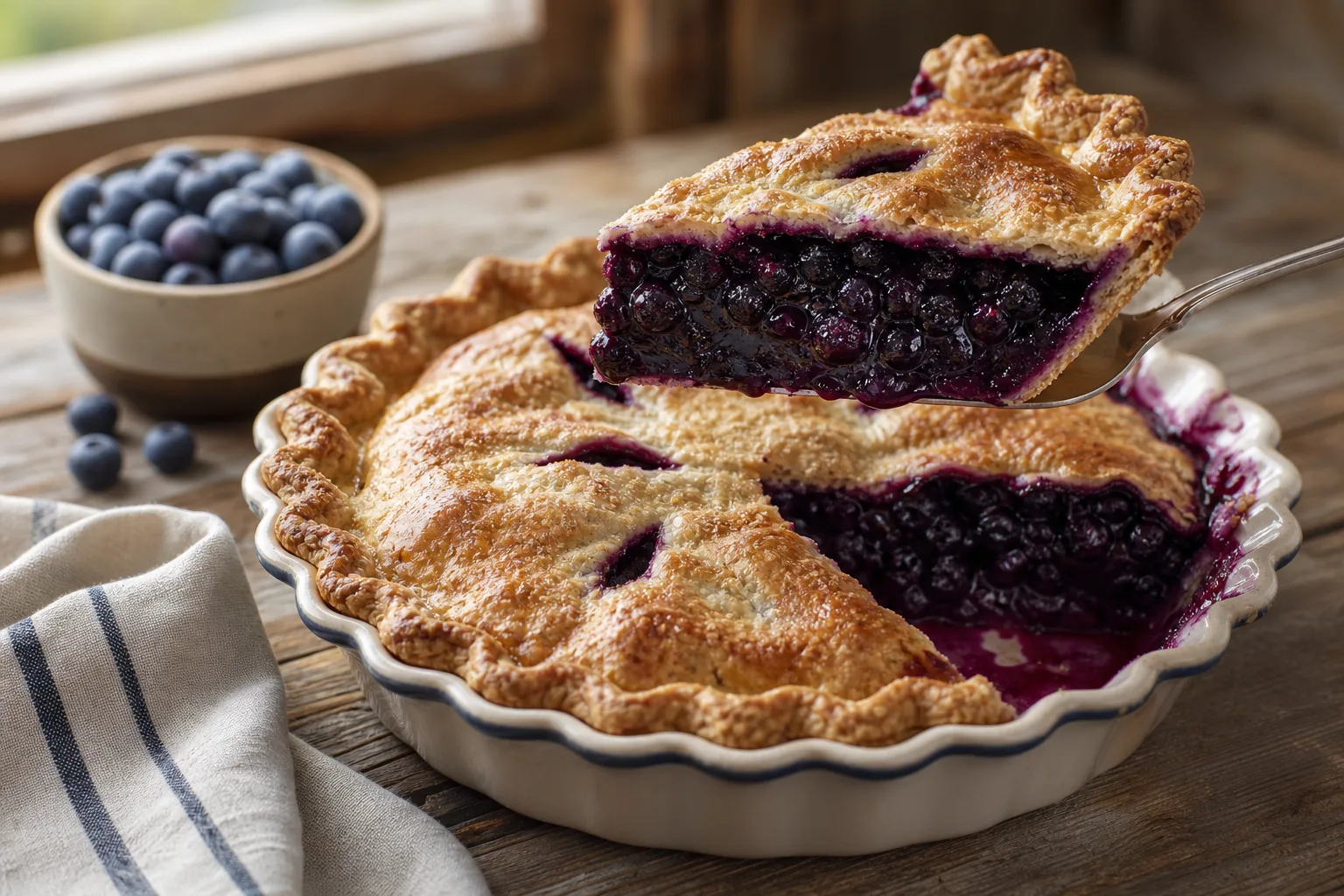
- Brush the top with the egg wash and sprinkle with coarse sugar. Set the pie on the hot baking sheet and bake for 20 minutes, then reduce the oven to 375°F and bake 40 to 45 minutes more, until the crust is deep golden and the filling bubbles thickly through the vents, with slow, fat bubbles rather than quick, thin ones. Tent with foil if the edges darken early.
- Cool the pie on a wire rack for at least 4 hours before slicing. The starch finishes setting as it cools, and a pie cut warm will run no matter how well it was thickened.
Notes
- Filling is built on 30 ounces (about 6 cups) of blueberries for a standard 9-inch pie plate. Weigh them if you can; a heaped cup and a level cup differ enough to matter here.
The first blueberry pie I ever served looked wonderful and sliced like a bowl of soup. The top crust was a deep, even gold, and the moment the knife went in, a purple tide ran across the plate and soaked straight into the bottom crust. I had followed the recipe exactly. It called for three tablespoons of cornstarch, and I assumed the failure was somewhere in my technique.
It wasn’t. The problem was arithmetic. I went back to that pie for most of a summer, changing one thing at a time, and the thickener amount turned out to be the whole story. Blueberries are the wettest common pie fruit, they are small and round so they pack with large air gaps, and most recipes quietly underdose the starch because they were written for apples.
This post is about that one variable: how much thickener a pound of blueberries actually needs, why the usual amount fails, and a short step in the middle of the recipe where you mash and cook a portion of the berries so the filling thickens itself before it ever reaches the oven.
Why This Works
Blueberries release a large volume of juice, and their skins keep much of it trapped until the oven heat bursts them. Starch only works on liquid it can reach and only gels once it is fully hot, so a pie needs enough starch for the juice that will actually flood out, plus a head start. Cooking down and mashing a portion of the berries first releases their natural pectin and gets that juice thickening before the pie is assembled, so the filling is already set in the pan instead of racing the clock in the oven.
Ingredients
Filling is built on 30 ounces (about 6 cups) of blueberries for a standard 9-inch pie plate. Weigh them if you can; a heaped cup and a level cup differ enough to matter here.
For the Crust
- 2 1/2 cups (315 g) all-purpose flour, plus more for rolling
- 1 tablespoon granulated sugar
- 1 teaspoon fine salt
- 1 cup (2 sticks, 226 g) cold unsalted butter, cut into 1/2-inch cubes
- 6 to 8 tablespoons ice water
For the Filling
- 30 ounces (about 6 cups) fresh or frozen blueberries, divided
- 3/4 cup (150 g) granulated sugar
- 1/4 cup (30 g) cornstarch
- 2 tablespoons water
- 1 tablespoon fresh lemon juice
- 1/4 teaspoon fine salt
- 1 tablespoon cold unsalted butter, cut into small pieces
For Finishing
- 1 large egg, beaten with 1 tablespoon water
- 1 tablespoon coarse sugar
Easy Swap
Frozen blueberries work well and need no thawing. Use them straight from the freezer and add 1 extra tablespoon of cornstarch, because they shed more juice as they heat. Cook the mashed portion for an extra minute to account for the ice.
How to Make It
Prep: 45 minutes | Bake: 60 minutes | Cool or chill: 4 hours | Serves: 8 slices
- Make the dough. Whisk the flour, sugar and salt in a large bowl. Work in the butter with your fingertips or a pastry cutter until the largest pieces are the size of peas. Sprinkle in 6 tablespoons of ice water and toss with a fork; add more only until the dough holds together when squeezed. Divide into two discs, one slightly larger, wrap tightly and chill for at least 1 hour.
- Heat the oven to 425°F with a rack in the lower third and a rimmed baking sheet on the rack. The hot sheet starts browning the bottom crust right away and catches any drips.
- Make the thickened portion. Put 2 cups of the blueberries in a medium saucepan with the water, lemon juice, 1/4 cup of the sugar and the salt. Cook over medium heat, mashing with a spoon or potato masher as the berries soften, for about 4 minutes, until they have broken down into a loose, juicy purple mash.
- Whisk the cornstarch into the remaining 1/2 cup sugar so it disperses without lumps, then stir it into the hot mash. Keep cooking, stirring constantly, for 1 to 2 minutes until the mixture turns glossy, thickens noticeably and large bubbles break the surface slowly. Remove from the heat and let it cool for 10 minutes.
- Fold in the remaining 4 cups of whole berries gently, so most of them stay intact. The filling should look like whole berries suspended in a thick jam, with no free-flowing liquid pooling in the bowl.
- Roll out the larger disc on a floured surface to a 12-inch round, about 1/8 inch thick, and ease it into a 9-inch pie plate. Pour in the filling and dot with the butter. Roll the second disc, then cover the pie, trim and crimp the edges, and cut 5 or 6 slits in the top for steam. Chill the assembled pie for 15 minutes.
- Brush the top with the egg wash and sprinkle with coarse sugar. Set the pie on the hot baking sheet and bake for 20 minutes, then reduce the oven to 375°F and bake 40 to 45 minutes more, until the crust is deep golden and the filling bubbles thickly through the vents, with slow, fat bubbles rather than quick, thin ones. Tent with foil if the edges darken early.
- Cool the pie on a wire rack for at least 4 hours before slicing. The starch finishes setting as it cools, and a pie cut warm will run no matter how well it was thickened.
Don’t Do This
Don’t cut the cornstarch back to the 2 or 3 tablespoons many recipes call for, and don’t skip the full cooling time. Under-thickened filling and a warm slice are the two reasons blueberry pies run, and neither one can be fixed after baking.
Can You Make This Pie Ahead?
Not Fully — Here Is What You Can Prep
The dough and the cooked, cooled filling can both be prepared a day ahead, but the assembled pie should be baked the day it is built. Assembled and refrigerated overnight, the bottom crust turns damp before it ever reaches the oven.
The dough keeps for 2 days in the refrigerator or 2 months wrapped well in the freezer; thaw frozen discs overnight in the refrigerator. The thickened filling can be cooled completely, covered, and refrigerated for a day. Bring it close to room temperature before filling the crust, since cold filling in a cold crust bakes unevenly.
Once the pie is baked, it is best the day it is made. Cooled and covered loosely at room temperature, it keeps for 2 days; after that, refrigerate it and expect the crust to soften. A slice reheated for 10 minutes in a 350°F oven recovers some crispness. I would not freeze a baked blueberry pie, as the filling releases water on thawing and the bottom crust suffers.
How Much Thickener a Pound of Blueberries Actually Needs
Most blueberry pie recipes call for 3 tablespoons of cornstarch against 5 to 6 cups of berries. I tested that ratio, and it produced a filling that looked set in the oven and ran as soon as the knife went in. My working number is closer to 1/4 cup (about 30 grams) of cornstarch for 30 ounces of fruit. That is roughly 2 tablespoons per pound plus a little extra for insurance.
The reason is the volume of liquid. A blueberry is small and round, so a pie packed with them has a lot of dead air, and as the berries heat, their skins split and that air space fills with juice. An apple pie has fruit that collapses and settles into itself; a blueberry pie has fruit that floods. Starch can only thicken what it is surrounded by, and 3 tablespoons spread across that much juice leaves a loose, syrupy liquid.
I made the same pie three times, changing only the cornstarch: 3 tablespoons, 4 tablespoons and 5 tablespoons. At 3, it flooded the plate. At 5, the filling set stiff and slightly gluey, the sort of texture that tastes more of starch than fruit. At 4, it held its shape and still tasted like blueberries, so that is the number in the recipe above.
Margaret’s Tip
Weigh your berries. A pint of blueberries ranges from about 9 to 12 ounces depending on how tightly they are packed, so a recipe that says ‘two pints’ can differ in fruit by 25 percent. Thickener ratios only mean something when the fruit is measured by weight.
Why Mashing a Portion Changes Everything
Raising the cornstarch is half the fix. The other half is a technique I now use for every berry pie: cook and mash about a third of the fruit before assembling. When the berries break down, they release their own pectin, and the mash becomes a thick, jammy base. Stirring the starch into that hot mash gets it fully gelled on the stovetop, where you can see it happen, instead of hoping it reaches the right temperature somewhere in the center of a pie.
Cornstarch needs to reach a full bubble to reach its maximum thickening power. In a closed pie, the center of the filling takes a long time to get that hot, and by then the juice has already soaked into the bottom crust. A pre-thickened base gives you control. The filling is largely set before the oven, and baking only has to warm it through and finish the crust.
The whole berries folded in afterward give the pie its texture. You get distinct, plump berries suspended in a thick, glossy filling, instead of either a uniform jam or loose fruit in thin syrup. I tested a version where I cooked all the berries, and the filling set well but tasted like a flat preserve. A third mashed, two-thirds whole, was the balance that worked.
Don’t Do This
Don’t pull the pie when the crust looks done but the bubbling is still thin and fast. The crust and the filling finish on different schedules. Foil the edges and keep baking until the center vents show thick, slow bubbles, then give it the full 4 hours to cool before you cut.
Margaret’s Tip
Test your filling before it goes in the crust. Spoon a little onto a cold plate, wait 30 seconds, and tilt the plate. If it creeps more than an inch, cook the mash another minute. It is an easier fix on the stovetop than in the pie.
Questions People Ask
How much cornstarch do I need for a blueberry pie?
For a 9-inch double-crust pie with about 30 ounces of blueberries, I use 1/4 cup of cornstarch, or roughly 2 tablespoons per pound plus a little extra. The 3 tablespoons many recipes call for leaves the filling loose, because blueberries release far more juice than their size suggests.
Why is my blueberry pie runny even though I used cornstarch?
There are usually three causes: too little starch for the volume of fruit, the filling never reaching a full bubble in the oven, or slicing the pie before it has cooled for at least 4 hours. Cooking and mashing part of the berries first with the starch addresses the first two, and the cooling time handles the third.
Can I use flour or tapioca instead of cornstarch?
Yes, with adjustments. All-purpose flour is a weaker thickener, so use about double the amount, and it produces a cloudier, slightly pasty filling. Quick-cooking tapioca works at roughly the same amount as cornstarch and gives a clear, glossy set, though you may find small pearls in the finished pie. I prefer cornstarch for the cleanest result.
About This Article

Written by Margaret Chen. Margaret Chen is a home baker and recipe developer with over 15 years of experience perfecting cookie recipes through rigorous testing and detailed experimentation. She tests every recipe multiple times, documents every variable, and applies the same rigor professional bakers use, with the warmth and accessibility of home baking. More about this site.
Scope and limits. Margaret is a home baker and recipe developer with no formal culinary training. Follow current food safety guidance for egg handling, storage, and anything you are serving to other people.
Verify this against a primary source
Specifics change, and your situation may differ from the one described here. These are the authorities worth checking directly:
- USDA FoodData Central — ingredient composition and nutrition data
- FoodSafety.gov — safe handling, storage and egg safety