
Blueberry Crumb Pie: Oat Crumb on a Wet Filling
A blueberry crumb pie with an oat crumb that soaks up stray juice, plus the flour-to-oat ratio, butter amount, and bake cues that keep it crisp.
Ingredients
- 1 1/4 cups all-purpose flour
- 1 teaspoon granulated sugar
- 1/2 teaspoon fine salt
- 1/2 cup (1 stick) cold unsalted butter, cubed
- 3 to 4 tablespoons ice water
- 6 cups blueberries, fresh or frozen (do not thaw)
- 2/3 cup granulated sugar
- 3 tablespoons cornstarch
- 1 tablespoon lemon juice
- 1 teaspoon lemon zest
- 1/2 teaspoon ground cinnamon
- 1/4 teaspoon fine salt
- 3/4 cup all-purpose flour
- 3/4 cup old-fashioned rolled oats
- 1/2 cup packed light brown sugar
- 1/2 teaspoon ground cinnamon
- 1/4 teaspoon fine salt
- 8 tablespoons (1 stick) cold unsalted butter, cubed
Instructions
- Make the dough. Whisk the flour, sugar, and salt. Work in the cold butter with your fingertips until the largest pieces are the size of peas. Sprinkle over 3 tablespoons ice water and toss with a fork. Squeeze a handful: if it holds, it is ready; if not, add water a teaspoon at a time. Press into a disk and chill at least 1 hour, or up to 2 days.
- Shape the shell. Heat the oven to 400°F with a rack in the lower third and a rimmed baking sheet on it. Roll the dough into a 12-inch round, fit it into a 9-inch pie plate, trim to a 1-inch overhang, tuck under, and crimp. Freeze the shell for 20 minutes.
- Blind bake. Line the shell with parchment, fill with pie weights or dried beans, and bake 15 minutes. Lift out the parchment and weights and bake 5 to 6 minutes more, until the bottom looks dry and pale gold. Lower the oven to 375°F.
- Make the crumb. Whisk the flour, oats, brown sugar, cinnamon, and salt. Add the cubed butter and rub it in with your fingertips until the mixture looks shaggy, with sandy bits and clumps from pea to marble size. Squeeze a few handfuls into bigger clumps, then refrigerate.
- Make the filling. Toss the blueberries with the sugar, cornstarch, lemon juice, zest, cinnamon, and salt until no dry cornstarch remains. Pour into the warm shell right away and mound it slightly in the center.
- Top the pie. Scatter the crumb over the berries in loose handfuls, all the way to the crimped rim so no berries are exposed. Press only enough to nestle the clumps together. Do not pack it down.
- Bake. Set the pie on the hot baking sheet and bake 55 to 65 minutes, or up to 70 with frozen berries. It is done when the crumb is deep golden and thick, slow bubbles break in the center of the filling, not just at the edges. If the crumb is already dark at 40 minutes, tent loosely with foil.
- Cool completely. Move the pie to a wire rack and leave it at least 4 hours. The filling finishes setting as it cools, and cutting early will let it run.
- Serve. Slice with a sharp knife, wiping the blade between cuts, and serve at room temperature.
Notes
- Makes one 9-inch pie, about 8 slices. Six cups of blueberries is roughly 1 3/4 pounds, fresh or frozen.
The first blueberry crumb pie I made had a perfectly respectable flour-and-butter streusel, and by the time it cooled, the underside of that crumb had gone gummy where the berry juice crept up into it. The filling was fine. The topping was the problem.
The fix was not a better filling. It was replacing part of the flour in the crumb with old-fashioned rolled oats. Oats are thirsty, so the layer of crumb sitting directly on the berries takes on some of the juice that would otherwise pool at the edge of the slice. It is a modest effect, and I will be straight about what it can and cannot do, but it is real, and it changes the ratio of flour, butter, and sugar.
This post is about that crumb: how much oat, how much flour, how much butter, and what it looks like when the proportions are right. The filling is a plain cornstarch-thickened blueberry filling, kept simple on purpose so the crumb is what you are testing.
Why This Works
An oat crumb pairs better with a wet filling than a all-purpose flour crumb because rolled oats absorb some of the juice that rises into the topping’s underside, so that layer turns chewy and toasty instead of pasty. The flour is cut to make room for the oats, and the butter and sugar are set so the crumb still clumps and still crisps.
Ingredients
Makes one 9-inch pie, about 8 slices. Six cups of blueberries is roughly 1 3/4 pounds, fresh or frozen.
For the Crust
- 1 1/4 cups all-purpose flour
- 1 teaspoon granulated sugar
- 1/2 teaspoon fine salt
- 1/2 cup (1 stick) cold unsalted butter, cubed
- 3 to 4 tablespoons ice water
For the Filling
- 6 cups blueberries, fresh or frozen (do not thaw)
- 2/3 cup granulated sugar
- 3 tablespoons cornstarch
- 1 tablespoon lemon juice
- 1 teaspoon lemon zest
- 1/2 teaspoon ground cinnamon
- 1/4 teaspoon fine salt
For the Oat Crumb
- 3/4 cup all-purpose flour
- 3/4 cup old-fashioned rolled oats
- 1/2 cup packed light brown sugar
- 1/2 teaspoon ground cinnamon
- 1/4 teaspoon fine salt
- 8 tablespoons (1 stick) cold unsalted butter, cubed
Easy Swap
For a gluten-free crumb, use rolled oats labeled gluten-free and replace the flour with a 1:1 gluten-free baking blend. The crumb behaves almost the same. The crust needs its own gluten-free recipe.
How to Make It
Prep: 35 minutes | Bake: 80 minutes | Cool or chill: 4 hours | Serves: 8 slices
- Make the dough. Whisk the flour, sugar, and salt. Work in the cold butter with your fingertips until the largest pieces are the size of peas. Sprinkle over 3 tablespoons ice water and toss with a fork. Squeeze a handful: if it holds, it is ready; if not, add water a teaspoon at a time. Press into a disk and chill at least 1 hour, or up to 2 days.
- Shape the shell. Heat the oven to 400°F with a rack in the lower third and a rimmed baking sheet on it. Roll the dough into a 12-inch round, fit it into a 9-inch pie plate, trim to a 1-inch overhang, tuck under, and crimp. Freeze the shell for 20 minutes.
- Blind bake. Line the shell with parchment, fill with pie weights or dried beans, and bake 15 minutes. Lift out the parchment and weights and bake 5 to 6 minutes more, until the bottom looks dry and pale gold. Lower the oven to 375°F.
- Make the crumb. Whisk the flour, oats, brown sugar, cinnamon, and salt. Add the cubed butter and rub it in with your fingertips until the mixture looks shaggy, with sandy bits and clumps from pea to marble size. Squeeze a few handfuls into bigger clumps, then refrigerate.
- Make the filling. Toss the blueberries with the sugar, cornstarch, lemon juice, zest, cinnamon, and salt until no dry cornstarch remains. Pour into the warm shell right away and mound it slightly in the center.
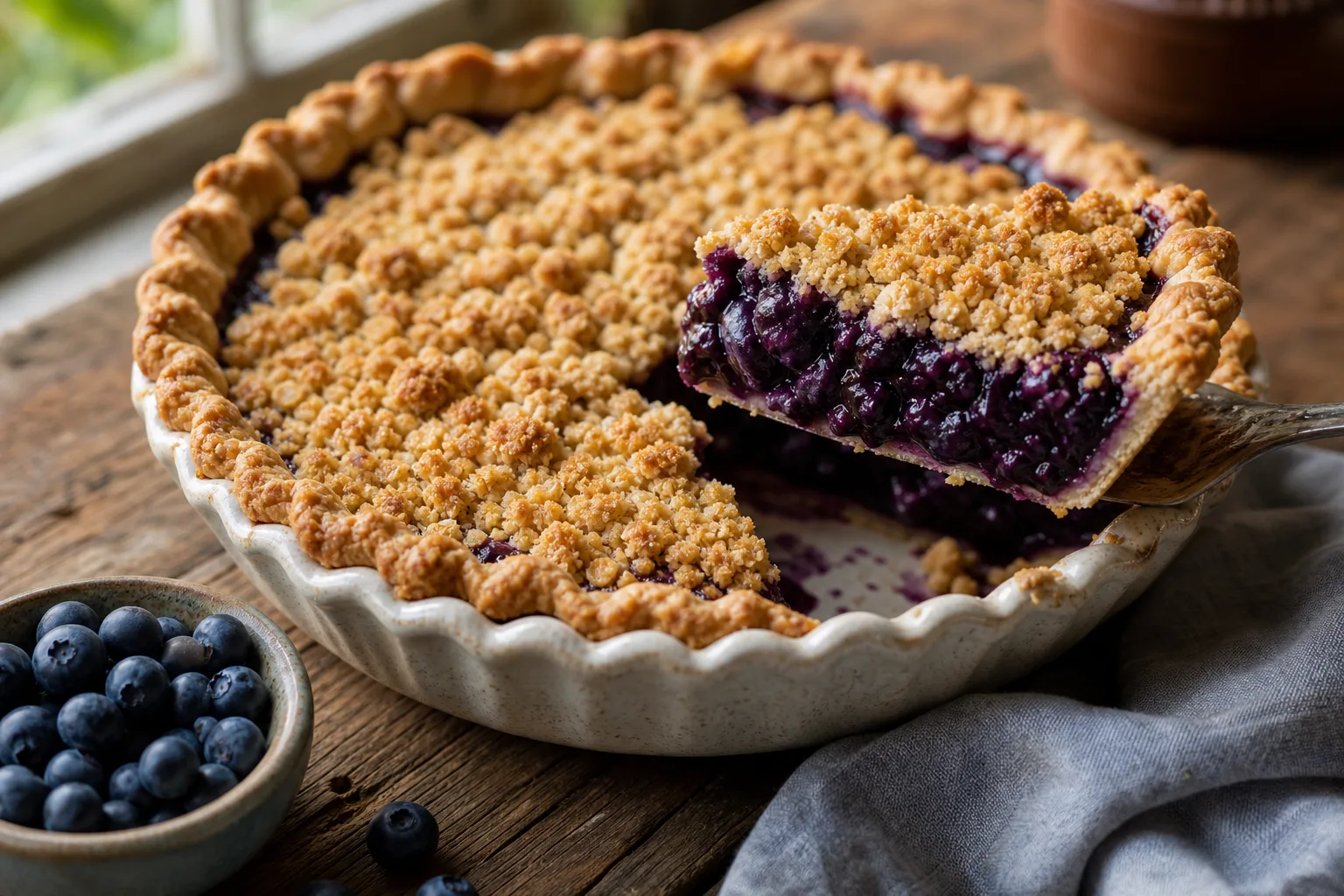
- Top the pie. Scatter the crumb over the berries in loose handfuls, all the way to the crimped rim so no berries are exposed. Press only enough to nestle the clumps together. Do not pack it down.
- Bake. Set the pie on the hot baking sheet and bake 55 to 65 minutes, or up to 70 with frozen berries. It is done when the crumb is deep golden and thick, slow bubbles break in the center of the filling, not just at the edges. If the crumb is already dark at 40 minutes, tent loosely with foil.
- Cool completely. Move the pie to a wire rack and leave it at least 4 hours. The filling finishes setting as it cools, and cutting early will let it run.
- Serve. Slice with a sharp knife, wiping the blade between cuts, and serve at room temperature.
Don’t Do This
Do not press the crumb into a solid cap. A packed topping bakes like a lid, traps steam, and leaves the oats on its underside damp. Scatter it loosely so steam escapes between the clumps.
Can You Make This Pie Ahead?
Yes — Here Is the Timeline
Yes. Bake the whole pie a day ahead, cool it completely, and keep it loosely covered at room temperature. The oat crumb softens a little overnight, and 10 minutes in a 325°F oven brings the crispness back.
The components stage easily: dough keeps 2 days in the refrigerator or a month in the freezer, and the crumb keeps 3 days refrigerated or a month frozen. Frozen crumb goes straight onto the pie, no thawing. I often make a double batch of crumb and freeze half.
For the finished pie, cool it fully, cover loosely with foil, and hold it at room temperature up to 24 hours. After that, refrigerate for up to 3 days and reheat at 325°F for 10 to 15 minutes. The refrigerator softens both the crust and the crumb, so reheating matters.
You can also assemble the pie unbaked, freeze it solid, wrap it well, and bake from frozen at 375°F, adding 20 to 25 minutes and tenting with foil once the crumb colors.
What Oats Do to a Wet Filling That Flour Doesn’t
Blueberries release liquid in two stages. First, sugar draws juice out of the berries while the pie waits. Then, in the oven, the skins split and the remainder comes out as the cornstarch gels. Some of that juice always travels upward through the gaps between berries into whatever sits on top. With a all-purpose flour crumb, that creates a paste layer: the flour hydrates, the butter around it cannot stop it, and the bottom quarter inch of the topping goes from sandy to gluey.
Rolled oats behave differently because they are flakes, not powder. Each flake is thick with a porous surface, so it takes up liquid slowly and swells to a chewy texture rather than dissolving. I want to be realistic about the size of the effect. The oats absorb a share of the stray juice at the interface, but they are not a thickener. The cornstarch in the filling still sets the berries. What the oats do is keep the underside of the crumb from turning to paste and cut down the little ring of free juice that otherwise collects where the crumb meets the crust.
I tested this side by side with the same filling, shell, and oven. The flour-only crumb had a pale, damp underside and more juice at the rim of the slice. The oat crumb had a chewy, toasted underside and a tidier slice. The difference was not dramatic, but I saw it every time.
The Ratio: Equal Flour and Oats, and a Full Stick of Butter
A typical flour crumb runs about 1 cup flour, 1/2 cup sugar, and 1/2 cup butter. For this pie I cut the flour to 3/4 cup and add 3/4 cup oats, so flour and oats are equal parts by volume. That leaves enough flour to bind the clumps and enough oats to absorb juice. With more oats than flour, the crumb turns granola-like and falls apart under the knife. With much less than a third oats, you lose the effect.
The butter is the counterintuitive part. You would expect to cut it as the flour goes down, but oats soak up butter too. At 6 tablespoons my oat crumb was dry and would not clump. At 10 it spread and turned greasy. Eight tablespoons, a full stick, gave clumps that held when squeezed and still crisped.
Light brown sugar works better than white here. Its moisture helps the clumps hold together, and molasses and toasted oats go well together. Keep the butter cold and rub it in only until the mixture looks shaggy. A mix of pea-size and marble-size clumps is the goal: the big ones stay crunchy, and the small ones settle into the berries.
Use Old-Fashioned Rolled Oats
Quick oats are cut finer and absorb too fast, so they melt into the juice and make the same paste you were trying to avoid. Steel-cut oats stay hard and taste raw. Old-fashioned rolled oats are the only kind that works here.
Baking and Cooling Under an Oat Crumb
Oats brown faster than a flour crumb. The flakes sit at the surface and toast while the sugar caramelizes around them, so the top can look done while the filling is still lazy. Check at 40 minutes. If the crumb is the color you want, tent loosely with foil and keep baking. Color is not the doneness cue. Thick, slow bubbles in the middle of the pie are. Bubbling at the edge only tells you the outside is hot.
Bake on a preheated sheet on the lower rack. It gives the bottom crust a direct blast of heat and catches any drips.
Cooling is part of the recipe. The oats keep absorbing as the pie cools, and the cornstarch finishes setting, which is why the 4 hours matter. Cut at one hour and the filling runs. At four hours the crumb is chewy and crisp, and the slice stands up on the plate.
Margaret’s Tip
Before scattering, flatten a handful of crumb clumps between your fingers into thin shards. They bake into crisp, flaky bits that give the top some contrast against the chewier layer below.
Questions People Ask
Do the oats replace the cornstarch in the filling?
No. The oats absorb some stray juice at the underside of the crumb, but they do not set the berries. Without the cornstarch in the filling you will still get a runny pie, just with a slightly better topping.
Why is my oat crumb soggy on top?
Usually it was packed too tightly and trapped steam, the butter was warm when rubbed in, or the pie came out before the filling bubbled in the center. Scatter the crumb loosely, keep the butter cold, and bake until the middle bubbles slowly.
Can I use frozen blueberries?
Yes. Use them straight from the freezer and do not thaw them, which would release juice before baking. Plan on 5 to 10 extra minutes in the oven, and tent the crumb with foil as soon as it reaches the color you want.
Can I use this oat crumb on other fruit pies?
Yes, it works on peach, cherry, and apple pies too. The benefit is biggest on juicy fruit like blueberries and peaches. On a drier filling like apple, the oats mostly add texture and flavor rather than absorbing much liquid.
About This Article

Written by Margaret Chen. Margaret Chen is a home baker and recipe developer with over 15 years of experience perfecting cookie recipes through rigorous testing and detailed experimentation. She tests every recipe multiple times, documents every variable, and applies the same rigor professional bakers use, with the warmth and accessibility of home baking. More about this site.
Scope and limits. Margaret is a home baker and recipe developer with no formal culinary training. Follow current food safety guidance for egg handling, storage, and anything you are serving to other people.
Verify this against a primary source
Specifics change, and your situation may differ from the one described here. These are the authorities worth checking directly:
- USDA FoodData Central — ingredient composition and nutrition data
- FoodSafety.gov — safe handling, storage and egg safety