
A few years ago, my cousin called me in tears. She had ordered a box of my famous brown butter snickerdoodles as a birthday gift for her daughter in Portland — and they arrived as crumbs. Not broken cookies. Actual, sandy crumbs rattling around at the bottom of a crushed box. That moment crystallized exactly why knowing how to ship homemade cookies without breaking is a genuine skill, not a lucky guess. Since then, I have shipped over 200 boxes of homemade cookies across the country, refining every single step of my packing process through real trial, real failure, and a lot of bubble wrap.
These days, my boxes arrive intact almost every single time. Friends in New York, family in Texas, corporate cookie orders to California — the cookies land looking bakery-fresh. I want to share exactly how I do it, because the difference between a crumbled mess and a perfect delivery comes down to a handful of specific decisions most bakers never think about.
Start With the Right Cookies: Not Everything Ships Well
Before we even talk about boxes and packing materials, we need to talk about cookie selection. This is where most people go wrong first. In my experience, the cookies that survive shipping are the ones with low moisture content, a sturdy structure, and enough fat to stay tender without crumbling on contact. Thin, crispy shortbreads, dense chocolate chip cookies baked slightly past golden, and sturdy gingerbread are consistently my best shippers.
Delicate cookies simply do not survive the journey. Meringues shatter. Sandwich cookies with cream fillings weep and stick together. Frosted sugar cookies with thick royal icing can survive if packed meticulously, but they require extra work. Anything with a fresh fruit filling, custard, or whipped component is completely off the table for shipping. I have a full breakdown of my tested picks in my post on 12 cookies that ship beautifully, but the short rule is: low moisture, high fat, firm structure wins every time.
Baking temperature matters here, too. I deliberately bake my shipping cookies at 325°F rather than 350°F, which gives them a slower, more even bake. The result is a slightly drier interior that holds together better under pressure. That extra 3–4 minutes in the oven can be the difference between a cookie that survives and one that doesn’t.
How to Ship Homemade Cookies Without Breaking: The Inner Packing Layer
The single most important thing I have learned after shipping 200+ boxes is this: cookies need to be completely immobilized. Movement is the enemy. Every time a package shifts on a conveyor belt or gets stacked under another box, any unsecured cookie becomes a projectile inside its own container. My inner packing system prevents that entirely.
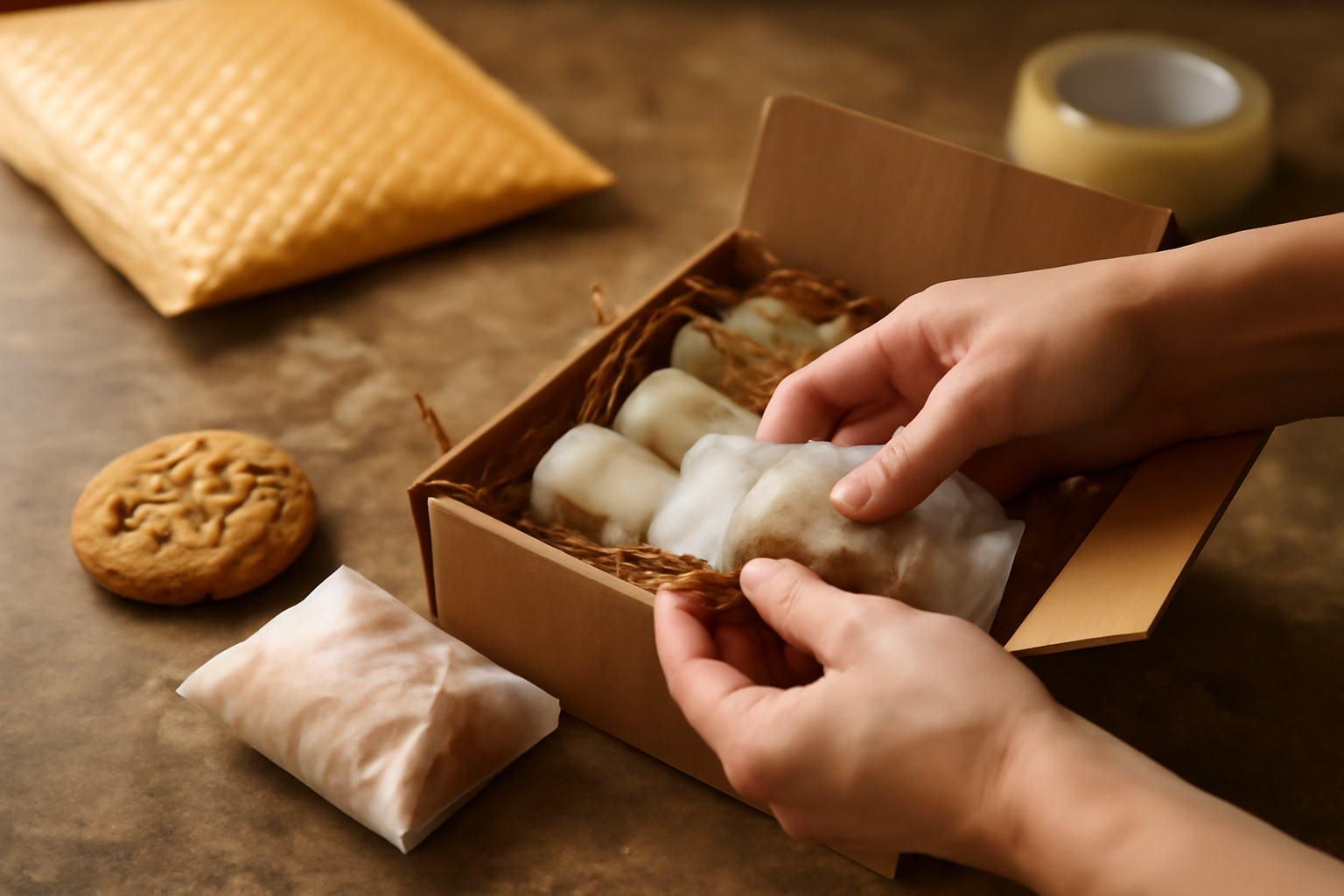
I start by stacking cookies in pairs, back-to-back. Then I wrap each pair tightly in plastic wrap — not loosely, but genuinely snug. After that, I wrap the whole bundle in a layer of bubble wrap. Specifically, I use small-bubble wrap (3/16 inch) for most cookies and large-bubble wrap (1/2 inch) for anything thicker or more fragile. Each wrapped bundle goes into a rigid inner container, either a metal tin or a sturdy cardboard gift box, packed tightly enough that nothing moves when you shake it.
I learned the “shake test” the hard way. My third-ever shipping batch was chocolate chunk cookies packed loosely in a tin with crinkle paper. I shook the tin and could hear movement. I shipped it anyway. They arrived broken. Now I shake every inner container before closing it. If I hear or feel any shifting, I add more packing until the contents are completely still. This single habit has eliminated almost all of my breakage.
How Many Cookies Fit Per Box?
For a standard 9x6x4 inch shipping box, I comfortably fit 12–16 medium cookies (roughly 2.5 inches in diameter) when packed properly. Smaller 2-inch cookies can go up to 20–24 per box. I never cram more than that — overpacking increases pressure on the bottom layer, and underpacking leaves too much room for shifting. Both extremes cause breakage.
The Shipping Box That Finally Stopped My Cookies From Arriving as Crumbs
After that Portland disaster, I realized the box itself was half the battle — too flimsy, and even careful packing can’t save cookies from collapse during transit. The right shipping box gives your cookies a fighting chance before the padding even comes into play.
What works
- The walls are genuinely rigid — they don’t compress or flex when the box gets jostled in a mail truck, which means less pressure on the cookies inside.
- The 9x6x4 size is perfectly proportioned for stacking cookies in layers without packing them too densely, and it fits standard poly mailers without awkward overhang.
- The black color hides any minor wear during shipping, so the box still looks intentional and thoughtful when it arrives at someone’s door.
What doesn’t
- They’re slightly pricier than the thinnest alternatives, but once I did the math on replacing broken batches, the cost difference disappeared fast.
- If you’re shipping extremely delicate cookies (like thin tuiles), this box alone won’t save you — you still need excellent internal padding and technique.
I almost talked myself out of upgrading boxes because I was convinced good packing technique could compensate for a flimsy box, but my first order shipped in these and arrived completely intact — that’s when I knew I’d found the real difference-maker. Lmuze Small Black Shipping Boxes (9x6x4 inches, Pack of 30)
This post contains affiliate links. As an Amazon Associate, I earn from qualifying purchases at no extra cost to you.