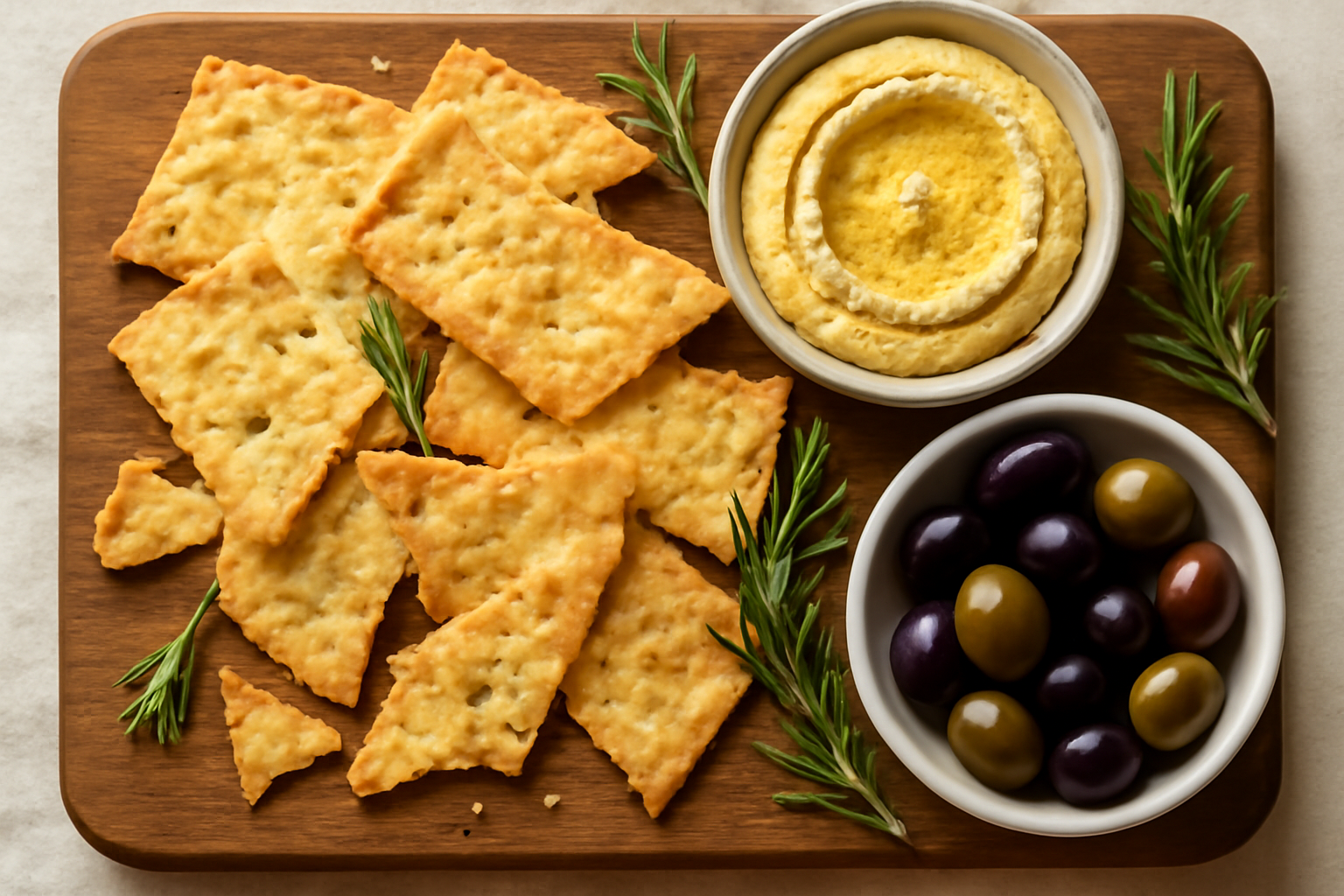
I did not set out to replace bread at my dinner table. That was never the plan. However, the winter I finally nailed my rosemary olive oil crackers homemade recipe — after 47 failed batches spanning two years — my family quietly stopped asking me to slice the sourdough. These thin, shatteringly crisp crackers now appear at nearly every meal I host, and three of my neighbors have asked for the recipe after one bite. That kind of reaction does not happen by accident. It happens because of ratio, temperature, and one very specific rolling technique I will walk you through today.
The first time I tried making savory crackers was Thanksgiving 2020. I had a wedge of good Parmigiano Reggiano sitting on the counter, a bundle of fresh rosemary from my garden, and a half-bottle of excellent Sicilian olive oil. I thought, how hard can this be? The answer: much harder than it looks. My first batch came out pale, soft in the center, and faintly bitter from scorched rosemary. My second batch shattered unevenly. By batch twelve, I was genuinely frustrated. That frustration is exactly what sent me down a rabbit hole of baking science, and what ultimately produced the recipe I am sharing with you today.
Why Olive Oil Changes Everything in a Cracker Dough
Most cracker recipes rely on butter or shortening. In my experience, olive oil behaves fundamentally differently in dough — and that difference is the secret to this recipe’s texture. Butter is roughly 80% fat and 20% water. When it melts in the oven, that water creates steam, which lifts layers. Olive oil, however, is nearly 100% fat with zero water content. As a result, it coats gluten strands rather than creating steam pockets, and that coating action is what produces a cracker that snaps cleanly rather than flaking.
Specifically, olive oil interferes with gluten network formation in a way that butter does not. The fat molecules physically surround the flour proteins before they can fully bond, shortening the gluten strands and producing a tender, crisp texture rather than a chewy one. This is called “shortening action” in food science, and it is the same principle that makes olive oil cakes so moist and delicate. In a cracker, you want controlled gluten development — enough to roll the dough thin without tearing, but not so much that the cracker becomes tough.
The ratio I landed on after extensive testing is 1 cup all-purpose flour to 3 tablespoons extra-virgin olive oil. Going below 2.5 tablespoons produces a dry, crumbly dough that tears when rolled. Going above 3.5 tablespoons makes the crackers greasy and prone to burning. That half-tablespoon window matters more than most people expect. I learned this the hard way during batch 23, which I generously over-oiled because I thought more fat would mean more flavor. The result was a sheet pan of sad, oily chips that burned at the edges while the centers stayed chewy. Not my finest hour.
The Rosemary Question: Fresh vs. Dried and When to Add It
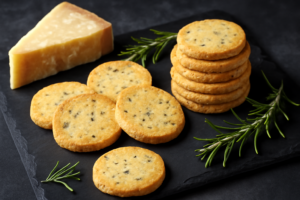
I have tested this recipe with fresh rosemary, dried rosemary, and rosemary-infused olive oil. Each version produces a noticeably different cracker. Fresh rosemary chopped very fine — I mean truly fine, almost a paste — distributes throughout the dough and bakes into a grassy, aromatic cracker with visible green flecks. Dried rosemary, unless you grind it yourself, creates unpleasant sharp pieces that poke through the thin dough and can feel like eating tiny pine needles. That said, dried rosemary that you crush between your palms for 30 seconds is actually quite good in a pinch.
However, the version I keep coming back to uses fresh rosemary added in two stages. Half goes into the dough itself, finely minced. The other half gets pressed gently onto the surface of the rolled-out dough before baking, combined with flaky sea salt. The surface rosemary toasts and crisps during baking, delivering intense fragrance. The rosemary inside the dough stays slightly more subtle and herbal. Together, they create a layered flavor experience that no single-addition method can replicate.
One critical timing note: do not add rosemary to hot oil before mixing it into the dough. I tried this in several early batches, thinking it would bloom the oils and intensify the flavor. Instead, the rosemary continued cooking in the dough as it baked and turned acrid. Room temperature oil, fresh rosemary, and a quick mix is all you need. The oven will do the blooming for you.
The Full Rosemary Olive Oil Crackers Homemade Recipe (With Exact Measurements)
Ingredients
- 1 cup (120g) all-purpose flour, plus more for dusting
- ½ teaspoon fine sea salt
- ½ teaspoon granulated sugar (yes, even in a savory cracker — more on this below)
- 3 tablespoons (40ml) extra-virgin olive oil
- ¼ cup (60ml) cold water
- 1 tablespoon fresh rosemary, very finely minced (divided)
- ½ cup (40g) finely grated Parmigiano Reggiano (optional but transformative)
- Flaky sea salt for topping
Method
- Preheat your oven to 375°F (190°C). Line two sheet pans with parchment paper.
- Whisk together flour, fine sea salt, sugar, and half the rosemary in a medium bowl.
- Add olive oil and mix with a fork until the mixture resembles coarse sand. This should take about 45 seconds.
- Add cold water one tablespoon at a time, mixing after each addition. Stop when the dough just comes together. It should feel slightly tacky but not sticky.
- If using Parmigiano Reggiano, fold it in now with a gentle hand. Overworking at this stage develops gluten and toughens the crackers.
- Divide dough in half. Working directly on a lightly floured piece of parchment, roll each half to approximately 1/16 inch thickness — you should be able to see your hand slightly through it when held up to the light.
- Transfer parchment directly to the sheet pan. Scatter remaining rosemary and flaky salt over the surface. Press gently with your palm to adhere.
- Score the dough into rough rectangles or squares with a pizza cutter or sharp knife. Do not separate the pieces yet.
- Bake for 13 to 16 minutes, rotating the pan at the 8-minute mark. Watch closely after 12 minutes. You want deep golden edges and a lightly bronzed center.
- Cool completely on the pan before breaking apart. Crackers crisp up significantly as they cool.
About that half teaspoon of sugar: even in a savory recipe, a small amount of sugar encourages the Maillard reaction. This is the same browning process responsible for the color and complex flavor in seared meat or toasted bread. Without sugar, these crackers can bake up pale and flat-tasting even when fully cooked through. With it, you get caramelized, nutty edges that make every bite deeply satisfying.
The Parmigiano Reggiano That Finally Made These Crackers Worth the 47 Batches
After two years of failed batches, I realized the problem wasn’t my technique — it was the cheese. A sharp, properly aged Parmigiano Reggiano is what transforms these crackers from bland and forgettable into something guests actually ask for by name.
What works
- The nutty, complex flavor cuts through the olive oil without getting lost or tasting metallic the way younger cheeses do in these thin crackers.
- It grates finely and distributes evenly across the dough, so you actually taste cheese in every bite instead of hitting pockets of nothing.
- The crystals don’t dissolve completely during baking — they stay slightly crunchy, which adds an unexpected textural element that makes the whole cracker more interesting.
What doesn’t
- The price is substantially higher than pre-shredded or domestic alternatives, which stings when you’re making a large batch for entertaining.
- You have to grate it fresh every time — it doesn’t keep well once shredded, so there’s no batch-prepping ahead for multiple baking days.
I almost gave up on this recipe entirely when a block of grocery-store knockoff cheese turned one batch into greasy, flavor-flat disappointment, but switching to this made me understand what had been missing all along. Frank and Sal Parmigiano Reggiano 24 Month Excellent Top Grade
This post contains affiliate links. As an Amazon Associate, I earn from qualifying purchases at no extra cost to you.